
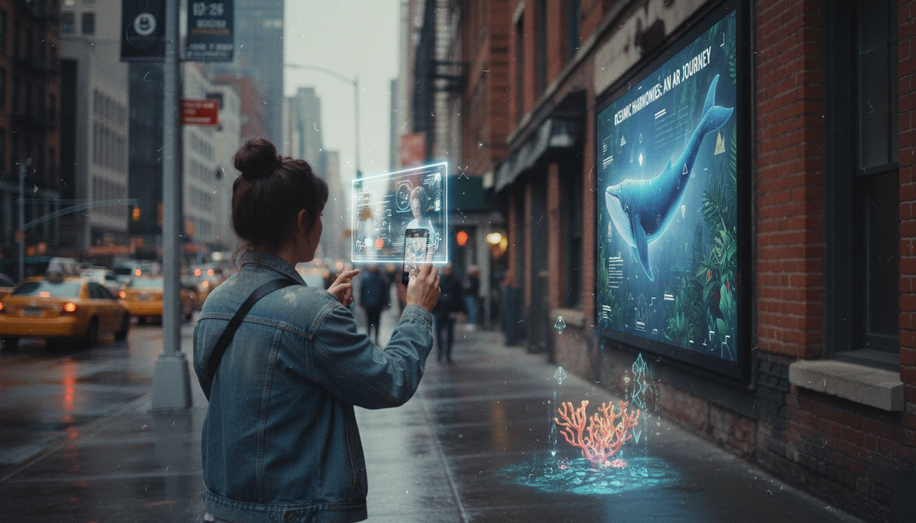

In the bustling heart of a city, a static billboard springs to life not through flashing lights or bold colors, but through the lens of a smartphone camera. Augmented reality (AR) is redefining out-of-home (OOH) advertising, turning passive posters and digital screens into portals that pull consumers into interactive, brand-driven worlds. By layering digital overlays onto the physical environment, AR transforms fleeting glances into memorable engagements, where users don’t just see an ad—they step into it.
This evolution builds on the shift from traditional static billboards to digital signage, which has made AR more accessible and cost-effective. Marketers can now deploy spatial computing to turn any urban surface—a subway poster, bus shelter, or city mural—into an AR opportunity. QR codes or app-based scans activate these experiences, blending the real world with virtual elements to create immersion that static media can’t match. The result? Deeper emotional connections, as users receive instant feedback from their interactions, fostering positive associations with the brand.
Consider Burger King’s audacious “Burn that Ad” campaign in Brazil, which weaponized competitors’ billboards against them. Users downloaded the BK app, pointed their phone at a rival’s poster, and watched it virtually ignite, replaced by a Whopper coupon. The stunt drove one million app downloads in a month and boosted in-app sales by 56.4 percent, proving AR’s power to hijack attention and convert it into action. Similarly, Ally Bank’s Monopoly-themed treasure hunt installed 36 game-board squares across six U.S. cities. Scanning revealed Mr. Monopoly dispensing points and prizes via Web AR, no app required. It garnered 100,000 plays, with 86 percent of participants completing the game, blending fun with financial literacy messaging.
Bus shelters have become AR playgrounds for viral spectacle. Pepsi Max’s “Unbelievable” installation in London turned a glass panel into a window on chaos: flying saucers, prowling tigers, and alien invasions overlaid on live street feeds. The campaign exploded online, amassing over six million YouTube views and 24,000 shares in days, amplifying OOH’s reach through social buzz. Echoing this, “The Walking Dead” promotion in Vienna’s tram stops unleashed 3D zombies on real-time footage, heightening the horror theme and drawing crowds to the “Scary Shelter.”
Brands are pushing further with holographic and mirror-like innovations. Jackson Family Wines’ Siduri campaign let users scan in-store billboards or bottles to summon a photorealistic hologram of founder Adam Lee, chatting about Pinot Noir in mixed reality captured via Microsoft’s studio. Maybelline’s massive AR mirror at Kyiv’s Gulliver Mall spanned 4,000 square meters, allowing virtual mascara try-ons in real time, turning shoppers into participants. Even retail murals, like BON V!V Spiked Seltzer’s in Los Angeles and San Diego, spawned tappable 3D vending machines via Web AR, enhancing product discovery without downloads.
Vodafone exemplifies AR’s scalability in murals and billboards, creating “surprise and delight” moments that dominate public spaces. National Geographic’s Rotterdam train station activation let commuters “step into” dinosaur eras or spacewalks by interacting with screens, celebrating the society’s 125th anniversary with immersive adventures. Cadbury commandeered London’s Waterloo Station’s 120-square-meter digital screen for an AR game, inviting passengers to play amid the rush. Ralph Lauren’s Times Square spectacle wove CGI fragrances into the city’s pulse, a fixed-outdoor (FOOH) marvel that captured Polo 67’s masculine energy.
These campaigns highlight AR’s tangible benefits: heightened engagement, virality, and measurable ROI. Unlike traditional OOH, which relies on dwell time, AR invites active participation, extending interactions beyond the street via shares and redemptions. Web AR’s app-less entry lowers barriers, making it ideal for impulse scans in high-traffic zones. Yet challenges remain, from tech glitches in varying light to ensuring inclusivity for non-smartphone users. Still, as digital OOH proliferates, AR positions brands to own the user’s world, not just rent their gaze.
Looking ahead, expect AR filters and overlays to evolve with 5G and advanced spatial tech, enabling multiplayer hunts or personalized narratives tied to location data. Audible’s recent highway and bus stop activations signal this trend, transforming leases into narrative gateways. In an era of ad fatigue, AR OOH doesn’t compete for eyes—it commandeers reality, making every scan a story consumers want to live. The medium is no longer the message; it’s the playground.