
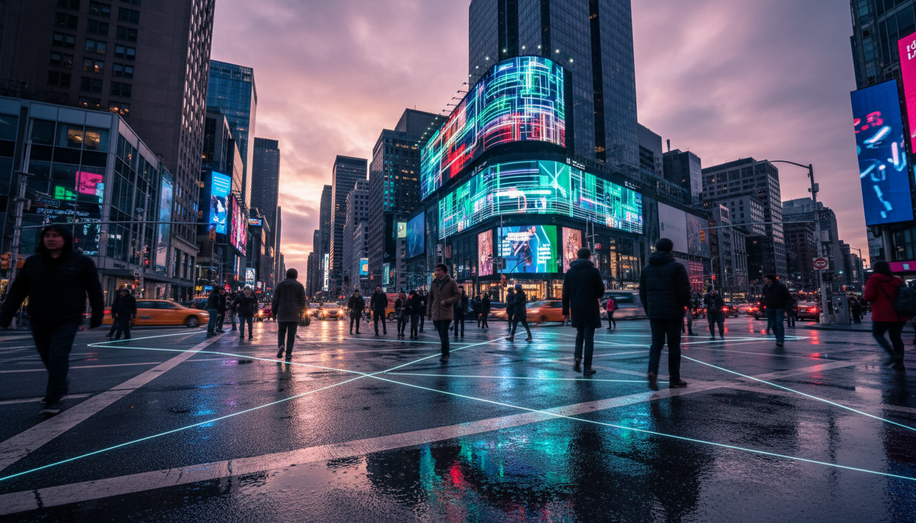

In the bustling streets of modern cities, where digital billboards flicker with tailored messages and smart screens respond to passing crowds, artificial intelligence is reshaping out-of-home (OOH) advertising into a precision instrument far surpassing rudimentary demographic profiling. No longer confined to age, gender, or income brackets, AI empowers marketers to dissect audiences through behavioral patterns, real-time interests, and hyper-local movements, delivering campaigns that feel eerily personal amid the chaos of urban life. This evolution marks a pivotal shift: OOH, once a blunt tool for mass exposure, now rivals the sophistication of online platforms, leveraging vast data streams to target individuals based on what they do, not just who they are.
At the heart of this transformation lies AI-driven audience segmentation, which sifts through layers of data—foot traffic sensors, mobile geolocation, social media signals, and even satellite imagery—to uncover micro-audiences invisible to human analysts. Traditional OOH relied on high-traffic guesses, placing ads in busy plazas hoping for broad reach; AI flips this script by mapping ideal customer profiles in the physical world. For instance, OneScreen.ai employs proprietary datasets to pinpoint high-density zones for specific decision-makers or demographics, turning static billboards into calculated strikes for account-based marketing. Behavioral insights elevate this further: machine learning algorithms detect patterns like shopping habits or event attendance, enabling ads that adapt to a viewer’s likely mindset—promoing coffee to morning commuters or event tickets to festival-goers nearby.
Real-time location data supercharges this capability, allowing OOH screens to pivot instantaneously based on environmental cues and audience proximity. IoT-connected displays integrate traffic flow, weather, and local events to serve contextually relevant content, a feat programmatic digital out-of-home (DOOH) platforms automate with stunning efficiency. Consider Kia’s campaign at electric vehicle charging stations: using Volta Vision’s vehicle-recognition technology, AI identified charging EVs and triggered tailored ads for the EV9 SUV via Vistar Media’s Cortex software, yielding an 8% sales uplift. Similarly, PODS harnessed AI for hyperlocal dynamic billboards that generated over 6,000 unique messages, driving a 60% surge in website visits by aligning content with nearby searcher intent. These examples illustrate AI’s prowess in fusing geofencing with predictive analytics, ensuring messages land when and where they matter most.
Beyond location, AI delves into interests and behaviors, drawing from cross-channel data to build holistic profiles. Platforms like Billups layer 20 years of campaign history with advertiser datasets, social signals, and street-view imagery to optimize placements—flagging issues like obstructing tree branches while refining targeting. This creates “smart targeting” that anticipates engagement: an ad for fitness gear might activate near gyms for active users, inferred from mobility patterns, while music promoters segment by taste and location to craft variant copy that resonates personally. Machine learning excels here, identifying subtle signals—frequent visits to retail zones or peak-hour routes—that signal purchase intent, enabling automated creative tweaks for higher conversion.
Programmatic buying amplifies this precision, automating ad purchases based on AI algorithms that prioritize relevance over volume. In 2026, over 70% of DOOH campaigns in advanced markets begin with audience-first planning, integrating with smart city infrastructure for seamless execution. The U.S. DOOH market, valued at $9.4 billion and growing at 6.2% annually, underscores the momentum, as brands link exposures to outcomes like foot traffic and sales via advanced analytics. This accountability closes the loop: AI not only segments and targets but forecasts performance, optimizes budgets, and measures ROI in real time, making OOH as agile as digital channels.
Challenges persist, from data privacy concerns to ensuring equitable access across global markets, yet the benefits are undeniable. AI’s integration with augmented reality and interactive screens adds immersive layers, blurring physical and digital realms for deeper engagement. Brands like Kia and PODS prove that behavioral and interest-based targeting yields tangible gains, far outpacing demographic-only approaches. As urbanization accelerates and consumer mobility rises, OOH’s strategic placements—at transit hubs, retail zones, and street furniture—gain potency when AI directs the narrative.
Ultimately, AI elevates OOH from passive signage to a dynamic ecosystem, where every glance holds potential impact. Marketers who embrace this—layering real-time data with behavioral intelligence—unlock campaigns that don’t just reach audiences but anticipate and influence them, redefining precision in the public sphere. In 2026, the message is clear: in OOH, relevance is the new currency, and AI holds the mint.
Blindspot’s platform empowers marketers to fully harness this new currency, offering precise audience measurement and analytics combined with location intelligence for optimal targeting and site selection. Its programmatic DOOH campaign management enables real-time campaign adjustments and seamless execution, while robust ROI measurement and attribution ensures every AI-driven exposure translates into measurable business outcomes, truly bringing OOH into the era of precision marketing. https://seeblindspot.com/