
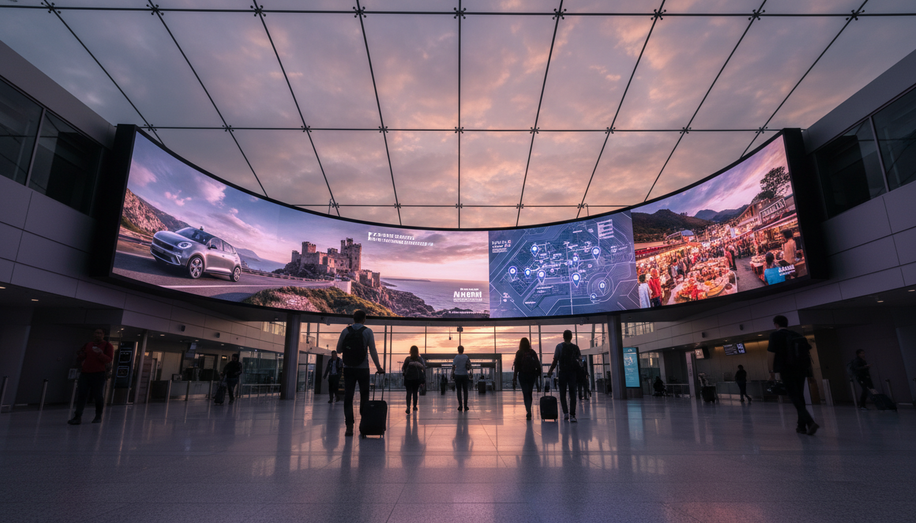

In the bustling streets of modern cities, where digital billboards flicker with life, artificial intelligence is quietly reshaping the art of out-of-home advertising. No longer confined to static images or pre-scheduled loops, digital out-of-home (DOOH) screens now harness AI-powered dynamic creative optimization (DCO) to deliver content that adapts in real time, tailoring messages to weather patterns, audience demographics, local events, and even fleeting moments like rush-hour commutes or sports scores. This revolution in creative automation promises not just relevance, but unprecedented scale in personalization and testing, turning passive passersby into engaged consumers.
At its core, AI-driven DCO automates the creative process by integrating live data feeds into modular ad templates. Imagine a single master creative—a high-quality video or image embodying a brand’s core message—that AI instantly morphs into countless variations. Headlines swap based on time of day, images adjust for weather, and calls to action personalize for nearby store locations, all without human intervention. Brands set rules via demand-side platforms (DSPs), and AI executes: sunny skies trigger beach getaway promotions, while rain prompts ads for cozy indoor offers. This fluidity eliminates the need for exhaustive static asset libraries, slashing production time and costs while enabling cohesive storytelling across screens.
Real-world campaigns illustrate the power of these AI-orchestrated shifts. During the ICC Men’s T20 World Cup 2022, Moving Walls’ globally connected DOOH DSP pushed near real-time match scores and highlights to 2,211 screens across 662 locations, generating 2.6 million ad plays with 149 unique creatives. Similarly, Sunsilk’s weather-triggered campaign in the Philippines and India automatically swapped to frizz-fighting messages whenever rain hit Manila or Mumbai, yielding a 203% increase in potential views and 289% jump in unique reach over 57 days. These examples underscore how AI capitalization on triggers—weather APIs, traffic data, event feeds—makes DOOH feel intuitively timely, boosting action rates as a Harris Poll for the OAAA revealed: 49% of viewers were more likely to respond to such adaptive ads.
Personalization takes this further, layering first-party data from CRM systems, loyalty programs, and audience movement patterns onto AI algorithms. Screens “follow” high-value segments through urban journeys, sequencing messages from morning coffee runs to evening commutes. A retail brand might display nearest-store promotions via Perion’s platform, pulling environmental triggers to refine targeting on the fly, ensuring every impression maximizes relevance. Caribbean tourism boards have leveraged this for winter campaigns in the snowy U.S. Northeast, flashing balmy destination weather to evoke escape desires precisely when cold snaps hit. Such precision transforms DOOH from broad awareness tools into high-engagement engines, blending the scale of traditional OOH with digital agility.
AI’s true game-changer lies in A/B testing and optimization at scale, once impossible in the physical world. DCO platforms conduct real-time multivariate tests, pitting ad variations against each other across networks while cross-referencing engagement metrics like dwell time or foot traffic lifts. Programmatic environments, powered by AI, enable continuous fine-tuning: underperforming creatives fade, winners amplify, all informed by live insights. The Trade Desk notes this on-the-fly optimization empowers campaigns to evolve mid-flight, much like online ads but with massive real-world reach. Vistar Media integrations, for instance, allow marketers to iterate dynamically within networks like Screenverse, learning audience preferences through in-campaign data to refine future plays.
Yet this AI infusion raises questions about execution and ethics. Seamless data integration—from sports scores to demographic overlays—demands robust privacy compliance, especially with first-party data’s rise amid cookie deprecation. Platforms like Broadsign and Simpli.fi emphasize modular templates that maintain brand consistency amid flux, preventing chaotic outputs. Challenges persist: not all inventory supports full DCO, and latency in data feeds can blunt real-time edges. Still, as programmatic DOOH matures, AI bridges these gaps, promising 2025 strategies centered on hyper-targeted, measurable impact.
The implications for creatives are profound. Designers now craft adaptable frameworks rather than one-offs, collaborating with AI to predict triggers and test narratives preemptively. Agencies report streamlined workflows, with automation handling 80-90% of variations, freeing humans for strategic innovation. For OOH publishers, this means premium inventory: screens that command higher CPMs through proven relevance and performance lifts.
As AI permeates DOOH, the medium evolves from spectacle to conversation. Billboards that once shouted now whisper precisely what viewers need, when they need it—raincoats in downpours, scores during games, escapes in blizzards. This automation of dynamic content and design optimization isn’t just technical wizardry; it’s a creative renaissance, proving OOH’s enduring power in an AI-augmented world. Brands embracing it early stand to capture not fleeting glances, but lasting connections.