
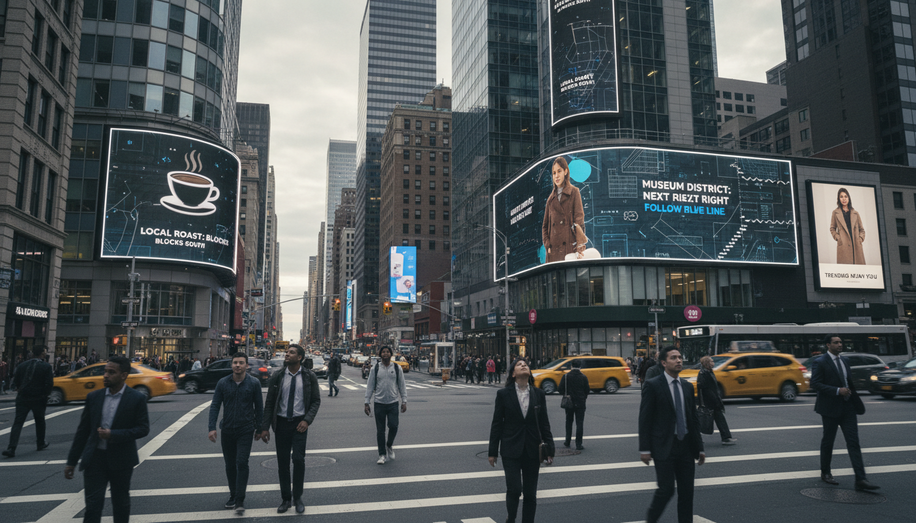

Artificial intelligence has moved beyond forecasting what outdoor advertising campaigns might accomplish—it now actively reshapes them in real time. As digital out-of-home (DOOH) advertising matures in 2026, the industry is witnessing a fundamental shift from AI as a predictive tool to AI as an operational engine that continuously optimizes campaigns, adjusts creative elements, and identifies the most effective placements while ads run live.
The evolution reflects a broader maturation in how marketers deploy technology. While predictive analytics offer valuable foresight—enabling marketers to forecast performance with 80-90% confidence before launch—real-time optimization addresses a more immediate challenge: the need to adapt as conditions change. Weather shifts, traffic patterns fluctuate, and audience composition evolves throughout the day. Static campaigns, even data-informed ones, cannot respond to these variables. AI-driven DOOH systems can.
Container company PODS demonstrated this capability with a dynamic digital billboard that generated more than 6,000 unique messages by leveraging Google’s Gemini AI platform. The roving billboard tailored ads to each neighborhood while adjusting for time, weather, traffic conditions, and even subway delays. The result was striking: a 60% increase in website visits in a single week. What made this approach powerful was not prediction but adaptation—the system learned what messages performed in specific contexts and continuously refined its outputs accordingly.
Real-time creative optimization represents another frontier. Traditional A/B testing requires campaigns to run for days or weeks before meaningful conclusions emerge. AI accelerates this process dramatically. By conducting multiple simultaneous tests and rapidly identifying which variations resonate, brands can make informed adjustments within hours rather than weeks. One digital billboard operator working with brand Billups adjusted logo sizing based on real-time performance data, determining that specific proportions drove better engagement. This level of agility would be impossible without AI managing the testing framework continuously.
The automotive industry showcases how AI enhances both targeting and creative delivery. Kia’s campaign at electric vehicle charging stations employed vehicle recognition technology to identify the specific model pulling up to charge. The AI system then selected advertisements highlighting relevant features—extra seating for families, acceleration performance for enthusiasts—rather than displaying generic EV content to all viewers. This precision drove a 517% surge in unaided brand awareness, 33% increase in consumer consideration, and ultimately an 8% sales lift. BMW similarly deployed camera systems to recognize passing vehicles and display tailored messages based on the model detected. These campaigns demonstrate how real-time identification enables dynamic, responsive creative strategies.
Site selection has traditionally relied on static metrics—foot traffic counts, demographic density, historical performance data. AI now layers dynamic variables into this equation. Satellite and street-view imagery can reveal physical obstructions affecting ad visibility, allowing teams to identify and address issues before they impact campaign performance. Location intelligence platforms map high-density areas for target audiences, transforming outdoor advertising from mass reach into precision targeting that mirrors digital advertising’s sophistication.
Programmatic DOOH buying amplifies these capabilities by automating the placement process itself. Rather than humans manually selecting sites and negotiating rates, algorithms evaluate thousands of potential placements against campaign objectives, audience data, and real-time conditions, selecting the optimal combination instantly. This automation reduces costs while simultaneously improving precision—a combination that was theoretically possible but practically unworkable at human scale.
The convergence of these capabilities—real-time creative optimization, dynamic site selection, automated buying, and continuous performance measurement—represents a qualitative shift in how DOOH functions. IoT-connected screens, real-time data feeds, and AI-driven content optimization enable brands to deliver messages that adapt to traffic flow, local events, and audience demographics. Advanced analytics now link DOOH exposure to measurable outcomes like foot traffic and conversions, creating accountability previously absent from outdoor advertising.
As marketers navigate 2026, the strategic imperative is clear: AI in DOOH has moved from a forward-looking forecasting tool to an operational necessity. The platforms that thrive will be those that embrace continuous optimization, treating campaigns as living systems rather than static deployments. The technology exists. The question now is execution and integration—how quickly brands can adapt their planning processes to leverage AI’s real-time capabilities at scale.