
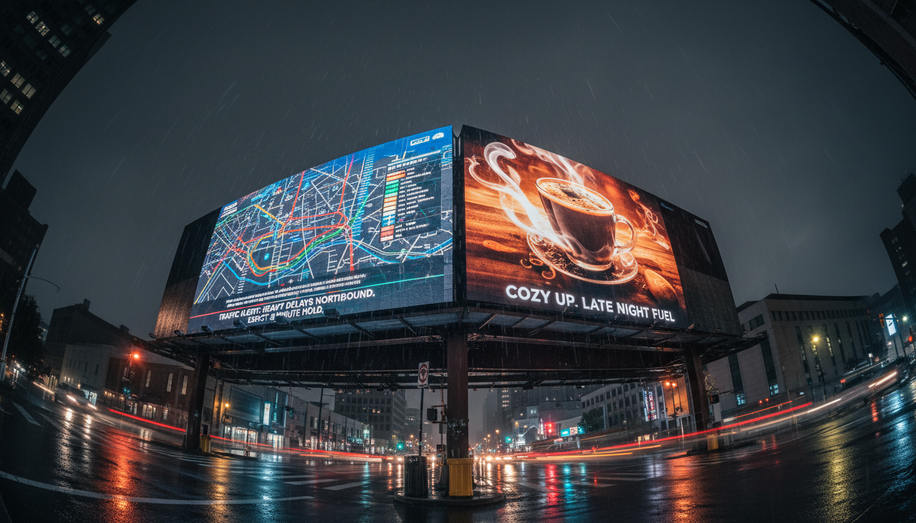

Digital billboards have transcended their origins as static advertising canvases. What began as a straightforward upgrade from print—the ability to change creative assets with a click—has evolved into something far more sophisticated: adaptive systems that respond to real-time environmental and behavioral data to maximize campaign relevance and effectiveness.
The shift reflects a fundamental change in how out-of-home advertising operates. Traditional billboards followed rigid schedules, displaying the same message regardless of external conditions or audience composition. Today’s most advanced DOOH platforms operate differently, leveraging real-time data streams to continuously optimize when, where, and how often messages appear. This isn’t about novelty; it’s about precision. The goal is delivering the right message at the right moment, informed by live conditions rather than predetermined placements.
Weather represents one of the most compelling data inputs for adaptive billboards. An apparel brand’s messaging can shift automatically based on temperature, precipitation, or forecast data. A retailer advertising cold-weather gear gains prominence during unexpected snow, while summer products surface when conditions turn warm. This contextual relevance extends beyond environmental triggers. Time-of-day optimization ensures messaging evolves across commute patterns—peak morning transit receives commuter-focused messaging, midday periods shift to different demographics, and evening hours adapt again as traffic patterns change. The system prioritizes delivery during moments with the highest potential impact rather than spreading impressions evenly throughout the day.
Local events and social signals introduce another layer of optimization. Mobile billboard campaigns can redirect toward festival routes during evening hours or adjust messaging for family neighborhoods during weekends. Fixed digital billboards similarly respond by tailoring content to coincide with local happenings, holidays, or trending topics. This agility represents something previously impossible in out-of-home media: the ability to stay contextually relevant as circumstances shift.
Traffic volume and flow data enhance this optimization further. Billboards in high-congestion areas receive higher-frequency placements since audiences have longer viewing windows, while lighter-traffic periods may reduce frequency to maximize efficiency. Location-specific audience patterns inform which creatives perform best in particular geographies, enabling marketers to understand not just who sees their ads, but how different messages resonate across different areas.
Beyond environmental triggers, programmatic DOOH platforms enable dynamic creative rotation without manual intervention. Marketers can test multiple creative approaches simultaneously, with the system automatically increasing frequency for top performers and reducing underperforming variations. This real-time A/B testing delivers measurable results in days rather than weeks, fundamentally accelerating the feedback loop between creative testing and optimization. Campaign data becomes immediately actionable; marketers learn which creatives drive engagement, how performance varies by location, and when audiences are most receptive.
The infrastructure supporting this intelligence relies on IoT-enabled billboard management systems that collect operational data and present it through centralized dashboards. These systems don’t merely react to conditions; they anticipate disruptions, allowing operators and advertisers to adjust content proactively rather than responsively. A sophisticated system monitors display performance, local traffic patterns, and environmental conditions simultaneously, enabling teams to make informed decisions about content updates in real time.
The practical implications extend beyond individual campaign performance. By prioritizing delivery during high-impact periods and reducing wasted impressions, adaptive billboards help marketers achieve more consistent performance while improving overall efficiency. Brands gain clearer visibility into results, understanding not just impressions served but the conditions under which audiences engaged with messaging.
What separates adaptive optimization from basic programmatic ad serving is this depth of responsiveness. Programmatic platforms automate buying; adaptive systems automate intelligence gathering and decision-making. The technology continuously learns, adjusts, and evolves—transforming billboards from static placements into proactive assets that stay relevant regardless of external circumstances.
For marketers maximizing impact in out-of-home advertising, adaptive billboards represent the present, not a distant future. The ability to synchronize messaging with real-world conditions in real time fundamentally changes what’s possible in outdoor advertising, delivering measurable advantages in relevance, efficiency, and performance.