
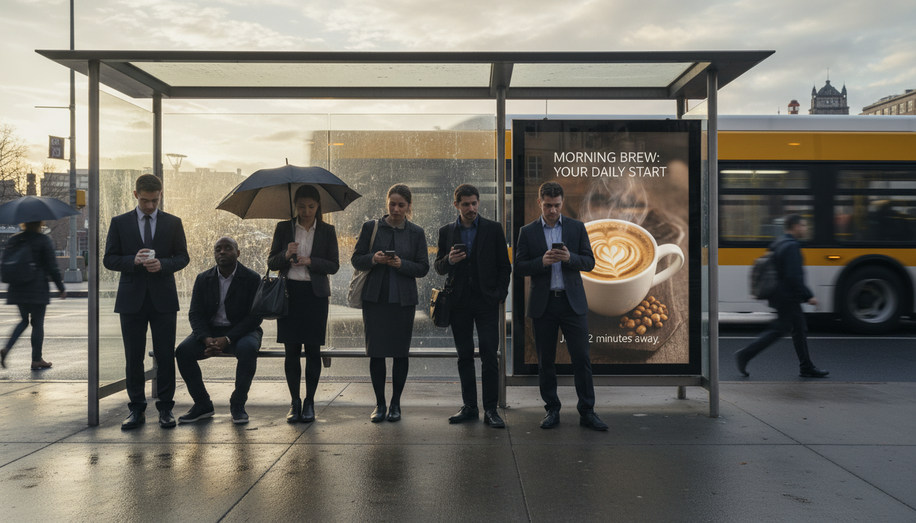

In the bustling arteries of urban life, where billboards loom over highways and posters line subway corridors, the placement of out-of-home (OOH) advertisements is not merely a logistical decision—it’s a psychological one. Context shapes how viewers engage with these unskippable messages, transforming passive glances into memorable encounters that drive brand recall and action. A fitness brand’s ad near a park doesn’t just appear; it resonates because it mirrors the viewer’s mindset, amplifying relevance and impact.
Strategic placement hinges on aligning ads with the environmental and behavioral cues that capture attention amid daily chaos. High-traffic zones like busy intersections or commuter routes offer prime real estate, where slowed traffic at lights or roundabouts extends dwell time, allowing drivers and pedestrians to absorb messaging. Yet volume alone falls short; psychology underscores that the brain prioritizes high-contrast visuals and structured information hierarchies in fast-moving settings. On highways, where speeds exceed 60 miles per hour, larger fonts and dynamic elements on the right-hand side exploit natural sightlines, ensuring the ad registers subconsciously before it blurs into the background.
Context elevates this further by forging emotional connections. Placing a fast-food promotion near a highway exit taps into hunger cues during decision-making moments, far outperforming the same creative in an incongruent industrial zone. Similarly, luxury goods thrive in affluent suburbs or financial districts during weekday rushes, where professionals’ mindsets align with aspirational messaging, while entertainment district placements suit youth-oriented campaigns on weekend evenings. This isn’t guesswork; data on foot traffic, demographics, and geographic behaviors reveals audience “footprints,” pinpointing where health-conscious joggers cluster near gyms or shoppers linger at transport hubs.
Visibility remains paramount, dictated by physical and environmental factors. Elevated billboards command long-distance views, but ground-level formats excel for pedestrian flows, provided lighting—such as backlit digital screens—sustain readability from dawn to dusk. Cluttered surroundings dilute impact, so agencies scrutinize competing visuals and distractions, opting for spots where the ad stands alone. Color psychology enhances this: reds and yellows signal urgency for time-sensitive offers, while blues foster trust for financial services, all calibrated to the locale’s vibe.
Beyond static positioning, contextual relevance boosts engagement through targeted resonance. Fitness ads near parks or health stores create logical associations, enhancing believability and prompting immediate action, like a gym sign-up. Retail promotions at shopping centers capitalize on high footfall and dwell time, where consumers pause to process calls-to-action. OOH’s 24/7 presence reinforces this, embedding brands in the public psyche across dayparts—morning commutes for professionals, evenings for families—without the skip button of digital media.
Advertisers who master context integrate it with creative execution. Concise messaging—ideally seven words or fewer—pairs with bold fonts and minimal text, readable in seconds. High-quality graphics draw the eye, while QR codes bridge physical placement to digital realms, extending engagement via geotargeting. Agencies leverage location intelligence to analyze traffic patterns, competitor placements, and audience habits, recommending spots that outshine rivals.
Real-world campaigns illustrate the payoff. A beverage brand positioning vibrant, thirst-evoking visuals near sports arenas during game days doesn’t just gain impressions; it influences impulse buys by syncing with elevated excitement. Conversely, mismatched contexts flop: a serene financial ad amid chaotic construction zones erodes credibility. Studies affirm that contextually attuned OOH yields higher recall—up to 40% more than mismatched efforts—because it leverages subconscious triggers, making the ad feel intuitive rather than intrusive.
As digital out-of-home (DOOH) evolves, context grows even sharper. Programmable screens adapt messaging by time, weather, or events, like coffee promotions during rainstorms at bus stops, hyper-targeting receptive audiences. Location-first strategies outperform audience estimates alone, prioritizing “where” over mere “who” for efficient reach.
Ultimately, in OOH, context isn’t an add-on—it’s the multiplier. By embedding ads in environments that echo audience intent, brands don’t just interrupt the journey; they become part of it. Forward-thinking marketers who dissect demographics, traffic flows, and psychological sightlines will dominate this space, turning urban landscapes into engagement engines. The lesson is clear: place wisely, contextually, and watch passive viewers become active advocates.