
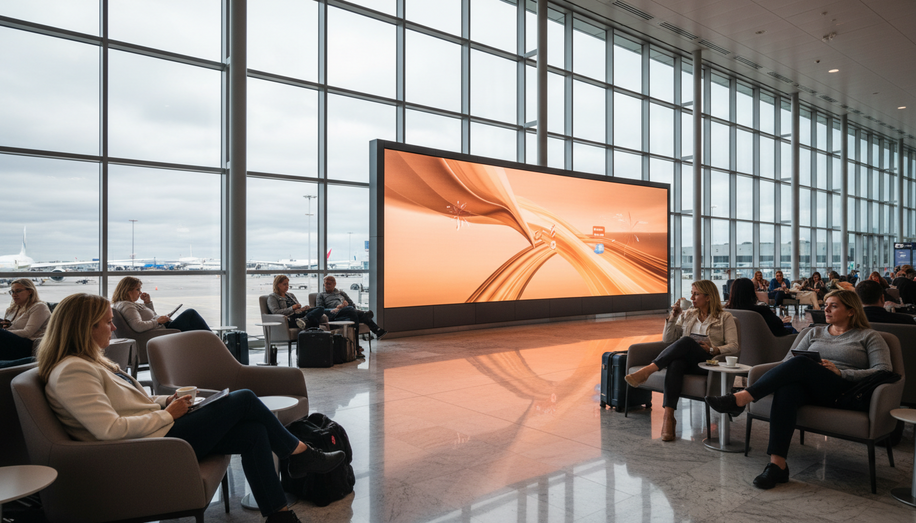

In the bustling terminals of the world’s busiest airports, where 9.5 billion passengers passed through in 2024, out-of-home (OOH) advertising has emerged as a powerhouse for brands targeting high-value travelers at pivotal moments. This gateway audience—comprising business elites, affluent tourists, and frequent flyers—offers advertisers a rare blend of captivity, affluence, and intent, amplified by extended dwell times in environments stripped of digital distractions.
Airports are no longer mere transit points; they are vibrant commercial hubs where passengers linger amid delays, security lines, and gate waits, creating ideal conditions for ad engagement. A 2025 Nielsen study commissioned by Clear Channel Outdoor found that 82 percent of frequent flyers read airport ads, 61 percent recall them, and 57 percent—an eight percent increase from 2022—take action afterward. These actions are tangible: 61 percent visited advertised locations, 53 percent checked websites, 45 percent scanned QR codes (up six percent since 2022), and 36 percent explored social media. Such metrics highlight why airport OOH converts fleeting exposure into measurable ROI, outpacing cluttered urban billboards.
The appeal lies in the audience’s profile. Business travelers, who dominate frequent flyer ranks, are twice as likely to be their company’s AI decision-makers, wielding significant purchasing power. Affluent tourists and millennials flock to international gateways like Miami International (MIA), with its 201 digital screens delivering 130 million monthly impressions to Latin American and European routes, or Los Angeles International (LAX), where 42 percent of the 5 million monthly passengers are millennials generating 217 million ad impressions. Dallas Fort Worth (DFW) similarly serves 6.6 million passengers monthly, yielding 183 million impressions to business corridors. This demographic mosaic—high-income professionals with expense accounts and leisure spenders in vacation mode—provides brands in retail, finance, healthcare, and luxury with precise targeting opportunities.
Dwell time is the secret weapon. Unlike fleeting street encounters, airport sojourns average longer exposures in high-traffic zones: security queues, baggage claims, and lounges where eyes have few escapes. Travelers arrive with open minds, often in a liminal state of anticipation or relaxation, making them receptive to suggestions—from upgrading travel gear to booking upscale hotels. Global air travel’s rebound, with 6 percent growth in 2025 and 5.8 percent projected for 2026, fuels this dynamic, alongside airport expansions that boost passenger volumes and media infrastructure.
Digital innovation supercharges these advantages. Programmatic OOH and interactive elements like QR codes enable real-time personalization, turning static displays into dynamic portals. At Pittsburgh International (PIT), 16 high-tech screens in a low-clutter setting produce 3.1 million impressions, ideal for campaign testing. Larger networks, such as Clear Channel’s across 55 U.S. commercial airports reaching 52 percent of domestic travelers, offer scale: Boston Logan (BOS) deploys 92 screens for Northeast business hubs, while Houston Hobby (HOU) provides 17 screens and 19 million impressions for local brands. Data-driven insights refine this further, segmenting by demographics—millennials at LAX, international elites at MIA—to craft narratives that resonate and extend digitally via scans.
The market’s trajectory underscores the urgency. Valued at $4.24 billion in 2024, airport advertising is forecast to hit $4.5 billion in 2025, $4.78 billion in 2026, $7.43 billion by 2033, and $8.36 billion by 2035, growing at a 6.1 percent CAGR. Drivers include surging tourism, especially in Asia-Pacific, and technological advances in digital and smart displays. Post-pandemic recovery has pivoted the industry toward resilient strategies: data analytics for personalization and hybrid static-digital formats that thrive amid high footfall.
Yet success demands strategy. Placement in dwell-heavy areas maximizes visibility, while partnerships with exclusive operators unlock premium inventory. Challenges like regulatory hurdles and variable dwell times persist, but they pale against the upside: airports as “sense-of-place” destinations blending retail, dining, and media. Morten Gotterup, president of Clear Channel Outdoor’s Airports Division, emphasizes this: “Airport advertising is not only seen, but it also inspires action,” especially as over half of travelers act post-exposure.
For brands, ignoring this arena means ceding ground. In 2026, with passenger surges and modernization accelerating, airport OOH stands as the ultimate gateway to loyalty. Business travelers plotting deals mid-layover, tourists dreaming of indulgences—these mindsets, captured in distraction-free precision, propel browsers to buyers. As revenues climb and technologies evolve, savvy advertisers will dominate the skies, turning terminals into profit runways.