

Out-of-home advertising stands as one of the oldest and most enduring forms of commercial communication, with roots stretching back thousands of years to ancient civilizations. What began as carved stone obelisks in Egypt has evolved into the dynamic digital ecosystems that dominate modern cityscapes, reflecting humanity’s constant drive to capture attention and communicate messages in public spaces.
The earliest forms of outdoor advertising were deliberately monumental. The Egyptians employed tall stone obelisks to publicize laws and important proclamations, while civilizations across the globe recognized the power of placing messages where people gathered. These ancient precedents established a principle that remains fundamental to OOH advertising today: strategic placement in high-traffic areas maximizes reach and impact.
The modern era of outdoor advertising began in earnest during the 19th century, coinciding with advances in printing technology. The invention of the lithographic process in 1796 revolutionized poster production, allowing for illustrated designs that captured public imagination far more effectively than text alone. By 1835, Jared Bell created the first outdoor poster in New York, advertising the circus—a moment that marked the birth of purposeful, large-format outdoor advertising as a commercial medium. The expansion continued rapidly: exterior advertisements appeared on street railways by 1850, and by 1870, nearly 300 posting companies existed across America.
Recognizing the need for organization and standardization, industry leaders established the Associated Bill Posters’ Association of the US and Canada in 1891, now known as the Outdoor Advertising Association of America (OAAA). This organization’s founding reflected the industry’s maturation and its commitment to ethical practices and professional standards. By the early 20th century, major brands including Palmolive, Kellogg, and Coca-Cola had embraced billboard advertising for national campaigns, demonstrating the medium’s effectiveness in reaching mass audiences.
The mid-20th century brought regulatory changes and operational innovations. The 1965 Highway Beautification Act introduced controls on billboard placement, limiting structures to commercial and industrial areas while establishing standards for size, lighting, and spacing. The 1970s witnessed a material transformation, as vinyl replaced traditional painted billboards, making campaigns easier and faster to execute. Perhaps more significantly, the 1975 campaign featuring newly crowned Miss America Shirley Cochran proved the medium’s power: her name recognition soared 940 percent following the billboard campaign, offering compelling quantitative evidence of OOH’s effectiveness.
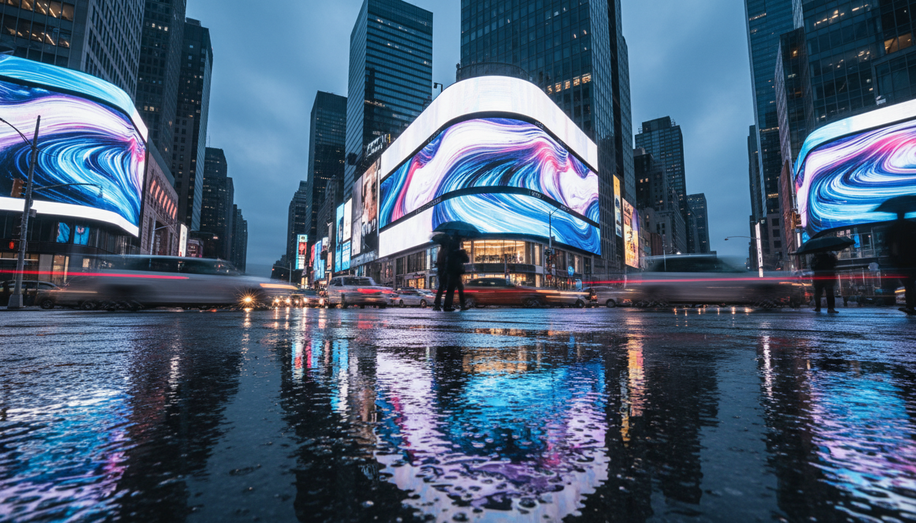
The digital revolution fundamentally transformed outdoor advertising beginning in the early 2000s. Digital Out-of-Home (DOOH) advertising introduced unprecedented flexibility, enabling real-time content updates, multiple messages on single structures, and the ability to adjust creative based on time, weather, location, or audience data. Times Square in New York City became emblematic of this transformation, its towering digital displays showcasing vibrant, dynamic advertisements to millions of viewers daily.
Today, DOOH encompasses far more than traditional billboards. Digital street furniture, transit screens in trains and buses, retail and airport networks, and immersive 3D LED installations represent the cutting edge of the medium. These formats enable advertisers to create visually striking experiences that engage audiences in ways static posters never could, while providing measurable performance data that continue to refine campaign effectiveness.
The journey from ancient stone obelisks to today’s programmable LED networks reflects broader trends in communication technology and consumer engagement. Yet the fundamental principle remains unchanged: out-of-home advertising succeeds by placing compelling messages in spaces where people naturally congregate. As the industry continues evolving, this core strength—the ability to reach audiences at scale in their daily environments—ensures that OOH remains a vital component of modern marketing ecosystems.