
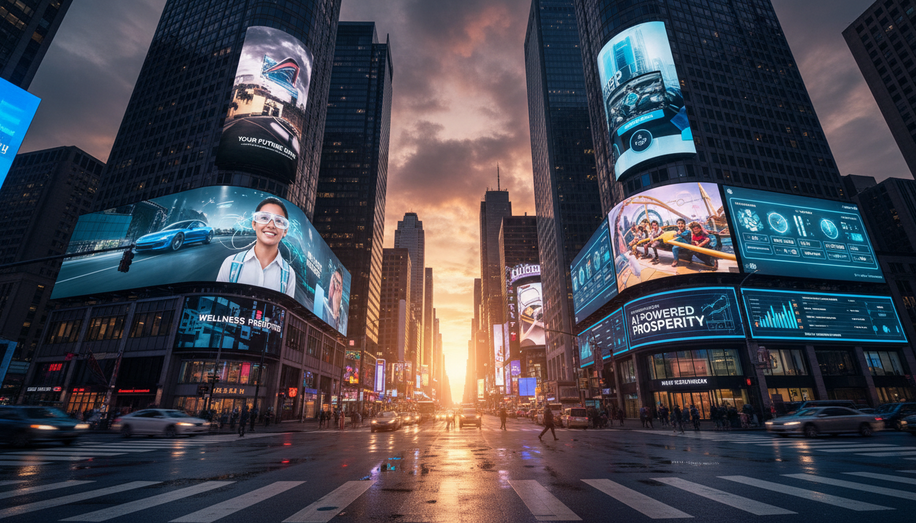

In the bustling urban landscapes where billboards and digital screens command attention, artificial intelligence is quietly revolutionizing out-of-home (OOH) advertising, transforming gut-driven decisions into precise, predictive strategies. Once reliant on manual market research and demographic guesswork, campaign planners now harness AI’s vast data-crunching power to select optimal sites, forecast performance, and tailor messages with unprecedented relevance, boosting efficiency and ROI across static and digital OOH formats.
Site selection, a cornerstone of OOH success, has evolved from intuition to intelligence. AI-powered location tools analyze geospatial data, pedestrian traffic patterns, demographic profiles, and proximity to points of interest to pinpoint high-impact placements. For instance, a sportswear brand might deploy AI to target screens near stadiums during major events, capitalizing on heightened fan engagement and emotional resonance. Similarly, in Madrid’s transport hubs, algorithms prioritize screens based on real-time passenger flows, such as peak times for students, directing language academy ads to bus bays and corridors where they resonate most. Platforms like AdQuick’s AI OOH Campaign Planner take this further, integrating over 10,000 audience segments and millions of inventory data points—from pricing to impressions—to generate map-based strategies aligned with user-defined goals, budgets, and timelines. This data fusion, often layered with satellite imagery and street-view analysis, even flags practical issues like obstructing tree branches, ensuring ads deliver maximum visibility.
Predictive modeling elevates planning from reactive to proactive. Machine learning algorithms sift through historical sales data, market trends, competitor activity, weather patterns, and traffic to simulate scenarios and forecast outcomes. A global retail chain, for example, could use AI during the Christmas rush to identify prime OOH spots, craft seasonal creatives, and allocate budgets for peak shopping periods, anticipating sales lifts with remarkable accuracy. StackAdapt highlights how AI forecasts optimal ad timings and locations by factoring in external variables, ensuring messages reach audiences when they are most receptive. Programmatic buying amplifies this, automating ad purchases via algorithms that refine targeting in real time, linking exposures to tangible metrics like foot traffic and conversions. Billups, with nearly two decades of campaign data, exemplifies this by blending proprietary insights with social media and advertiser data for agile, accountable executions.
Personalization pushes OOH into hyper-relevant territory, especially with digital out-of-home (DOOH) screens. Dynamic content optimization allows ads to adapt on the fly—shifting a beverage brand’s messaging to promote refreshing drinks when temperatures soar, or adjusting copy based on real-time weather and traffic. Clece OOH’s platforms, like APPcelerate, deliver real-time audience insights, enabling mid-campaign tweaks for maximum impact. Tombras’ campaign for PODS storage took this to creative extremes, using AI to generate “Impossible Ads” that changed based on live data, such as local moving trends. Generative AI tools further empower designers to transcend traditional limits, crafting personalized visuals that feel bespoke to passersby. OneScreen aggregates over 100 data sources to execute such campaigns, complementing digital marketing with measurable real-world reach.
Performance measurement, long OOH’s Achilles’ heel, now thrives on AI analytics. Platforms track impressions, engagement, and conversions in real time, visualizing foot traffic spikes and sales lifts to inform optimizations. A retail chain might analyze interactions across creative variants and placements, refining future spends with data-backed precision. This closed-loop intelligence fosters continuous improvement, turning OOH into a nimble channel rivaling online advertising.
Yet AI’s ascent isn’t without nuance. While it democratizes access—making sophisticated planning available beyond big agencies—human oversight remains vital to infuse creativity and context. Limitations persist, such as data privacy concerns and the need for quality inputs to avoid flawed predictions, but blending machine precision with human ingenuity yields the strongest results.
As AI matures, its predictive power promises an OOH era of unparalleled agility. Advertisers who embrace it gain not just efficiency, but deeper consumer connections, proving that in the predictive age, foresight is the ultimate ad space.