
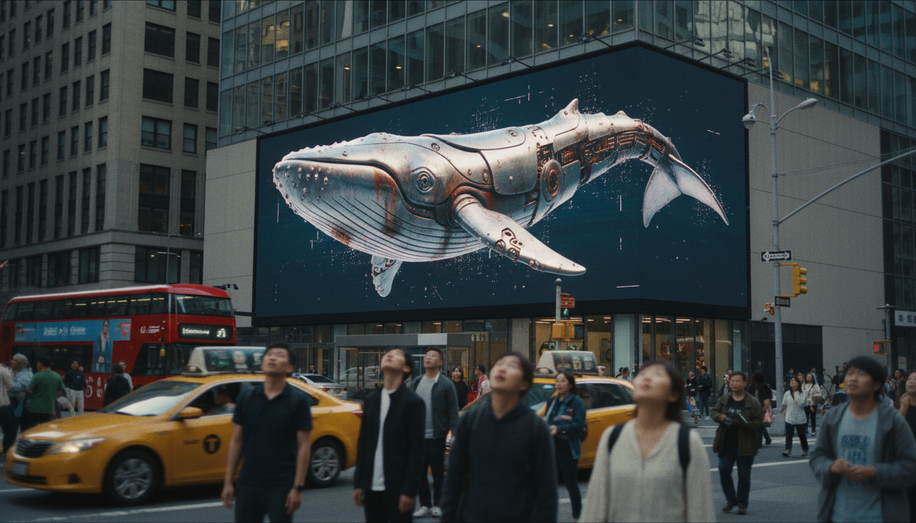

In the bustling heart of Times Square or along the neon-veined streets of Las Vegas, a flat digital billboard suddenly erupts into life. A colossal soda can tips precariously, spilling fizzy rivers onto the pavement below, while a massive shoe hovers as if poised to squash passing cars. These aren’t holographic projections or physical sculptures—they’re 3D anamorphic illusions, meticulously crafted distortions that exploit the human eye’s hunger for depth on two-dimensional screens. Rooted in a 500-year-old artistic trickery pioneered by Renaissance masters like Leonardo da Vinci, anamorphosis warps images so they appear grotesquely stretched from most angles but snap into breathtaking three-dimensionality from one precise vantage point.
The magic hinges on perspective manipulation. Creators begin by pinpointing the “sweet spot”—the optimal viewing angle where pedestrians, drivers, or crowds will congregate. This isn’t guesswork; it’s precision engineering. Using 3D software like Blender, Cinema 4D, or Maxon One, artists replicate the billboard’s real-world dimensions and position a virtual camera to mimic the spectator’s point of view. “We replicate the viewer’s POV with a 3D camera so we can accurately capture the necessary perspective,” explains one production guide, emphasizing how this step ensures the illusion holds only for those in the targeted zone. The billboard itself becomes a digital stage: for flat screens, the content is “unwrapped” from a simulated 3D scene, flattening dynamic animations into a 2D video loop that plays seamlessly on LED panels.
Forced perspective amplifies the drama, borrowing from street chalk artists who draw oversized objects on sidewalks to fool the eye into seeing impossible scale. On digital out-of-home (OOH) displays, this means a brand’s mascot might leap from a corner-wrapped screen, its limbs extending into traffic as if defying gravity. Multi-sided LED billboards—curved, L-shaped, or even triangular—enhance the effect, allowing content to wrap around edges and create emergent depth without glasses or filters. “Having a corner, two or three-sided shapes helps enhance the effect,” notes experts at Groove Jones, who design animations tailored to the site’s geometry, often previewing in virtual reality to test traffic flow and sightlines.
The production pipeline is a symphony of storytelling and technical wizardry. It kicks off with collaboration: agencies like Froth & Fur dive into concepting, scripting, and storyboarding to ensure the illusion serves the brand message, not just dazzles. Next comes modeling—building the environment, assets, and billboard in high-resolution 3D. Animators layer motion: a tiger’s roar might propel it forward, or a perfume bottle could shatter realistically, shards glinting under virtual streetlights. Lighting analysis is crucial; creators simulate ambient conditions to blend the illusion with reality, avoiding jarring mismatches at dusk or dawn. “Virtual testing and pre-viz mock-ups are integral,” says Territory Studio’s Justin Molush, who stresses overscanning renders to combat pixel stretch on massive screens, maintaining sharpness to the farthest corners.
Rendering demands horsepower. In Blender tutorials, pros subdivide billboard meshes, apply shape keys for deformation, and project UV maps via the camera’s focal length—often around 80mm—to bake out anamorphic footage. Cinema 4D workflows similarly lock perspectives, animating elements before unwrapping for final export. The output? High-frame-rate videos optimized for OOH playback, looping indefinitely to snare repeat viewers. No stereoscopic trickery here—unlike true 3D displays that superimpose left- and right-eye images—this is naked-eye anamorphism, pure optical deceit that thrives on motion and context.
What elevates these from gimmicks to marketing juggernauts? Measurable impact. Campaigns for Google Chromebook in Times Square or global brands in London have spiked engagement, with illusions driving social shares as passersby whip out phones to capture the “pop-out” moment. Recall soars because the brain fills perceptual gaps, imprinting the brand amid the surprise. Yet challenges persist: the effect vanishes off-angle, demanding site-specific design, and high-traffic variability requires broad “forgiveness zones” via subtle motion cues.
As digital billboards proliferate—now in high-traffic hubs worldwide—these illusions signal OOH’s evolution. Agencies push boundaries with AI-assisted modeling for faster iterations and real-time adaptations to weather or crowds. The result? Billboards that don’t just advertise; they hijack attention, turning urban thoroughfares into theaters of wonder. In an era of ad fatigue, this Renaissance revival proves timeless: distort the view, captivate the mind.
To truly harness the potential of these captivating illusions, advertisers must navigate the complexities of precise deployment and measurable impact. Platforms like Blindspot offer crucial tools, providing detailed location intelligence and audience measurement to identify optimal “sweet spots” for maximum viewer engagement. By leveraging real-time campaign performance tracking and ROI attribution, brands can meticulously evaluate the effectiveness of their anamorphic investments, ensuring these spectacular displays translate directly into tangible marketing success. Visit https://seeblindspot.com/ to learn more.