
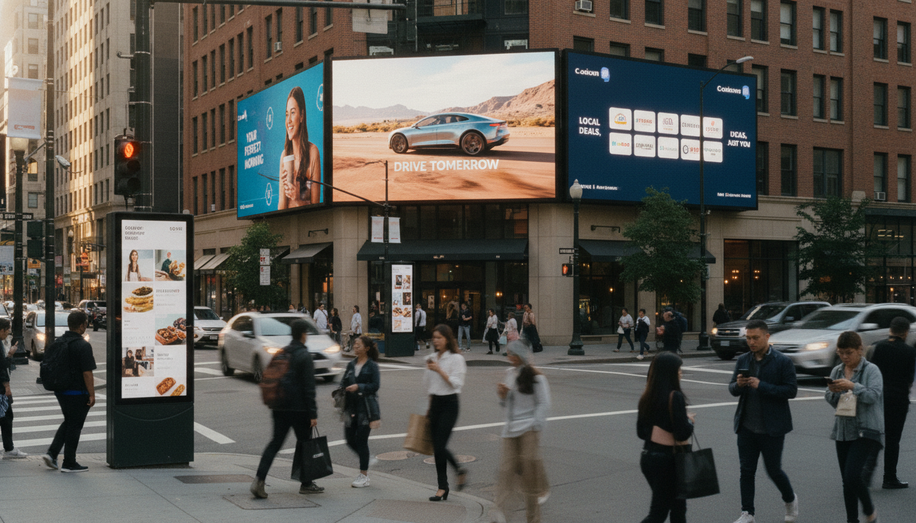

In the bustling streets of major cities, where digital billboards flicker to life with uncanny precision, programmatic out-of-home (OOH) advertising is revolutionizing how brands connect with audiences. Once a manual process reliant on negotiations and static placements, OOH buying is now automated through programmatic platforms, enabling real-time transactions that streamline operations and sharpen targeting like never before. This shift, accelerating into 2026, allows advertisers to purchase inventory across thousands of screens with the click of a button, mirroring the efficiency of digital programmatic while harnessing the unfiltered impact of physical spaces.
Programmatic DOOH, as it’s commonly known, leverages data from diverse sources—location signals, weather patterns, consumer demographics, and even traffic flows—to deliver ads at the perfect moment. For instance, ice cream brands like Magnum have dynamically swapped creatives based on temperature thresholds, activating coastal screens only when conditions dipped below 24 degrees Celsius, resulting in a 15% revenue boost and 14% uplift in market share. Such automation eliminates the guesswork of traditional buys, where advertisers committed to fixed slots months in advance, often missing fleeting opportunities. Now, platforms integrate with supply-side systems like VIOOH, offering curated deals that span multiple media owners and markets, making cross-border campaigns routine rather than experimental. In 2025, multi-market deals already comprised 37% of one platform’s revenue, a figure poised to surge as AI refines inventory forecasting and dynamic pricing.
This precision extends to audience targeting, transforming OOH from a broad-reach medium into a scalpel for fragmented consumers. Advertisers fuse first-party data, geofencing, and real-time analytics to serve personalized messages—think promoting umbrellas during sudden downpours or event tie-ins at transit hubs. Digital OOH screens, projected to capture over 40% of total outdoor ad spend in 2026, refresh content instantly based on triggers like time of day or nearby footfall, far outpacing static billboards. Smaller brands, previously sidelined by high costs, now compete via programmatic’s surgical approach, accessing premium inventory without multimillion-dollar commitments. The result? Campaigns that feel immediate and relevant, boosting engagement as dynamic creative optimization (DCO) adapts visuals in flight, much like online retargeting but with the tangible presence of a 3D display.
Flexibility in campaign management is perhaps programmatic OOH’s most disruptive edge. Unlike rigid contracts, these platforms enable self-optimizing ecosystems where machine learning analyzes performance data across channels, adjusting bids and creatives on the fly. Dell’s recent omnichannel push paired programmatic DOOH with mobile and desktop ads, yielding a six-point lift in purchase intent and doubled click-through rates—a “priming effect” that amplifies every touchpoint. Attribution has matured too, with standardized measurement linking OOH exposures to downstream actions like store visits or app downloads, proving ROI in ways skeptics once dismissed. As AI embeds deeper into workflows, upper-funnel brand building merges seamlessly with performance tactics, rebalancing budgets toward proven channels.
Yet this evolution isn’t without challenges. Regulatory hurdles, such as the UK’s 2026 enforcement of restrictions on less healthy food ads across TV and online, push more spend into OOH’s less-constrained arena, but demand robust compliance tools. Privacy concerns around location data persist, though anonymized aggregation and opt-in models are standardizing practices. Sustainability also factors in: programmatic DOOH proves over 20 times more carbon-efficient than alternatives when optimized via video-on-video (VIOOH) tech, aligning with eco-focused brands favoring LED and solar-powered screens.
Looking ahead, 2026 marks programmatic OOH’s maturation into a global operating system for advertising. Multi-channel integration will dominate, with curated deals simplifying buys across owners and borders, while AI-driven strategies turn campaigns into living entities. Interactive elements—AR overlays, motion-sensing kiosks—layer atop programmatic foundations, increasing dwell time by 20-40% and sparking social shares. In a media landscape plagued by digital fatigue, OOH’s physicality commands 71% consumer attention on billboards alone, with 26% prompting website visits. Brands embracing this—through hyper-local relevance, real-time adaptability, and measurable impact—aren’t just buying ads; they’re orchestrating encounters that drive action. Programmatic OOH isn’t disrupting the industry; it’s redefining it as the connective tissue between worlds, proving that in advertising’s next era, the most powerful messages still demand to be seen.