
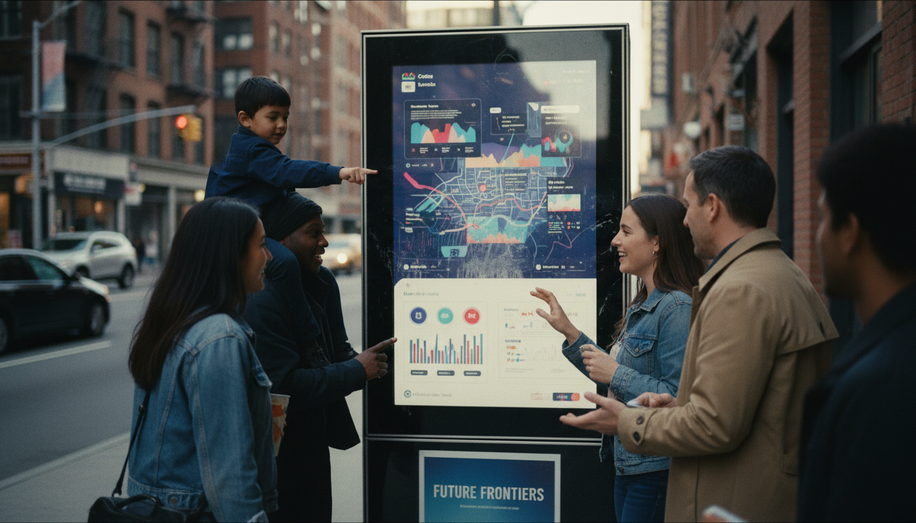

The advertising landscape is undergoing a fundamental transformation. Where outdoor displays once served as static billboards competing for passing attention, interactive out-of-home (OOH) advertising now invites audiences to participate, respond, and engage in real time. This shift from passive consumption to active participation represents one of the most significant evolutions in outdoor marketing, fundamentally changing how brands connect with consumers in public spaces.
The power of interactive OOH lies in its ability to break through the noise of traditional advertising. Industry data shows that interactive advertising formats can increase dwell time by 20 to 40 percent, a substantial metric that translates directly into deeper brand engagement and message retention. When audiences stop to interact with a display rather than passively glance at it, they transition from observers to participants, creating memorable experiences that extend far beyond the initial encounter.
Touchscreens and motion-sensing technology form the foundation of this interactive revolution. Touch-enabled kiosks mounted on digital billboards and street furniture now enable instant feedback, product demonstrations, and personalized content delivery. These interfaces transform billboards into functional tools rather than mere advertisements, allowing consumers to make purchasing decisions, access exclusive offers, or gather product information without visiting a retail location. Motion-sensing screens take engagement further by detecting passerby movement and responding in real time, creating an almost magical quality that stops pedestrians in their tracks and encourages them to explore what the display offers.
Augmented reality represents perhaps the most immersive frontier of interactive OOH. AR-powered ads overlay digital content onto real-world environments, enabling consumers to visualize products in their own context or experience branded narratives that blend physical and digital spaces. A global beverage brand recently deployed AR-enabled billboards for interactive storytelling, achieving a 30 percent lift in brand recall. These experiences create shareable moments that amplify campaign reach far beyond the immediate outdoor audience, as users photograph or video their interactions and distribute them across social networks.
Gamification has emerged as a particularly effective mechanism for driving direct response and immediate user action. When Netflix invited consumers to tweet in support of superhero characters displayed on interactive billboards, the winning character’s image was damaged in real time based on social media mentions, creating a feedback loop that encouraged participation. Dogs Trust employed a similar approach with a traditional billboard covered in plush toy puppies that pedestrians could take, revealing a hard-hitting anti-smuggling message beneath. Within hours, all 750 puppies had been claimed, and 17,000 members of the public engaged with the campaign on the first day alone.
Weather-triggered and location-based campaigns demonstrate how data integration amplifies interactive OOH effectiveness. Aperol used programmatic technology to activate ads only during ideal “summer cocktail weather,” ensuring their message reached target audiences at the precise moment they were most receptive. Rain-X similarly deployed weather-responsive digital displays that activated when rain fell, seamlessly blending product messaging with atmospheric conditions. These data-driven approaches transform passive billboards into intelligent systems that understand context and timing.
The integration of mobile and social platforms creates a complete ecosystem around interactive OOH. QR codes on outdoor displays now drive instant app downloads and exclusive offers, while geo-fencing and beacon technology enable brands to retarget mobile users after they pass a digital billboard or interact with a smart kiosk. This creates measurable conversion paths that connect offline interactions with online actions, providing marketers with concrete data about campaign effectiveness.
Perhaps most importantly, interactive OOH fosters genuine brand relationships rather than momentary brand awareness. When audiences invest time and attention in an interactive experience, they develop a stake in the brand narrative. They become ambassadors, sharing their experiences with others and creating organic amplification that traditional advertising cannot achieve. As outdoor advertising continues to blur the boundaries between physical and digital spaces, the brands that master interactive engagement will define the future of public marketing.