
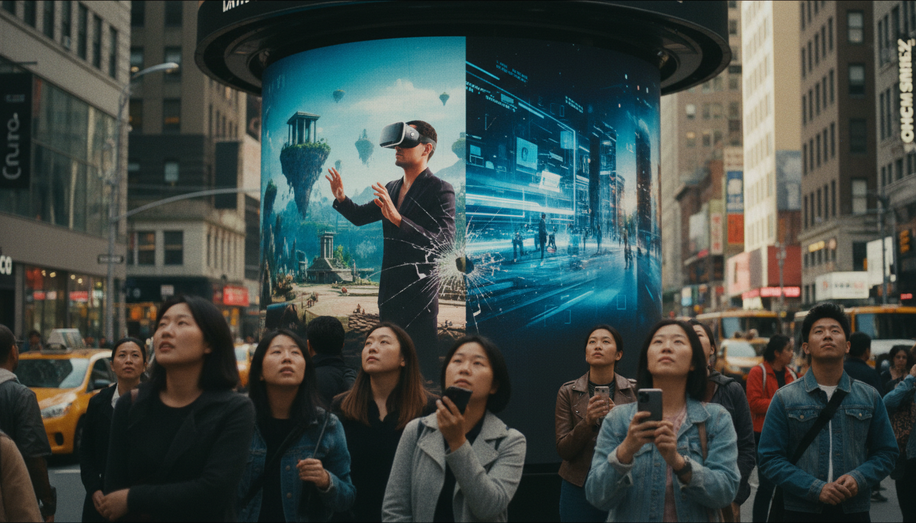

In the bustling streets of urban centers, where digital billboards already command attention with their vibrant displays, a new era is dawning. Augmented reality (AR) and virtual reality (VR) are poised to redefine digital out-of-home (DOOH) advertising, transforming passive glances into immersive interactions that captivate audiences on the move. By layering digital overlays onto the real world or plunging viewers into fully virtual environments, these technologies promise not just visibility, but genuine engagement, turning billboards into portals for personalized experiences.
AR, in particular, has already proven its prowess through WebAR—web-based augmented reality accessed via simple QR codes on billboards. Unlike static images or basic QR links, WebAR delivers response rates exceeding 40% and click-through rates above 50%, while capturing rich behavioral data like scan duration, IP addresses, and GPS locations. This allows advertisers to evaluate billboard performance with precision, identifying high-engagement spots and refining strategies in real time. Imagine a pedestrian scanning a billboard for a fashion brand like Calvin Klein, where a red QR code unlocks a 40-second AR video featuring models in dynamic poses, complete with shareable social media options. Victoria’s Secret took a similar approach in its “Sexier than Skin” campaign, directing scans to interactive lingerie showcases, while BTS fans delved into the band’s “Armypedia” world, blending fandom with seamless tech integration.
As we move deeper into 2026, these AR experiments are evolving into sophisticated, always-on features. Advertisers are integrating AR directly with 5G-enabled billboards for lag-free experiences, such as interactive product demos or gamified adventures that reward scans with prizes or exclusive content. Nartak Media Group predicts AR will immerse customers in “wow” moments—like virtual games or AR filters—that prompt instant social sharing, exponentially extending campaign reach. Plug Talk Media highlights how brands like Chipotle use QR-tied AR for time-sensitive offers, tracking scans to optimize meal-time messaging and measure ROI through foot traffic analytics. This interactivity fosters emotional connections, as users manipulate 3D models, explore virtual worlds, or receive hyper-localized content based on their GPS data, making ads feel tailor-made rather than generic blasts.
VR enters the equation as a complementary force, pushing DOOH toward fully enclosed experiences. While AR enhances the physical environment, VR could transport users via billboards equipped with NFC or proximity sensors, inviting brief headphone-free dives into brand universes. Picture a travel billboard where scanning pulls commuters into a 360-degree VR tour of a tropical resort, complete with interactive booking overlays. Though still emerging, VR’s potential shines in high-traffic zones like Times Square, where Time Magazine’s AR-enhanced boards already link to polls and videos; scaling to VR could amplify dwell time and conversions. Internet of Things (IoT) integration further empowers this, enabling touchless engagement or content that adapts to crowd density, weather, or events.
Programmatic DOOH platforms are the backbone of this transformation, automating ad buys and dynamically swapping AR/VR content based on real-time data. Digital billboards, now standard with LED efficiency and solar power, refresh messages instantly—swapping sunny-day sunscreen promos for rainy-evening delivery deals via AI analysis. The global DOOH market underscores the momentum, projected to surge from $21.62 billion in 2025 to $24.24 billion in 2026 at a 12.1% CAGR, fueled by these immersive techs. Sustainability adds another layer: eco-friendly “living” billboards with air-purifying materials pair naturally with AR/VR, appealing to conscious consumers without sacrificing spectacle.
Challenges remain, of course. Successful AR/VR billboards demand scannable QR codes, bold calls-to-action promising AR thrills, and seamless mobile integration to avoid frustrating passes-by. Privacy concerns around GPS and biometrics necessitate transparent data use, while high development costs could sideline smaller brands—though cloud-based WebAR levels the field. Yet, the metrics speak volumes: deeper engagement translates to stronger recall, higher conversions, and viral amplification as users share their “wow” encounters.
Looking ahead, 3D anamorphic displays fused with AR/VR will create illusions that leap from screens, blending hyper-realism with interactivity. AI will orchestrate it all, predicting audience moods from demographics or trends, while hyper-local targeting ensures relevance. Brands like The North Face, Spotify, and McDonald’s, already QR pioneers, are primed to lead this charge, proving DOOH’s evolution from eyesore to ecosystem.
Ultimately, AR and VR aren’t just gimmicks; they’re the future of DOOH, forging bonds in fleeting urban moments. As smartphones become ubiquitous extensions of our senses, billboards will evolve from broadcasters to conversation starters, delivering not ads, but adventures that linger long after the scan. In a world craving connection, this immersive pivot positions digital billboards as indispensable tools for brands daring to engage the now.