
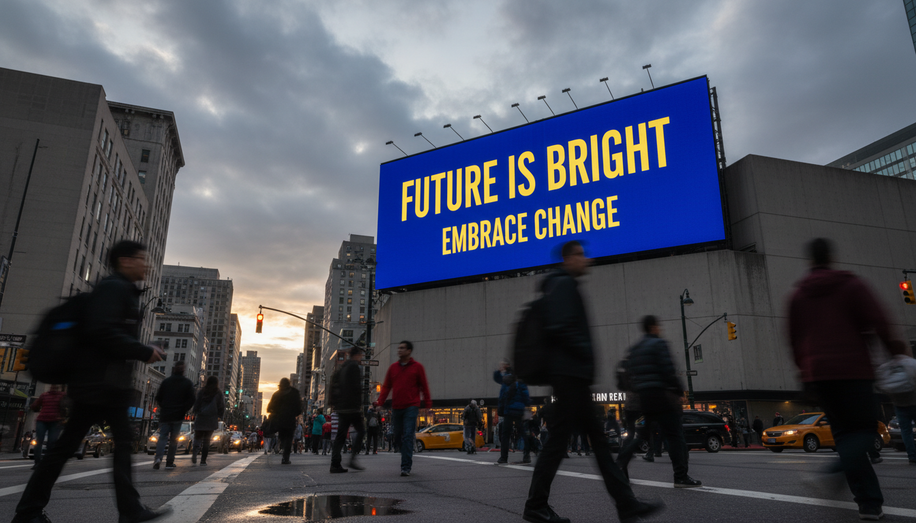

In the fleeting seconds a driver or pedestrian glances at an out-of-home (OOH) advertisement, color and typography become the silent architects of perception, dictating whether a message registers or fades into the urban blur. These elements do more than decorate; they tap into the brain’s primal responses, shaping emotions, ensuring legibility amid motion, and driving behavioral nudges that can turn passive viewers into engaged consumers. Designers who master their interplay create campaigns that not only capture attention but linger in memory, leveraging psychological principles honed by decades of research in marketing and neuroscience.
Color psychology, at its core, examines how hues trigger subconscious reactions, a phenomenon rooted in evolutionary biology and cultural conditioning. Red, for instance, commands immediate focus by evoking urgency and excitement—think stop signs or sale banners that prompt impulsive action. Its warm tone stimulates the reticular activating system, the brain’s attention filter, making it ideal for calls-to-action in high-speed OOH environments like billboards. Blue, by contrast, radiates trust and stability, qualities banks and tech firms exploit to foster reliability amid the chaos of city streets. Green signals growth and harmony, often deployed by eco-brands to evoke freshness and prosperity, while yellow bursts with optimism to snag eyes but risks overwhelming if overused due to its high visibility.
Yet color’s power amplifies or crumbles based on context, particularly in OOH where sunlight, distance, and speed demand strategic pairings. High-contrast combinations—bold red against white or navy on yellow—cut through visual noise, enhancing readability by up to 40% in studies of outdoor signage. Saturation and brightness play pivotal roles too; overly muted tones blend into grayscapes, while vibrant ones fatigue the eye. Emotional synergy emerges in thoughtful palettes: orange blends red’s energy with yellow’s cheer for youthful innovation, purple whispers luxury and mystery for premium goods, and black exudes authority for high-end appeal. White offers purity and clarity in Western markets but signals mourning in Eastern cultures, underscoring the need for audience-specific research to avoid misfires.
Typography enters as color’s indispensable partner, transforming abstract emotions into legible intent. In OOH, where dwell time averages under eight seconds, fonts must prioritize scannability over artistry. Bold sans-serif typefaces like Helvetica or Futura dominate because their clean lines and uniform stroke widths ensure instant recognition from 500 feet away, aligning with cognitive load theory that favors simplicity to prevent mental overload. Serif fonts, with their subtle flourishes, evoke tradition and readability in print but falter outdoors, where motion blurs fine details. The psychology here ties to familiarity: the brain processes bold, uppercase headlines 20% faster, mimicking how we scan road signs for survival cues.
Font choices also stir emotions, much like colors. Angular, condensed fonts convey dynamism and urgency—perfect for event promotions—while rounded, open styles suggest approachability and warmth, suiting family-oriented brands. Hierarchy matters profoundly: oversized headlines in contrasting colors draw the eye first, followed by subtext in complementary hues, guiding perception in a Z-pattern that mirrors natural reading flow under duress. Poor pairings sabotage this: a playful script font in low-contrast pastel against a busy background invites confusion, eroding trust and recall.
The magic unfolds in their fusion. A luxury watch ad might pair deep purple with elegant sans-serif caps for sophistication, the hue’s mystery amplified by typography’s precision. Fast-food chains slam red urgency with blocky, all-caps fonts to scream “now.” Data from signage studies shows such combos boost retention by 55%, as aligned color-font dynamics reinforce brand identity subconsciously. Yet pitfalls abound: cultural variances demand vigilance—white’s innocence in the West clashes with its funerary weight elsewhere—and overdesign invites cognitive dissonance.
OOH thrives on repetition via the mere exposure effect, where consistent color-typography schemes build familiarity and affinity over repeated sightings. Brands like Coca-Cola have etched red-and-white curves into collective psyche through relentless outdoor presence. Emerging digital OOH (DOOH) adds dynamism, pulsing colors with adaptive fonts to match time-of-day moods, further hacking perception.
Ultimately, effective OOH design distills psychology into precision: select colors for emotion, fonts for clarity, and combinations for impact. Agencies wielding this knowledge don’t just advertise; they engineer encounters that resonate, proving that in the high-stakes arena of street-level persuasion, the right palette and type can move minds—and markets—as surely as any slogan.