
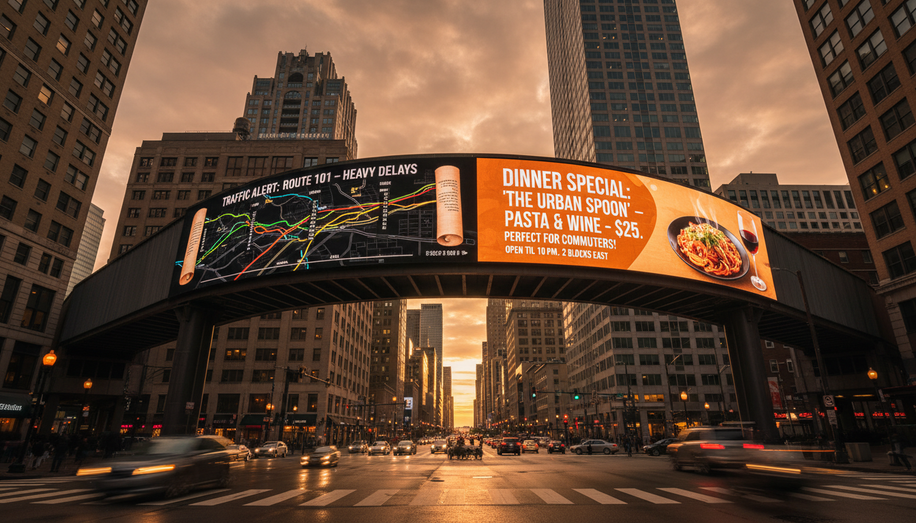

Digital billboards have fundamentally transformed outdoor advertising by enabling brands to respond to real-time conditions and events, creating moments of relevance that static advertisements simply cannot achieve. This capability represents a significant shift in how marketers can engage audiences, turning digital displays into dynamic platforms that adapt content instantly to maximize impact and resonance.
The power of real-time marketing on digital billboards lies in their ability to respond to immediate circumstances. Weather represents one of the most compelling examples of this dynamic approach. Brands like Rain-X have leveraged weather triggers to synchronize their advertisements with changing atmospheric conditions, positioning products precisely when consumer need is highest. By combining weather data with strategic placement near retail locations, these campaigns create a sense of perfect timing that feels personally relevant to viewers. Similarly, digital billboards can display current temperature and forecasts to capture attention by making advertisements contextually appropriate to the moment.
Major sporting events and cultural moments offer another avenue for real-time engagement. The NBA demonstrated this approach by launching a dynamic campaign across multiple digital billboards nationwide, automatically populating local game countdowns, live scores, and fan tweets throughout the 75th playoff anniversary. This strategy allowed the organization to build excitement while scaling the campaign efficiently across diverse markets. New Balance took a similar approach when celebrating Dutch athlete Femke Bol’s championship victory, shifting from motivational creative before the race to celebratory messaging immediately after her win. By advertising in real-time, the brand positioned itself as part of the moment of national pride, earning authentic connection with audiences through perceived timeliness and personal relevance.
Time-based personalization extends beyond major events to everyday consumer behavior. Restaurants and retail brands can leverage dayparting—the practice of displaying different content based on time of day—to show breakfast offerings in morning hours, lunch specials around noon, and dinner promotions in evening time slots. This approach ensures that messaging aligns with consumer mindset and immediate purchasing intent, dramatically improving the likelihood of engagement compared to static advertisements that remain constant regardless of audience context.
Digital billboards also excel at integrating real-time data from social platforms to create bidirectional engagement between online and offline audiences. When campaigns incorporate live social media feeds, hashtags, and user-generated content, they transform passive viewers into active participants. Movie studios have successfully employed this approach, encouraging audiences to tweet character names while live billboard displays showed virtual battles between nominees, updating in real-time based on social media mentions. This strategy not only captured attention but incentivized repeated engagement as audiences saw their participation directly influence what appeared on the physical display.
The effectiveness of real-time marketing on digital billboards extends to crisis response and urgent messaging. Blood donation organizations have utilized programmatic digital out-of-home advertising linked to live supply APIs, activating advertisements near donor centers only when specific blood types reached critically low levels. This precise, data-driven activation ensured that messages reached the right audience at exactly the moment when their action was most needed, resulting in measurable increases in donor center visits.
The measurement capability of digital billboard campaigns adds another dimension to real-time marketing. Analytics platforms now allow brands to combine impressions from billboard displays with online engagement metrics, providing comprehensive visibility into campaign performance. This integration enables marketers to understand not only how many people saw an advertisement but how many acted upon it, creating feedback loops that inform immediate optimization.
The success of real-time marketing on digital billboards ultimately stems from their ability to collapse the distance between consumer moment and brand message. By responding to weather, time, events, and social signals, these platforms deliver advertising that feels contextually earned rather than arbitrarily placed. As digital infrastructure continues advancing, brands that master real-time adaptation will increasingly differentiate themselves through relevance, creating campaigns that audiences don’t simply tolerate but actively engage with and share.