
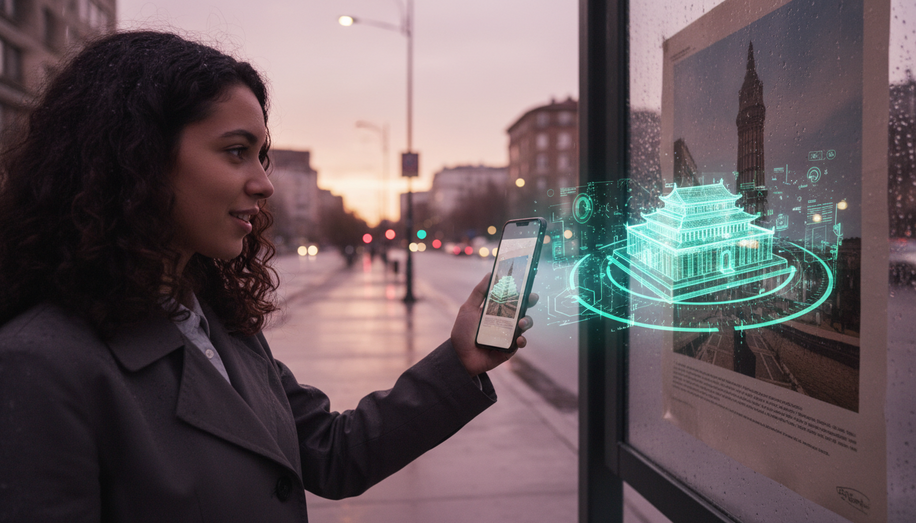

In the bustling streets of 2026, a pedestrian pauses before a towering digital billboard in Times Square, smartphone in hand. As they point their device at the glowing display, the static image of a luxury car springs to life, morphing into a three-dimensional hologram that appears to drive right out of the screen, weaving through virtual traffic while inviting the viewer to “test drive” it via augmented reality. This seamless fusion of augmented reality (AR) with out-of-home (OOH) advertising marks a pivotal shift, transforming passive billboards into interactive portals that demand engagement and forge unforgettable brand connections.
Augmented reality overlays digital elements onto the real world through mobile devices, turning everyday encounters with OOH media into participatory experiences. No longer confined to flat visuals, advertisers now deploy AR to create anamorphic illusions and motion-responsive displays that captivate high-traffic zones like airports, EV charging stations, and sports venues. Programmatic digital OOH (DOOH) platforms amplify this by delivering dynamic AR content in real-time, tailored to audience data such as demographics, weather, or local events, ensuring messages feel hyper-relevant rather than intrusive. Costs for these technologies have plummeted, enabling widespread adoption and positioning OOH as a leader in experiential marketing amid fragmented digital landscapes.
Brands are reaping measurable rewards from this evolution. Consider Nike’s Paris Olympics activation, where Snapchat AR lenses turned the city into a virtual sports arena; users hunted digital athletes amid landmarks, generating over 23 million impressions and reaching 90% of local youth in weeks. Translated to OOH, such tactics integrate with billboards via QR codes or NFC taps, prompting immediate AR interactions that boost dwell time and social shares. McDonald’s and Maybelline have similarly leveraged holographic AR billboards, where passersby gesture to “unwrap” virtual burgers or try on makeup, creating viral TikTok moments that extend campaign reach exponentially. Data analytics track these engagements—proximity sensors measure interactions, geofencing enables retargeting, and AI optimizes placements for maximum ROI, with digital OOH revenue projected to exceed 40% of total spend.
Interactive AR experiences elevate OOH beyond visibility to action. Gesture-controlled walls in urban corridors respond to hand waves, unveiling layered narratives, while proximity triggers activate personalized overlays, such as event promotions syncing with a user’s calendar. At high-dwell spots like stadiums, AR enhances halftime spectacles; fans at SoFi Stadium once watched virtual whales surf the field via apps linked to jumbotrons, blending sponsor messaging into the thrill of live events. For OOH campaigns, this means billboards that launch city-wide AR scavenger hunts—imagine a retail brand hiding virtual coupons at subway exits, scanned via phone to redeem in-store discounts, spiking foot traffic by hundreds of percent as seen in expo hall trials where dwell time soared from seconds to minutes.
Sustainability bolsters AR’s appeal in OOH. Energy-efficient LEDs and solar-powered displays make immersive setups viable for eco-conscious brands, aligning with stringent European standards while minimizing carbon footprints. AI further refines this by managing power usage based on real-time triggers, ensuring high-impact activations without waste. As advertisers shift budgets from saturated social feeds and unreliable digital metrics, OOH’s tangible presence—verified by footfall data and impression audits—delivers clarity and trust.
Challenges persist, including installation costs and competition from online channels, yet AR mitigates these by amplifying shareability and precision targeting. Programmatic buying streamlines deployment across networks, while data-driven insights refine audience segmentation, from commuting patterns to lifestyle clusters. In travel hubs, AR billboards simulate virtual tours of destinations, enticing tourists with interactive previews that convert browsers into bookers.
Looking ahead, AR will deepen OOH’s integration with mixed reality, potentially incorporating wearables for richer overlays in stadiums and conferences. Holographic keynotes and AR business cards at trade shows hint at a future where OOH evolves into a “global operating system,” merging physical infrastructure with digital immersion. Sensor fusion—combining gestures, voice, and biometrics—promises even more responsive campaigns, turning billboards into conversational hubs.
This transformation redefines OOH as active media, where consumers co-create the narrative. Psychological studies underscore AR’s edge: it commands four times the attention of standard ads, sparking emotions like wonder and competition that static formats can’t match. As revenue climbs across digital and traditional formats, OOH stands resilient against AI disruptions, proving its worth through real-world impact. In 2026, augmented reality isn’t just enhancing OOH—it’s propelling it into an era of indispensable, interactive storytelling that blurs the line between advertisement and experience.