

In the bustling streets of 19th-century New York, Jared Bell unveiled what is widely regarded as the first outdoor poster in 1835, promoting his circus with bold lithography that captured the imagination of passersby. This simple act marked the dawn of out-of-home (OOH) advertising, transforming public spaces into canvases for commerce and transforming static messages into a dynamic force that would evolve alongside technological and societal shifts. From hand-painted signs on fences to today’s interactive digital spectacles, OOH has mirrored humanity’s progress, adapting from rudimentary announcements to sophisticated, data-driven displays that command attention in an increasingly fragmented media landscape.
The roots of OOH stretch back millennia, with ancient Egyptians using stone obelisks around 3000 BC to proclaim laws and edicts, while traders in early civilizations relied on symbols and signs to lure customers. The modern era ignited with Johannes Gutenberg’s 1450 invention of movable type, which democratized printing and paved the way for the illustrated poster in 1796, perfected through lithography on smooth stone or metal plates. By the mid-1800s, Americans were painting vibrant signs on fences to hawk local wares, and street railways bore the earliest exterior ads by 1850. Jared Bell’s circus poster soon followed, igniting a frenzy: by 1870, nearly 300 posting companies dotted the U.S., leasing boards as early as 1867 and standardizing formats like 24- and 30-sheet posters.
Industry maturation came swiftly. In 1872, the International Bill Posters’ Association of North America formed, evolving into the Associated Bill Posters’ Association of the U.S. and Canada by 1891—today’s Outdoor Advertising Association of America (OAAA)—to promote ethical standards, coordinate services, and elevate the poster’s prestige. National expansion boomed around 1900, with brands like Palmolive, Kellogg, and Coca-Cola launching mass billboard campaigns. Mergers reshaped the landscape: the 1925 fusion of the Poster Advertising Association and Painted Outdoor Advertising Association birthed the OAAA, while the Fulton Group and Cusack Co. created General Outdoor Advertising Company, the sector’s first major consolidation. Illumination debuted in 1916 on San Francisco’s Market Street, and public service efforts began in 1913 with an OAAA educational committee donating ad space.
Regulation and innovation defined the mid-20th century. The 1934 Traffic Audit Bureau (TAB) introduced third-party audience data, lending credibility to OOH metrics. Bus stop shelters emerged in 1962, funded entirely by ad revenue, while the 1965 Highway Beautification Act curtailed billboards on interstates, confining them to commercial zones with strict size, lighting, and spacing rules. Vinyl supplanted paint in the 1970s, slashing production time and costs. Effectiveness was dramatically proven in 1975, when billboards featuring newly crowned Miss America Shirley Cochran skyrocketed her name recognition by 940 percent nationwide.
The digital revolution, foreshadowed in the 1990s, shattered static constraints. Arbitron and Nielsen tested outdoor ratings in 2002, and by 2005, the first digital networks flickered to life, enabling real-time content swaps and vivid animations. Ecoflex posters dominated by 2010, slashing paper use and installation time for greener operations. Transit expanded with mobile formats—truck-mounted 30-sheet posters in the 1990s—and street furniture like illuminated shelters proliferated. Regulatory hurdles persisted: tobacco ads vanished from OOH in 1999 after a landmark agreement, following a 1972 broadcast ban that funneled tobacco dollars outdoors.
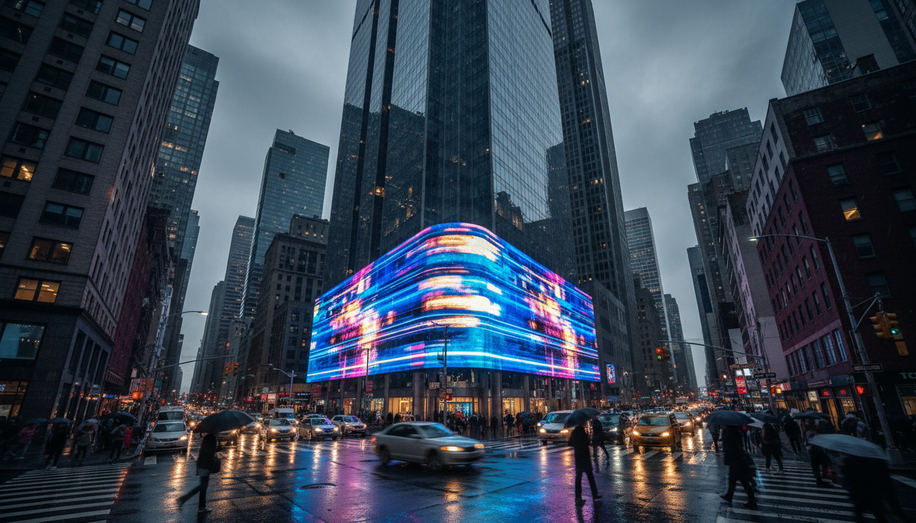
Today, OOH transcends billboards, street furniture, transit, and alternative media into a programmable ecosystem. Digital out-of-home (DOOH) displays now integrate sensors, AI, and geofencing for hyper-targeted messaging—think weather-responsive ads or those syncing with smartphones via QR codes. Programmatic buying automates inventory trades, while metrics from TAB and Geopath rival digital platforms in precision. The COVID-19 era accelerated DOOH growth, as brands pivoted to contactless, high-visibility outreach amid indoor media slumps. Historic milestones like the OAAA’s OBIE Awards (launched 1942) and Out of Home Media Plan Awards (2000) underscore enduring creativity, with Coca-Cola’s “Yes Girl” claiming the first OBIE.
This evolution from Bell’s circus poster to LED-powered interactivity reflects OOH’s resilience: it commands 98 percent unaided recall and thrives in mobility-driven worlds where consumers encounter 5,000 daily ad impressions. As 5G and AR blur physical-digital lines, OOH stands poised for further metamorphosis—perhaps holographic projections or drone-delivered visuals—proving that what began as stone carvings remains a cornerstone of modern marketing, captivating audiences wherever they roam.