
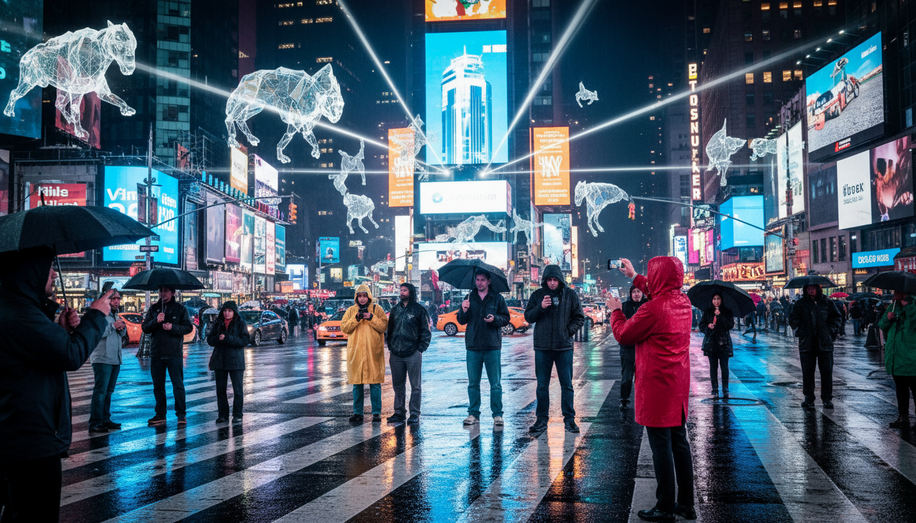

In the bustling heart of a city, where commuters rush past towering billboards and digital screens flicker with fleeting messages, augmented reality is quietly revolutionizing out-of-home advertising. Traditional OOH spaces—once static canvases of persuasion—are evolving into dynamic portals that invite passersby to step inside the ad, blurring the line between observer and participant. By overlaying digital elements onto the real world via smartphone cameras, AR transforms mundane encounters into memorable interactions, fostering deeper engagement in an era where attention is the scarcest commodity.
The appeal lies in AR’s ability to inject interactivity into environments that were previously one-way broadcasts. A simple QR code scan on a subway poster or bus shelter ad unlocks immersive experiences, from holographic projections to gamified challenges, making the physical space an extension of the brand’s narrative. This shift is fueled by advancements in web-based AR platforms like 8th Wall, which eliminate the need for app downloads, lowering barriers to entry and broadening reach. Digital out-of-home screens, now ubiquitous, serve as perfect launchpads, turning any urban surface into a potential AR billboard through spatial computing.
Consider Burger King’s audacious “Burn That Ad” campaign in Brazil, where rivals’ billboards became unwitting props. Users pointed their phones at competing fast-food ads, virtually setting them ablaze via the BK app; in their place emerged a Whopper coupon, redeemable nearby. The stunt drove one million app downloads in a month and boosted in-app sales by 56.4 percent, proving AR’s power to hijack attention and convert it into action. Similarly, Vodafone blanketed Germany with eight AR-enabled billboards, where scans triggered 3D games and prize hunts. The campaign reached 50 million people, with 40 percent of engagers visiting stores, 82 percent reporting excitement, and over 17,000 minutes of active interaction—plus a 10 percent lift in brand uniqueness.
These successes underscore AR’s emotional pull. Unlike passive viewing, AR delivers instant feedback, forging bonds through shared wonder. The NHS blood donation campaign let users “donate” virtually via a poster scan, visualizing life-saving impacts and leaving lasting positive impressions. Jackson Family Wines elevated in-store OOH with a holographic Web AR encounter featuring founder Adam Lee, scanned from billboards or bottles, blending storytelling with product intimacy. Even board games got in on the act: Ally Bank’s Monopoly-themed treasure hunt installed 36 game-board squares across six U.S. cities. Scans revealed Mr. Monopoly dispensing points and cash prizes, yielding 100,000 plays and 86 percent completion rates, all while subtly promoting financial literacy.
Pioneering efforts like Pepsi Max’s “Unbelievable” bus shelter in London set the viral template. Hidden cameras and AR overlays conjured asteroids, UFOs, and tentacles bursting from the pavement, startling passersby and amassing six million YouTube views. This 2014 spectacle, echoed in later campaigns, highlighted AR’s knack for buzz generation and social sharing. Red Bull amplified its cliff-diving spectacle with QR scans simulating 70-foot plunges, immersing remote audiences in the adrenaline. Pizza Hut’s Super Bowl tie-in turned pizza boxes into PAC-MAN arenas, selling 10.6 million units and garnering 741 million impressions.
Retail and experiential brands are pushing further. BON V!V Spiked Seltzer’s Los Angeles murals spawned virtual vending machines via Web AR, letting users “shop” in situ. Kinder’s in-store safari portals unleashed animated animals with fun facts, captivating families app-free. Cadbury commandeered London’s Waterloo Station with a 120-square-meter AR game on Europe’s largest digital screen, drawing commuters into playful chaos. National Geographic’s Rotterdam train station activation let riders “step into” dinosaur eras or spacewalks, celebrating the society’s 125th anniversary with visceral adventure. Ralph Lauren electrified Times Square, morphing the iconic plaza into a fragrance-fueled spectacle for Polo 67.
The data speaks volumes: AR OOH campaigns consistently outperform static formats. Vodafone’s metrics—hundreds of thousands of social shares, 81 percent craving more AR—mirror broader trends of heightened dwell time, recall, and conversion. Yet challenges persist. Accessibility hinges on smartphone penetration and data connectivity, while creative execution demands precision to avoid glitches that shatter immersion. Still, as hardware costs drop and 5G proliferates, AR’s scalability surges, making it viable for brands beyond big budgets.
Looking ahead, AR promises to redefine OOH’s versatility, from murals to highways. Audible’s recent push transformed billboards into audio adventure gateways, hinting at multisensory futures. By turning public spaces into playgrounds, AR doesn’t just advertise—it co-creates experiences, embedding brands in daily life. In a fragmented media landscape, this interactivity could be the ultimate differentiator, ensuring OOH remains not just seen, but felt.