

Transit advertising stands as one of the oldest and most resilient forms of out-of-home marketing, with roots extending back further than many industry professionals realize. The earliest recorded evidence of transit advertising in the United States dates to 1850, when a panel sign advertising Lord & Taylor appeared on the outside of a New York City streetcar. What began as a side venture for enterprising streetcar conductors has evolved into a sophisticated industry that generates nearly half a billion dollars annually for transit systems across the country.
The formative decades of transit advertising were shaped by pioneering entrepreneurs who recognized the medium’s potential to reach captive audiences. William J. Carleton, a conductor on the Third Avenue line in New York City during the 1870s, became one of the first to systematically sell advertising space within streetcars, establishing what historians recognize as the first organized approach to the medium. His vision ultimately led to the founding of Carleton & Kissam in 1889, the firm credited with pioneering the first national transit advertising network. The standardization of card racks in 1890 proved transformative, enabling more frequent advertisement rotations and driving estimated industry revenue from $25,000 in 1886 to $200,000 by 1890.
Technological advancement in transportation directly fueled advertising expansion. The introduction of cable-drawn cars in San Francisco during the 1870s, which subsequently spread to major cities by 1885, provided larger, better-lit vehicles with significantly more advertising real estate than their horse-drawn predecessors. The shift to electric vehicles in the late 1880s and 1890s further accelerated growth, as these cars offered superior lighting, greater capacity, and standardized dimensions ideal for uniform advertising placements. By 1895, Carleton & Kissam controlled advertising across 9,000 cars in 54 cities, demonstrating the medium’s rapid geographic expansion.
Throughout the twentieth century, transit advertising evolved alongside transportation infrastructure itself. The 1920s through 1950s witnessed steady growth as more businesses recognized the value of placing advertisements on buses and trains serving expanding urban populations. The subsequent decades introduced full bus wraps and comprehensive subway advertising networks, transforming entire vehicles into mobile billboards. This expansion reflected a fundamental truth about the medium: transit advertising thrives wherever people concentrate, offering repeated daily exposure to commuters who cannot escape the message.
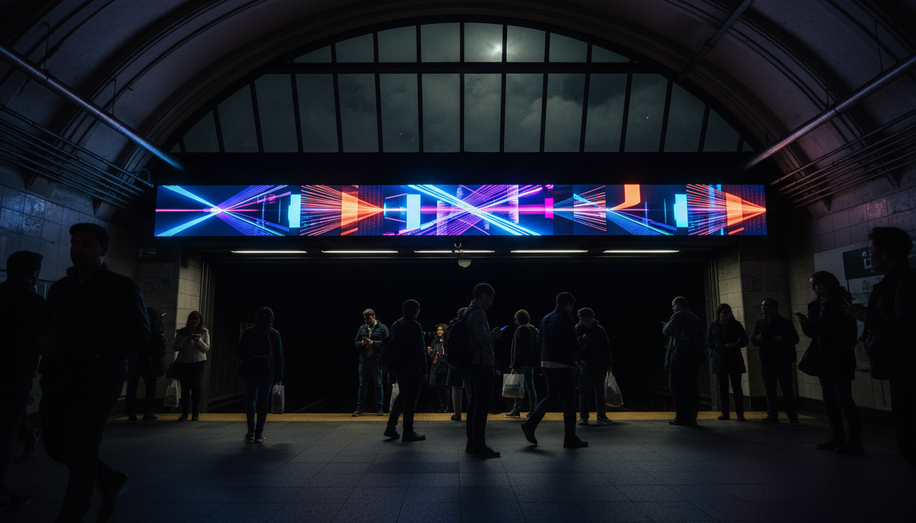
The digital revolution has fundamentally transformed how transit advertising operates and measures success. Beginning in the 1990s and accelerating through the 2000s, digital screens began replacing static posters at transit stations and inside vehicles. Today’s smart displays leverage GPS technology and location-based data to tailor advertising content in real time, enabling brands to display different messages based on geographic location or time of day. This technological sophistication has made transit advertising not merely visible but genuinely interactive, engaging commuters through dynamic content that responds to contextual variables.
Contemporary transit advertising reflects a convergence of physical and digital realms. Modern systems incorporate real-time performance tracking, allowing advertisers to measure campaign effectiveness with unprecedented precision. Interactive features transform passive viewing into active engagement, while data analytics provide insights into audience demographics and behavioral patterns. The standardization that once referred to card rack dimensions now encompasses technical specifications for digital displays and integration protocols across disparate transit networks.
The medium’s resilience stems from an unchanging core principle: transit advertising reaches people during moments when they are mobile, attentive, and receptive to messaging. Whether displayed on a streetcar in 1850, wrapped across a bus in 1990, or rendered on a smart display in 2026, transit advertising capitalizes on the convergence of movement, attention, and commercial intent. As transportation continues evolving—with autonomous vehicles, expanded metro systems, and emerging mobility solutions on the horizon—advertising will inevitably adapt alongside it, maintaining its position as one of the most effective channels for reaching audiences where they travel.
The article highlights how transit advertising has consistently evolved, leveraging technology to enhance reach and engagement. Platforms like Blindspot are crucial in this ongoing transformation, offering advanced programmatic DOOH campaign management, precise audience measurement, and real-time performance tracking that allow advertisers to navigate and optimize the complex, data-rich transit environment of today. This ensures brands can maximize their impact as transportation and advertising continue to converge and innovate. Learn more at https://seeblindspot.com/