
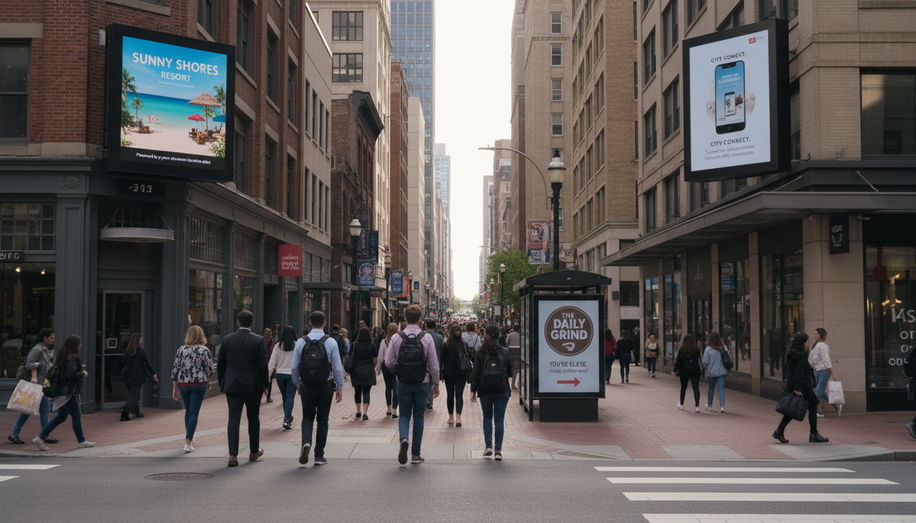

Location-based marketing has fundamentally transformed how out-of-home advertisers connect with consumers, shifting from broad-reach campaigns to hyper-targeted strategies that deliver messages precisely when and where audiences are most receptive. By integrating geofencing technology and real-time location data, brands can now guide entire purchase journeys while measuring impact with unprecedented accuracy, making location-based OOH a cornerstone of modern marketing effectiveness.
The foundation of location-based OOH success lies in understanding geofencing technology, which creates virtual boundaries around specific geographic areas to capture mobile device IDs via GPS. These geofences can be strategically positioned around high-traffic retail zones, competitor locations, or neighborhoods matching favorable demographic profiles. Once established, geofences enable advertisers to deliver targeted ads through multiple channels—banner notifications, in-app offers, text messages, and dynamic DOOH content that adapts in real-time to weather, time of day, or local events. This technological capability has driven adoption across the industry, with nearly 90% of digital marketers now incorporating location-based data into their campaigns.
The evidence supporting location-based OOH effectiveness is compelling. Geofencing boosts engagement rates by up to 30% and delivers a click-through rate of 4.39%, compared to just 0.7% for standard DOOH displays. Contextually relevant campaigns—those tailored to specific moments, locations, or weather conditions—demonstrate even stronger sales impact. When brands deploy location-aware messaging, sales increase by over 16% compared to environments without OOH media, substantially outperforming the 9% lift from standard DOOH campaigns. Brain imaging studies reveal the neurological basis for this success, showing a 32% increase in brain response when consumers encounter location-relevant ads.
Consumer behavior data underscores the practical value of location-based strategies. A significant 76% of respondents report that DOOH ads prompted them to take action, with common responses including restaurant visitation (36%), in-store purchasing (30%), and store visits (29%). Directional DOOH advertising proves especially powerful, with 51% of consumers who noticed such ads subsequently visiting the advertised business and 93% of those visitors completing purchases. These conversion rates demonstrate that location-based messaging doesn’t merely capture attention—it drives measurable business outcomes.
The integration of location data with DOOH also enhances overall campaign reach and frequency. According to the Location-Based Marketing Association, OOH campaigns increase website visits by 20% and sales by 10%. This measurable impact reflects the advantage of reaching audiences in their daily environments—commuting, shopping, socializing—where they’re already primed for brand engagement. Unlike digital channels increasingly plagued by ad-blocking technology, OOH reaches 90% of the U.S. population monthly, with 68% of adults actively noticing these advertisements.
For brands implementing location-based OOH strategies, success requires attention to data accuracy and strategic placement. Inaccurate location data can result in irrelevant messaging that diminishes campaign effectiveness, making precision critical. Equally important is continuous measurement and optimization. Forward-thinking marketers now track foot traffic changes, dwell times, venue visitation patterns, and brand lift metrics resulting from exposure to location-targeted billboards and transit advertising. This data-driven approach allows agencies to refine strategies in real-time and build stronger cases for campaign ROI.
Timing amplifies location-based messaging impact significantly. Consumers rate time-sensitive promotions featuring food, beverages, clothing, or special deals as highly useful, with 80% finding such offers valuable. When location-targeted messages arrive at the moment someone is near a relevant retail environment, decision-making friction decreases and conversion likelihood increases substantially.
As OOH advertising continues evolving from static to digital and programmatic formats, location-based targeting has become indispensable for brands seeking competitive advantage. By combining geofencing capabilities, real-time data, and contextually relevant creative, advertisers can transform outdoor media from passive impressions into active conversion drivers, creating seamless brand experiences that guide consumers through their purchase journeys with precision and measurable results.