
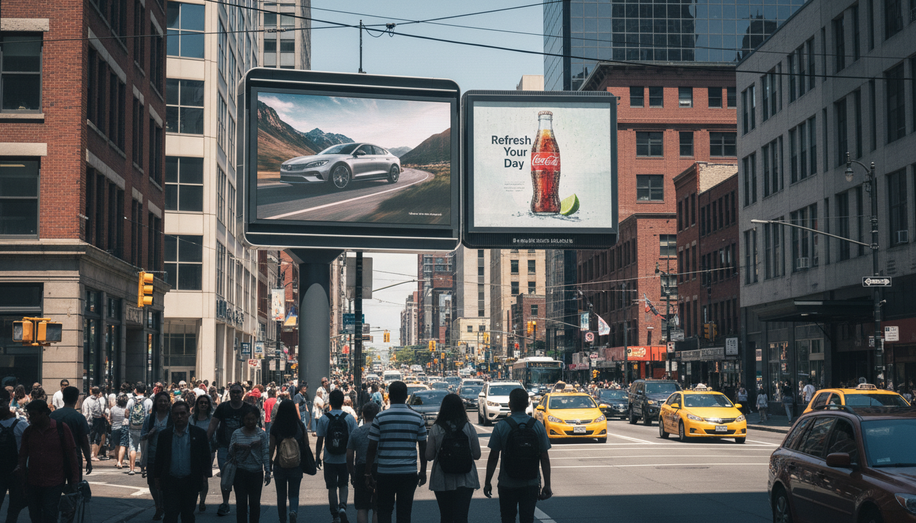

The intersection of traditional and digital billboard advertising has fundamentally transformed how brands capture attention in public spaces. Rather than viewing analog and digital formats as competitors, leading advertisers are increasingly recognizing that hybrid billboard campaigns—which strategically blend physical and digital elements—deliver superior engagement and measurable results compared to either approach alone.
The evolution toward hybrid advertising reflects a broader shift in out-of-home strategy. Traditional billboards offer permanence, constant visibility, and the ability to establish brand presence in high-traffic locations, while digital displays provide flexibility, real-time content updates, and the capacity to respond to external conditions. When combined effectively, these strengths amplify each other. Magnum’s recent 3D billboard campaign exemplified this fusion by pairing a digital installation with a branded bench positioned across the street, creating a physical touchpoint that extended the digital experience into the real world and encouraged passersby to pause and fully engage with the advertisement.
Interactive functionality represents one of the most compelling applications of hybrid advertising. Brands are moving beyond passive viewing by incorporating motion tracking, touch-activated elements, and augmented reality features that invite audience participation. Reebok’s Speed Test campaign in Stockholm deployed movement tracking technology on an interactive billboard that challenged pedestrians to sprint past the display while recording their times, transforming the advertisement into a participatory game with tangible rewards. Similarly, Gymshark’s shoplifting campaign cleverly combined real clothing items pinned to a digital display with hidden messaging that revealed progressive discounts as viewers physically removed items from the billboard.
The strategic deployment of multi-zone billboard layouts represents another dimension of this hybrid approach. According to digital signage experts, the most effective campaigns use a primary display zone for the main visual spectacle while reserving secondary zones for call-to-action elements such as QR codes or promotional offers. This design strategy bridges the gap between passive spectacle and active conversion, transforming impressive visuals into measurable marketing outcomes.
Environmental responsiveness has emerged as a sophisticated application of hybrid technology. Google’s partnership with The Hallway to promote Google Search across London exemplified this approach, with digital billboards that customized content based on real-time data—displaying weather updates, nearby landmark information, and restaurant suggestions that dynamically adjusted according to external conditions and user needs. This intelligence-driven advertising creates relevance that traditional static billboards cannot achieve.
Tech companies have particularly embraced hybrid innovation. Meta’s Quest 2 campaign at Piccadilly Lights during the 2021 holiday season leveraged the full curved surface of an existing digital screen to showcase virtual reality environments appearing to extend into physical space, capitalizing on the screen’s architectural properties while maintaining seasonal messaging timing. The campaign demonstrated how understanding a location’s physical characteristics—whether curved screens, L-shaped corner placements, or bustling transit hubs—enables advertisers to maximize the visual impact of hybrid campaigns.
The measurement and social amplification of hybrid campaigns represents a critical advantage over traditional advertising. Nike’s Air Max Day activation at Tokyo’s Shinjuku Station reportedly generated over 50 million combined social media video views globally during its one-week run, transforming a transit location with 3.6 million daily passersby into a digital phenomenon that extended far beyond the physical audience. This multiplier effect—where physical spectacle generates digital sharing—has become increasingly important as advertisers seek to maximize the reach of their outdoor investments.
Looking forward, the trajectory of hybrid advertising suggests that the integration of physical and digital elements will become standard rather than exceptional. Successful campaigns recognize that viewers inhabit both physical and digital spaces simultaneously, and the most effective advertising acknowledges this reality by creating seamless experiences that operate across both environments. As technology advances and measurement tools become more sophisticated, the sophistication of hybrid campaigns will likely increase, with advertisers continuing to discover new ways to fuse the permanence and presence of traditional billboards with the flexibility and responsiveness of digital displays. For outdoor advertising professionals, this evolution represents not a threat to traditional formats, but an an opportunity to enhance their effectiveness through strategic integration.