
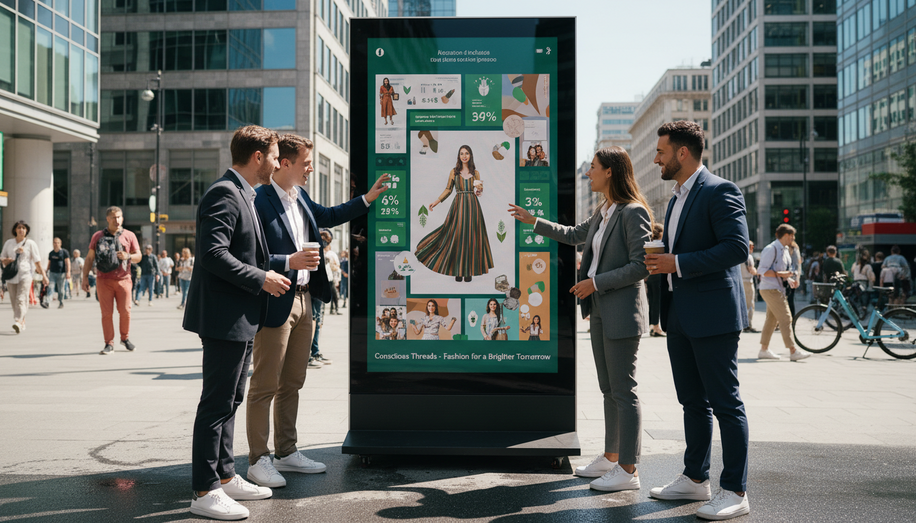

For a generation raised on smartphones and streaming, a poster on a wall is no longer enough. The most effective out-of-home campaigns today are not just seen; they are *used*, *played with* and shared. Interactivity has become the bridge between the physical city and the digital lives of younger audiences, turning traditional OOH into what many planners now describe as “dynamic experiences.”
Interactive formats span a wide spectrum, from simple touch screens to sophisticated motion‑tracking and augmented reality. At their core is the same idea: replacing one‑way broadcasting with a two‑way exchange that rewards participation. Agencies and brands increasingly treat the screen or structure as a live interface rather than a static canvas, building mechanics that invite passers‑by to tap, swipe, move, compete or co‑create content in real time. This shift aligns perfectly with the expectations of Gen Z and younger millennials, who are conditioned by mobile apps and gaming environments to expect feedback the moment they engage.
Touch‑enabled street furniture is often the entry point for brands testing interactivity. In stadiums and transport hubs, interactive kiosks and digital posters allow people to browse products, customise content or create shareable assets in a matter of seconds. At AT&T Stadium, for example, “Pose with the Pros” kiosks invited Dallas Cowboys fans to select their favourite players on a touch screen, then step into an augmented‑reality team photo that could be sent by email or shared on social platforms. The screen becomes both studio and distribution hub, turning a fleeting OOH impression into user‑generated content that continues to travel long after the fan has left the concourse.
Gamified experiences push this further by introducing challenge, reward and social status into the mix. Reebok’s Stockholm speed‑test billboard used motion‑tracking technology and a speed camera to challenge pedestrians to sprint past the screen; anyone who hit a target pace could win a pair of ZPump 2.0 trainers. The mechanics were simple, but the effect was powerful: the billboard effectively turned a city pavement into a game level, with the ad as the scoreboard. For younger audiences steeped in competitive mobile games, this type of OOH feels familiar, even irresistible.
Gamification need not rely solely on digital hardware. Some of the most striking campaigns blend physical elements with a reveal mechanic, rewarding people for “breaking” or changing the ad. Gymshark’s “shop lift‑ing” billboards pinned real garments to the creative and invited people to help themselves; as items were removed, a hidden message about an upcoming sale appeared underneath. Dogs Trust used plush toy puppies to similar effect, covering a traditional billboard with soft toys that could be taken away to reveal a hard‑hitting message about puppy smuggling. In both cases, interaction becomes a story: people physically alter the media, and the ad itself documents the impact.
Augmented reality adds another layer, using mobile devices or built‑in cameras to overlay digital content onto real‑world scenes. Pepsi Max’s famous London bus‑shelter takeover used a screen as a “window” to the street, inserting surreal scenes—UFOs, tigers, tentacles—into the everyday view. The result was not just a clever illusion but an experience people filmed, posted and discussed. AR‑powered OOH is particularly resonant for younger audiences already using filters and lenses on social apps; it extends a behaviour they know into public space, while the physical site gives the interaction a sense of occasion that a phone screen alone cannot.
Facial analytics and contextual triggers are also pushing interactivity into more personalised territory. GMC’s Acadia campaign used cameras and AI to determine basic demographics such as age and gender, then served one of 30 targeted creatives on a digital display. Weather‑triggered and location‑aware campaigns similarly adapt content to external conditions, ensuring that what appears on screen reflects the audience’s current reality. For younger consumers used to algorithmic feeds, this kind of adaptive OOH feels more like a live service than a static advert, reinforcing the idea that the environment “knows” and responds to them.
Crucially, interactive formats change how engagement is measured. Instead of relying solely on reach and estimated impressions, brands can track touches, dwell time, participation rates, game completions, photos captured or vouchers redeemed. Many experiences are designed with baked‑in social sharing—via QR codes, email capture or direct mobile integration—extending OOH’s value into digital attribution pathways. For marketers under pressure to justify investment to performance‑driven stakeholders, this data‑rich layer is as important as the spectacle itself.
Younger demographics respond strongly to experiences that offer agency, creativity and a sense of belonging. Campaigns that invite people to co‑create an image, test their skills, express a preference or unlock a hidden message tap into that desire to be more than an audience. Interactive and gamified OOH formats deliver exactly that, while giving brands a way to stand out in cluttered urban environments. The most effective executions tend to respect a few unwritten rules: keep the interaction intuitive, make the reward immediate, ensure the technology is robust, and design the experience so it is as compelling to watch as it is to play.
As cities grow smarter and screens more connected, interactivity is moving from novelty to expectation. The poster is evolving into a platform—a stage on which consumers, especially younger ones, expect to have a role. For brands willing to experiment with touch, motion, game mechanics and AR, OOH is no longer just out‑of‑home. It is out‑in‑the‑world: dynamic, participatory and built for an audience that refuses to sit still.