
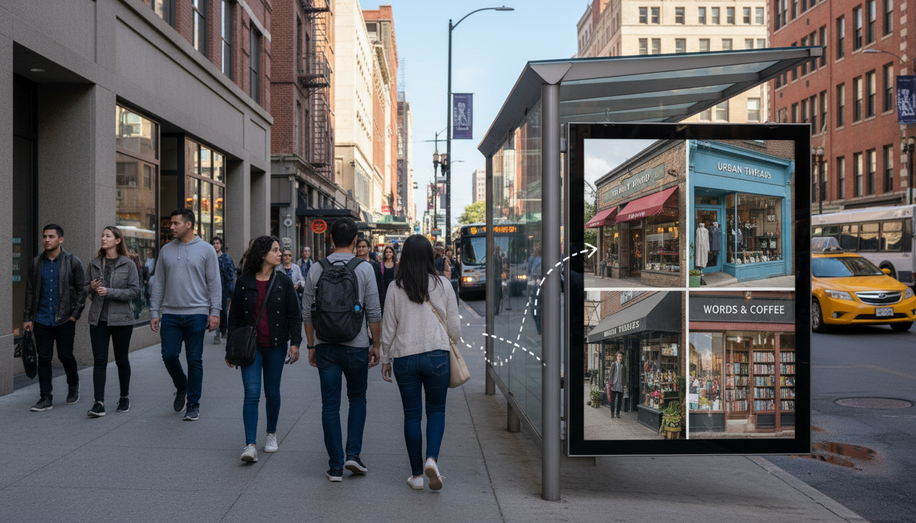

In the rush-hour ballet of buses, trains and streetcars, another quiet performance is unfolding: retail decisions being made in real time. Transit advertising, once treated as little more than moving wallpaper, is increasingly proving its power to shape where people shop and how often they step through a retailer’s door.
Unlike most media, transit environments offer a rare combination of dwell time and repetition. Commuters typically spend 45 to 60 minutes on public transit each day and more than 20 minutes a week in stations, often following the same routes again and again. This creates a captive audience that encounters the same creative multiple times over the course of a week, embedding brand cues and store locations into memory. By the time riders surface near a high street or shopping center, the gap between awareness and action can be a matter of a few steps.
The physical fabric of transit systems inherently overlaps with retail corridors. Hubs, business districts, university areas and shopping streets with heavy pedestrian volumes consistently deliver the strongest engagement for transit formats. Ads on shelters and vehicles effectively “escort” consumers along habitual paths: from residential neighborhoods into central business districts, past grocery stores, QSR chains and fashion retailers. For brands, these routes function like pre-defined shopper journeys, with transit media guiding attention at key decision points such as transfer stations or stops adjacent to malls.
At street level, the impact is increasingly measurable. The long-standing critique of out-of-home—that it is difficult to tie to real-world outcomes—is being dismantled by foot traffic analytics and offline attribution. Location-intelligence platforms can now identify audiences exposed to specific OOH assets, including transit placements, and track whether those devices later appear at defined retail points of interest. In practice, that means a campaign on buses serving a retail park can be linked directly to store visitation, not just impressions. When Panera Bread used offline attribution to measure a national broadcast campaign, analysts quantified a 4.5% lift in foot traffic tied to ad exposure; the same methodology is now being applied to OOH and transit to close the loop from creative to checkout.
The ability to connect transit exposure with store visits is reshaping how brands plan. Foot traffic data reveals not only where people move, but when and why. Retailers and media buyers are using these insights to map high-density trade areas, align routes with top-performing stores and identify opportunity gaps where visitation is strong but brand presence is weak. Peak-hour analysis can inform which lines to dominate during morning commutes to workplaces versus evening flows toward dining districts or entertainment zones. Transit becomes less a blunt-reach tool and more a precision instrument: the right message, on the right vehicle or shelter, at the moment shoppers are primed to detour or plan a future visit.
Travel behavior adds another layer of opportunity. Shopping is the second most common U.S. travel activity after visiting family, putting tourists and business travelers into an exploratory, spend-ready mindset. Transit ads placed around airports, rail terminals and visitor-heavy routes can function as navigational cues—essentially wayfinding for retail. For visitors unfamiliar with a city’s layout, a compelling message pointing to a nearby outlet mall, flagship store or dining cluster does more than build brand awareness; it offers a concrete plan for where to go next, driving incremental footfall that local media alone might miss.
The psychological mechanics at work are subtle but powerful. Repeated exposures along a commute create familiarity and social proof: if a brand is visible across the network, it feels established and trustworthy. Proximity messaging—“Two stops ahead,” “Around the corner on Main,” “In the food court above this station”—lowers perceived effort and friction. For value-driven shoppers, limited-time offers or dayparted creative can sync with commute patterns, nudging spontaneous visits on the way home. And because transit often reaches a broad, socioeconomically mixed audience, it can influence both planned stock-up trips and impulsive, high-margin purchases.
For brands looking to translate these dynamics into strategy, data is now the starting point rather than the postscript. Ridership and pedestrian counts help pinpoint which routes and stops intersect with a retailer’s best customers. Demographic overlays reveal whether those flows skew toward students, office workers, families or tourists, guiding creative and offer design. Foot traffic analytics then validate whether the media plan is performing, revealing which formats and locations are generating meaningful visitation lifts and which can be reallocated for greater ROI. The result is a feedback loop in which transit advertising and retail operations inform each other: campaigns drive visits; visit patterns inform future placements.
As urbanization continues and more daily life is mediated by shared mobility, the relationship between transit systems and retail ecosystems will only tighten. In that context, transit advertising is evolving from a peripheral branding channel into a lever on retail dynamics itself—shaping not just what people think of a brand, but where their feet and wallets ultimately go. For marketers intent on driving real-world outcomes, that shift makes the side of a bus or the wall of a station less an empty surface and more a critical, measurable touchpoint on the path to purchase.