
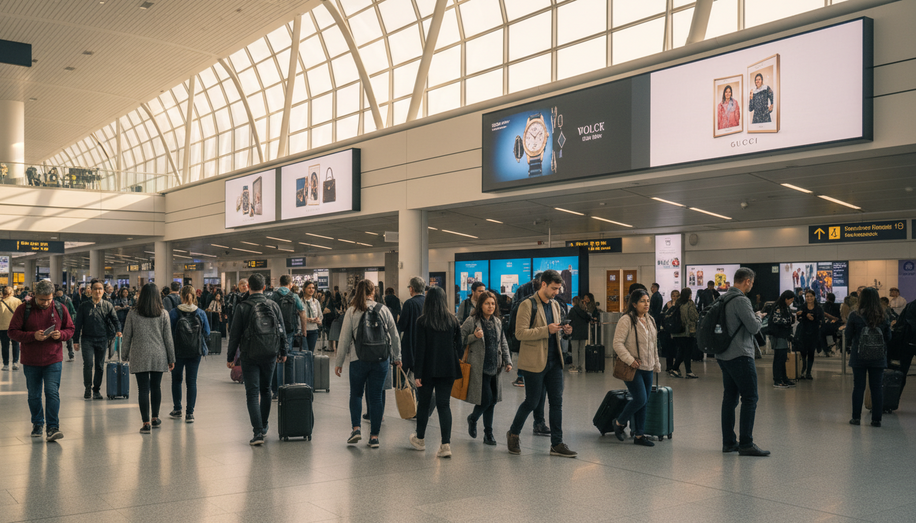

Once a backdrop of static posters and duty-free logos, airport advertising has transformed into one of the most dynamic, data-rich arenas in out-of-home media. As global passenger volumes surge back past pre-pandemic levels, brands are reappraising airports not just as transit spaces, but as high-intent marketplaces where affluent, time-rich travelers can be reached with precision and impact.
The core appeal has remained remarkably consistent: airports offer dwell time and scarcity of distraction. Unlike city streets where messages compete with endless stimuli, terminals are controlled environments where passengers queue, wait and wander. New research commissioned by Clear Channel Outdoor and conducted by Nielsen underscores just how attentive that audience has become. Among frequent flyers surveyed, 82% said they read airport ads, 61% recalled seeing them, and 57% took some form of action after exposure—a notable increase on 2022 figures. Parallel findings from the Out of Home Advertising Association of America report that 69% of flyers notice OOH ads in airports, and 87% of those who do take action, often by researching a brand online.
What is changing, rapidly, is how that attention is captured. The days when airport inventory meant backlit posters and a handful of digital screens are fading. Airports are investing heavily in large-format digital walls, immersive video corridors and architecturally integrated displays that turn walkways, check-in halls and baggage claims into canvases for brand storytelling. At Delhi Airport, for example, media operators highlight “iconic” terminals where digital walls and immersive corridors are designed to blur the line between infrastructure and experience. For advertisers, these formats enable cinematic creative, sequential storytelling and context-aware messaging that would be impossible on a static lightbox.
The shift is also technological behind the scenes. Programmatic digital out-of-home (pDOOH) is moving from pilot to default in many premium networks, including airports. Instead of buying fixed loops months in advance, brands can increasingly transact impressions based on audience profiles, time of day, or even real-time triggers such as weather, flight schedules or major events. A luxury brand might bid more aggressively when international long-haul flights are boarding, while a quick-service restaurant can weight spend toward peak mealtimes or delayed-departure windows. Advocates argue that this data-driven approach is “strategically dynamic and fundamentally accountable,” repositioning OOH—and airport media in particular—as a performance channel rather than a mere awareness play.
The traveler profile itself makes this evolution commercially attractive. Frequent flyers are disproportionately business decision-makers with higher disposable incomes and broader spheres of influence. The Clear Channel–Nielsen study notes that these travelers are significantly more likely to be technology and innovation decision-makers within their organizations, effectively doubling as both consumer and B2B targets. That duality is reshaping creative strategies: campaigns that once focused solely on luxury retail or tourism are now joined by enterprise software, fintech, and B2B tech brands vying for mindshare during layovers.
Interactivity is another frontier. As QR code usage has normalized post-pandemic, airports have become fertile ground for clickable physical media. In the latest Nielsen study, 45% of frequent flyers who took action after seeing airport ads said they scanned a QR code, a six-point rise from 2022. This bridges offline and online behavior, enabling instant product discovery, app downloads, loyalty sign-ups or personalized itineraries. Media owners report growing demand for creative that treats the terminal as a starting point for a longer-brand interaction, rather than a closed loop of exposure and recall.
Beyond QR codes, emerging technologies are pushing airport campaigns into experiential territory. Across OOH, 3D anamorphic and holographic displays are gaining traction at high-traffic hubs, creating “stop-and-stare” spectacles that often spill over onto social media. For airports, where architecture and wayfinding already guide passenger flows, these formats can be embedded into the built environment, creating photogenic landmarks that brands can temporarily own. Industry forecasts suggest that the next phase will bring sensor-based engagement and gesture control, turning passing travelers into participants who can explore content or customize experiences in real time.
This evolution coincides with a broader reimagining of the airport as a “sense of place” rather than a non-space. Many major hubs now see commercial partnerships, including advertising, as part of their identity-building strategy. Research shows that travelers respond positively to campaigns reflecting local culture: in the Clear Channel–Nielsen study, 88% of frequent travelers said they want to see ads from local businesses, 53% from local sports teams, and 48% from local educational institutions in their hometown airports. That appetite has encouraged brands to lean into localized creative—mixing global consistency with city-specific executions that acknowledge where the traveler is coming from or going to.
The net result is a medium that is simultaneously more premium and more pragmatic. On one hand, airports deliver uncluttered, brand-safe environments and high-impact canvases that appeal to marketers chasing fame. On the other, the growth of data analytics, programmatic buying and measurable calls to action speaks to a demand for accountability in every channel. For OOH specialists, this combination of scale, sophistication and receptivity is repositioning airport media as a strategic pillar in omnichannel plans, particularly for brands with international ambitions.
As travel demand continues to rise, with TSA screening record volumes and further growth forecast into 2026, the race is on to define what airport advertising looks like in its next chapter. The direction of travel is clear: fewer generic backdrops, more responsive platforms; fewer passive impressions, more participatory experiences. For brands willing to experiment at the intersection of place, data and design, airports are no longer just gateways to the world—they are becoming one of the most influential stages on which to meet it.