
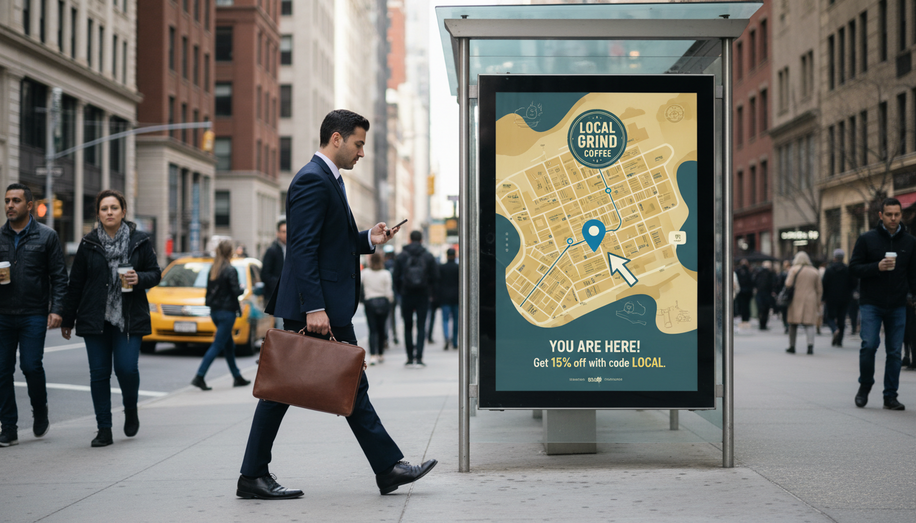

In an era when every screen can be personalized, out-of-home is undergoing a quiet revolution. Location marketing—once a blunt instrument built on traffic counts and broad demographics—is being rewired by geolocation data, enabling OOH campaigns that are not just visible, but contextually precise and locally resonant.
At the heart of this shift is the fusion of OOH with geo-targeting technologies such as geofencing and location intelligence. By defining virtual perimeters around real-world spaces—high streets, stadiums, transit hubs, retail parks—brands can trigger tailored messages on nearby digital screens and mobile devices as people move through those zones. Instead of planning only around static placements, marketers are now planning around *behavioural geography*: where people actually go, how often, and for what purpose.
Location-based targeting in OOH is no longer just about “right place, right time.” It is about understanding audiences through movement data and using those insights to shape both strategy and creative. Location intelligence platforms analyse footfall patterns, dwell time, and visit frequency to identify which panels, corridors or intersections truly over-index for a desired audience segment. This geo-behavioural lens is transforming site selection from media-owner availability to audience-first decisioning, elevating OOH from coverage medium to precision channel.
Digital out-of-home (DOOH) has been the catalyst. With dynamic screens connected to data feeds, advertisers can adapt content based on time of day, weather conditions, or local events inside a defined geofence. A coffee chain, for example, can push hot drink offers on cold mornings within commuting corridors, while a sports retailer can activate creative around a stadium footprint during match days, and switch back to generic brand copy when the crowds disperse. The same geofenced zones can also be used to trigger mobile ads, extending exposure beyond the moment someone glances at a screen.
This bridge between physical and mobile environments is where location marketing becomes especially powerful. Geofencing allows marketers to identify devices that have passed a billboard or street-level screen and then retarget those users later with complementary messaging on their phones. A consumer who sees a new SUV on a digital billboard might later receive a mobile ad offering a test drive at the nearest dealership, or directions to a local showroom. The result is an end‑to‑end journey in which OOH builds awareness and credibility, and mobile delivers personalization and action.
Proximity-based notifications push the idea further. When users opt into location services, brands can send timely prompts when people are in the vicinity of a relevant OOH placement or retail location. A passerby viewing a restaurant ad at a bus shelter might immediately receive a mobile voucher for a discount at that exact branch. These real-time, context-aware interactions turn traditionally passive OOH impressions into active triggers for store visits, app engagement or online search.
Importantly, this integration is transforming how OOH is measured. Historically, OOH accountability relied on modelled impressions and post-campaign brand studies. With geolocation data, marketers can now connect exposure to outcomes with far greater confidence. By tracking anonymized device movements after someone has been within viewable range of a DOOH screen, planners can attribute subsequent store visits, website sessions or app activity back to specific locations or creatives. Cross-channel attribution models are emerging that weigh the contribution of a single roadside panel or transit screen in driving downstream behaviour.
The data feedback loop is equally significant. Every geotargeted campaign generates a trove of insights: which locations produced the highest lift in store visits, which times of day drove the strongest engagement, how audience profiles shifted by neighbourhood or venue type. These learnings then feed back into future planning, enabling continuous optimisation of OOH placement, creative rotation and digital retargeting strategies. Over time, the network of locations itself becomes a kind of real-world dashboard of consumer intent.
For brands, the strategic implications are clear. First, OOH can no longer be treated as a silo. To fully exploit location marketing, OOH needs to sit at the centre of an omnichannel stack that includes mobile, social, search and CRM. Synchronising geo-targeted social media ads with OOH placements, for example, reinforces brand presence within a specific radius and creates a unified narrative across screens. Second, creative must evolve from generic, nationally uniform copy to modular, locally tuned assets that can flex by neighbourhood, language, cultural cues or even local competitors.
The technology underpinning location marketing is still advancing. The rollout of 5G, more accurate sensors and AI-driven analytics promises even more granular audience modelling and predictive capabilities. Emerging “ambient intelligence” systems can interpret environmental and behavioural signals in real time and recommend optimal content plays for each screen at each moment. In practice, that could mean DOOH networks that anticipate when a surge of likely shoppers is approaching a district and automatically switch to retail-focused messaging, while triggering complementary mobile ads to those same individuals.
Yet the future of location marketing in OOH will hinge not only on capability but on trust. As geolocation data becomes more central to media planning, advertisers will need to balance precision with privacy, relying on consented, anonymised data and transparent practices. The prize is substantial: campaigns that feel less like advertising and more like relevant, timely information tied to the places where people live, work and play.
For an industry built on the power of place, the integration of OOH with geo-targeting is less a disruption than a logical next step. As physical and digital environments continue to blend, the most effective OOH strategies will be those that treat location not just as a backdrop, but as the organising principle for how, when and where brands show up in consumers’ lives.