
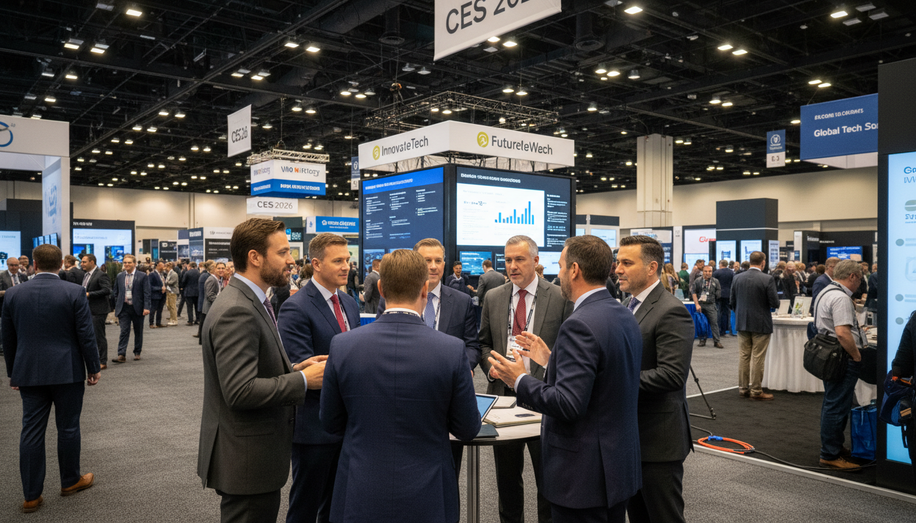

For all the neon and noise of Las Vegas, this year’s CES was defined less by spectacle than by a nagging, sober question: what kind of infrastructure does advertising actually need to survive the next wave of automation? In corridor conversations and closed-door suites, five themes kept surfacing: the plumbing required for agentic advertising, the stubborn power of live sports, the accelerating consolidation of agencies, the shifting economics of attention in an AI-first web, and the pressure on measurement to keep up.
Agentic advertising – autonomous AI agents planning, buying and optimizing media with minimal human intervention – was the obsession of the week. For years, AI at CES meant flashy demos and lofty decks; this year, it meant roadmaps, pilots and procurement. Marketers and adtech platforms alike were talking less about whether agents will take over parts of the media workflow and more about who controls the rails they’ll run on. That means identity infrastructure that can support machine-speed decisioning, standardized taxonomies for inventory and audiences, and interoperable APIs that let agents transact across channels rather than being trapped inside a single walled garden. The draw is obvious: agents promise to collapse weeks of RFPs, trafficking and optimization into minutes, and to ingest signals from retail media, CTV, social and OOH in one loop. But the fine print is what worried people in the suites upstairs: how to verify what an agent did, how to audit its logic for bias or brand safety breaches, and how to keep transparency from eroding as the buying brain moves further away from human hands.
Those conversations quickly turned from the glassy towers of programmatic to the concrete of infrastructure. If an agent is tasked with optimizing toward incremental reach among light TV viewers, does every publisher in the plan support the same log-level data? Can that data move into a clean room, be joined with retail signals and then be re-activated in near real time? Do SSPs and DSPs expose enough structured metadata on formats, locations, interactivity and context for agents to make smart decisions, instead of optimizing blindly to the cheapest CPM? For OOH operators, the question was even more physical: are networks ready to behave like API-first surfaces, with dynamic creative, real-time availability and proof-of-play stitched cleanly into omnichannel logs? The promise of agentic advertising is only as good as the pipes feeding it.
While the industry game-planned that future, the present tense of live sports was impossible to ignore. In a fragmented attention economy, live sports remained the one format everyone agreed still behaves like a cultural campfire. For streamers, leagues and brands, CES became a showcase for how far they can stretch that advantage: interactive overlays on connected TVs, shoppable moments synced to big plays, data-driven targeting that blends first-party fan data with household-level viewership patterns. Yet amid all the talk of interactivity, a note of restraint surfaced. Research shared on stage emphasized that viewers reward simple, low-friction interactions – think quick add-to-cart or “remind me later” prompts – and punish experiences that pull them out of the live moment. The lesson for advertisers was clear: in live environments, the job is to deepen engagement without stealing focus from the game.
This matters beyond TV. For OOH, live sports windows are increasingly being treated as omnichannel moments rather than siloed buys. Marketers spoke about syncing DOOH flights to tentpole matchups, using location data to identify fan hotspots and layering in mobile retargeting for fans leaving stadiums or sports bars. As agentic systems begin to orchestrate these moves, the key will be feeding them high-fidelity signals: live game schedules and triggers, venue and neighborhood profiles, and creative variations tuned to different fan cohorts. The enduring appeal of live sports gives advertisers rare reach; the work now is turning that reach into responsive, measurable impact across screens and streets.
If live sports was the emotional anchor of the week, agency consolidation was the structural undercurrent. With macroeconomic uncertainty still clouding the outlook, holding company leaders and independents alike framed consolidation as both cost discipline and a data play. Marketers, faced with proliferating retail networks, streaming platforms and AI tools, are pushing hard for fewer points of contact and cleaner accountability. In response, agency groups are knitting together media, creative, commerce and data units under tighter P&Ls, pitching “one brain” approaches that can supposedly interface more cleanly with brands’ own AI stacks. Private equity’s roll-up strategy was also very much in the air, with investors eyeing specialist shops in commerce, measurement and experiential to build scaled, AI-ready networks.
Yet consolidation is not just about headcount or logos on a slide; it is about who owns the connective tissue. As agentic buying gains traction, having fragmented teams and systems becomes a liability. Agencies that can present unified identity graphs, standardized taxonomies and a common operating system for experimentation are better positioned to tune and supervise clients’ agents. Those that cannot risk being relegated to brief-writing while algorithms and platforms do the actual trading. That in turn raises uncomfortable questions about talent: what skills do planners and buyers need when agents are handling line-item optimization? The emerging answer focuses on system design, scenario planning and governance – areas where agencies can still claim a strategic edge.
Hovering over all of this was the uneasy reality that AI-based search and content generation are draining oxygen from the open web and, by extension, from many of the publishers and data sources the ad ecosystem has long relied on. CES sessions and hallway chats circled the same concern: if traffic to independent publishers continues to erode, where will the diversity of content – and the diversity of signals – come from? The industry’s response is fragmenting into experiments: tighter alliances between retailers and media owners, more investment in creator-led properties, and renewed interest in OOH and experiential as sources of proprietary, real-world data. For advertisers, the question is how to build durable, privacy-safe signal graphs that do not depend solely on a handful of giant platforms or a single mode of discovery.
That loops back to measurement, the fifth thread tying so many debates together this year. Closed-loop reporting from retail media networks and streaming platforms looks attractive on paper, but marketers complained of wildly divergent methodologies and incompatible definitions of success. In a world where agentic systems are constantly testing and reallocating spend, noisy or incomparable feedback loops are more than an annoyance; they are a risk to capital allocation. The push at CES was toward more honest, interoperable incrementality frameworks and shared standards for how exposure, attention and outcome are defined and logged. OOH and experiential players, once peripheral to these measurement debates, now find themselves in the spotlight, under pressure to integrate with the same attribution and experimentation frameworks that govern digital channels.
Taken together, these five conversations reveal an industry that is both anxious and oddly optimistic. The tools on display in Las Vegas made clear that advertising is about to be reshaped by agents, data and automation at a far deeper level than previous waves of “programmatic” ever achieved. But they also underscored a more old-fashioned truth: without solid infrastructure, clear measurement and compelling cultural moments – like a big live game lighting up screens and billboards worldwide – even the smartest agents will have nothing worth optimizing.