
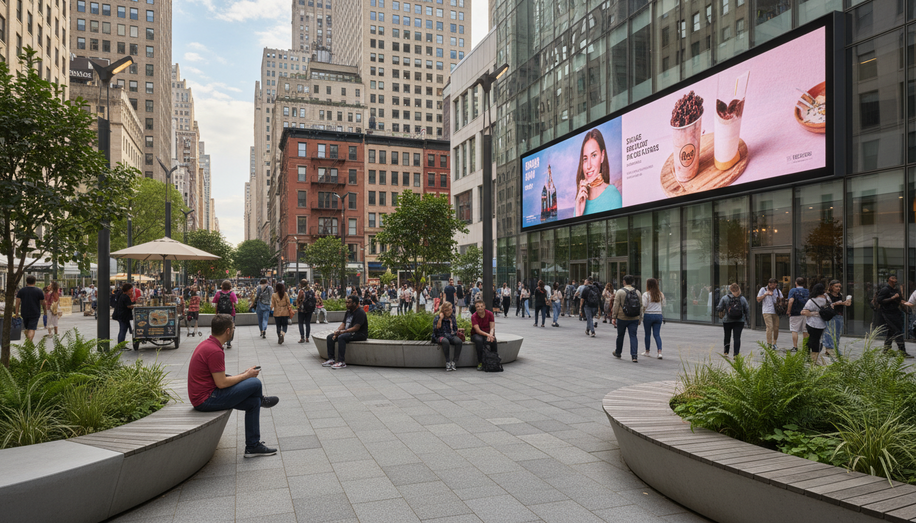

In cities around the world, the old argument that billboards are visual clutter is giving way to a more nuanced question: what if outdoor advertising could help make streets better places to be? As urban planners rethink public space in the wake of rapid densification and changing mobility, the intersection of urban design and out-of-home (OOH) media is emerging as a test case for how commercial interests can coexist with civic ambition.
The shift starts with the hardware itself. In the past, billboards were simply bolted onto whatever wall or gantry was available, often ignoring scale, sightlines and local character. Contemporary schemes in cities such as London, Paris and Dubai instead treat advertising structures as pieces of urban infrastructure in their own right: bespoke to their context, aligned with surrounding architecture and, increasingly, required to deliver a public benefit. Climate‑controlled bus and metro shelters in Dubai, funded through media contracts, double as comfort upgrades for transit riders and as architectural markers of the city’s futuristic brand.
This model of “media as street furniture” is spreading. Digital OOH (DOOH) screens are being built into kiosks, transport hubs and public squares in ways that prioritize both function and form. Because content can be changed instantly, a single display can serve as an emergency alert system, a wayfinding tool, or a cultural noticeboard between commercial spots. In theory, that flexibility allows local authorities to negotiate harder for civic uses—real‑time transport information, public health messages, weather and air‑quality data—while advertisers benefit from timely, context‑aware campaigns.
Urban planners argue that when these structures are designed properly, they do more than generate rent; they contribute to the identity of a place. Bespoke frames, materials and lighting schemes can echo local heritage or a district’s future‑facing ambitions. Research on urban advertising and landscape quality stresses the importance of readability, proportionality and harmony with other elements of the streetscape, from façades to trees to benches. Coherent design guidelines—covering height, typography, color and placement—can turn once‑chaotic corridors into legible, even distinctive, urban rooms.
There is also a sustainability story. Utrecht’s now‑famous “bee‑friendly” bus shelters, topped with green roofs above advertising panels, were designed to encourage biodiversity and manage stormwater while still delivering media inventory. At night, “Dark Sky” initiatives in cities such as Sydney and Hong Kong are prompting a re‑think of how illuminated ads use light, with stricter controls on brightness and direction to limit light pollution and protect nocturnal ecosystems. Digital displays, often criticized for their energy use, are gradually adopting more efficient LED technologies and smarter dimming systems that reduce consumption and glare.
Yet the promise of OOH as a tool for public‑space revitalization is shadowed by a persistent risk: visual pollution. Studies on cityscapes warn that an excess of outdoor ads can erode a neighborhood’s unique identity, contribute to stress, and amplify perceptions of inequality when aggressive commercial messaging dominates poorer districts. In some commercial centers, “no wall empty of advertising” is still the rule, overwhelming architectural features and confusing the visual hierarchy that helps people orient themselves in the city. Advocacy groups have gone further, arguing that giant digital billboards near roads and junctions are not only intrusive but potentially unsafe distractions.
The policy response in leading cities has been to move away from ad‑by‑ad permitting and toward integrated frameworks that treat media as one component of urban design. Singapore’s advertising controls and Amsterdam’s design policies, for example, set location, format and content standards in relation to broader goals around livability, heritage protection and mobility. The aim is not blanket prohibition but optimization: reducing the number of sites while improving their quality, ensuring lines of sight, and concentrating large formats where they reinforce rather than undermine the urban experience.
Data is becoming another point of connection between OOH and urban planning. Networked screens can capture anonymized information on traffic flows and pedestrian behavior, creating feedback loops that help transport agencies and planners refine crossings, signal timings and even land‑use decisions. For advertisers, that same data enables more accurate audience measurement and better campaign planning. For cities, it opens the door to performance‑based contracts where media operators are rewarded not only for impressions but for maintaining safe, attractive and well‑used public spaces.
Local economic development rounds out the equation. Digital advertising networks give small businesses relatively low‑cost access to professional‑grade media, with the ability to rotate creative based on time of day or season. When combined with thoughtfully branded wayfinding and neighborhood‑scale signage, this can strengthen a district’s commercial ecosystem and sense of place simultaneously. Municipalities, in turn, can channel media revenues into streetscape upgrades, parks, lighting and maintenance, creating a tangible link between what residents see on a screen and the quality of the public realm around it.
The emerging consensus among progressive planners and media owners is that the debate is no longer “advertising or aesthetics” but conditions and design. Where outdoor media is limited, coordinated and context‑sensitive, it can fund infrastructure, deliver information, and contribute to a city’s character. Where it is uncontrolled and purely extractive, it undermines the very environments that make advertising valuable in the first place. The next generation of contracts, guidelines and collaborations will determine which path cities follow, and whether the glowing surfaces of OOH become symbols of a more vibrant public realm—or reminders of an opportunity missed.