
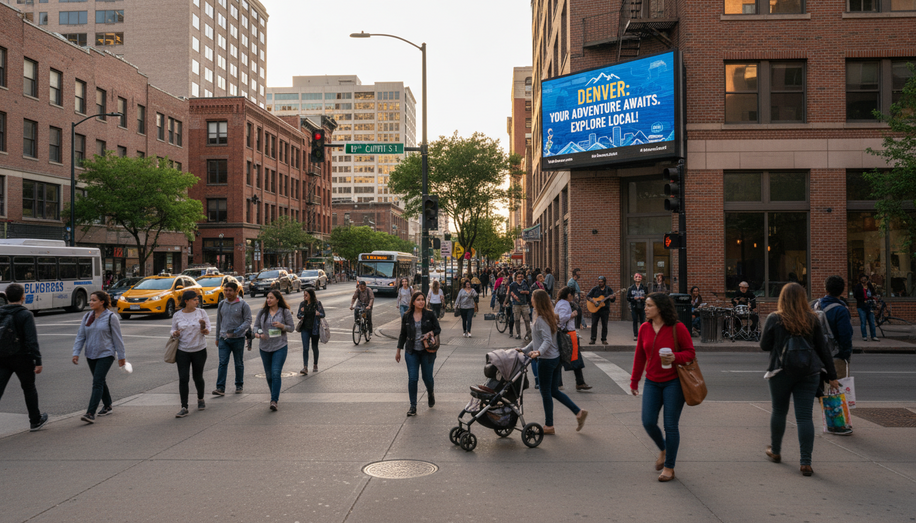

On a busy corner in a revitalized neighborhood, a digital billboard doesn’t just push a national slogan; it shows directions to a nearby café, a countdown to the local football kick-off and a weather-triggered offer for umbrellas at the shop across the street. This is location-based advertising at its best: not background noise, but part of the fabric of local life.
For brands investing in out-of-home, the shift from mass reach to *meaningful* reach is being powered by data, digital screens and precision location tools. Instead of buying generic impressions, marketers are now able to buy context – serving campaigns that respond to where people are, what they’re doing and what’s happening around them in real time. The result is OOH that feels less like advertising and more like a service.
At the core of this evolution is the ability to anchor creative to specific places and behaviors. Classic OOH has always been inherently location-based – a poster at a bus shelter or a banner on a lamp post reaches people who live, commute or shop nearby. The difference now is the granularity: geofencing, device ID data and programmatic buying allow brands to define audiences by the streets they walk, the venues they visit and even the weather they experience. Location, once a blunt instrument, has become a fine-tuned signal.
Community engagement is where that signal really pays off. When an OOH campaign acknowledges local rituals, landmarks and anxieties, it earns more attention and goodwill than a one-size-fits-all national message. Rain-X, for example, used weather triggers to activate digital out-of-home only when it was raining, with placements near retailers that stocked the product. The timing and placement made the creative feel like a helpful reminder rather than a random pitch, and tied the brand to a very familiar local experience: getting caught in a downpour on the way to the shops.
Food and beverage brands have been particularly quick to exploit this intersection of place, time and need. Aperol ran a campaign that only switched on in “summer cocktail weather,” with screens positioned near social hubs and high foot-traffic areas. By syncing creative with both temperature and the types of venues people were already heading toward, the brand latched onto spontaneous moments of sociability in specific neighborhoods. Meanwhile, QSR chains like Church’s Texas Chicken have used location-based targeting and device ID passback to reach people across a mix of outdoor venues and then retarget them on mobile, driving measurable visits to nearby stores. These campaigns show how OOH and mobile can work together to turn community presence into footfall.
Proximity tactics are also becoming more sophisticated. What started as simple conquesting – like placing a geofenced campaign around a rival coffee shop or a local high school – has matured into multi-layered strategies that consider both physical and cultural proximity. Hardware retailer B&Q ran dynamic OOH that changed with the local weather, pushing BBQs when the sun shone and switching to more utilitarian products when conditions worsened. Guinness used digital billboards in London not just to advertise the Six Nations, but to guide fans to nearby pubs showing the matches, dynamically updating directions and kick-off times and even redirecting people when a venue got too full. In both cases, the screen became a kind of neighborhood concierge.
The same principle applies in transit and place-based environments. Transit hubs, from train stations to airports, remain some of the most powerful community touchpoints because they aggregate local and visiting audiences with shared intents. The Financial Times used digital billboards at Heathrow Terminal 5 to target only passengers traveling to specific US cities, drawing on live flight data. It was an ultra-local message in a global setting, tailored to a temporary “community” of transatlantic travelers moving through a single terminal. Place-based networks in cafés, gyms, cinemas and campuses take this even further, allowing brands to speak directly to micro-communities defined by lifestyle as much as geography.
To make location-based OOH resonate, however, brands must do more than plug in a few data feeds. The campaigns that stand out share three traits. First, they are rooted in a clear understanding of local behavior – where people gather, how they move and what they care about in that area. A geofence around a library for a bookstore, a playground for a pediatric office or a car dealership for an insurer only works because it mirrors real-world patterns of need. Second, they use dynamic content sparingly but smartly, changing messages based on triggers like weather, time, crowding or events in ways that feel intuitive rather than gimmicky. Third, they connect OOH to other channels, especially mobile, so that exposure on the street can be reinforced with offers or information later on.
Measurement is increasingly closing the loop between location-based strategy and community impact. By logging anonymized device IDs when people pass an OOH site and matching them to subsequent store visits, brands like O2 and Church’s Texas Chicken have been able to quantify how many viewers became customers. These same techniques can be repurposed to understand which neighborhoods respond best to certain creative messages or formats, helping marketers tailor future campaigns to local tastes and expectations.
As cities become more data-rich and screens more ubiquitous, the risk is that location-based OOH becomes hyper-targeted but emotionally thin. The real opportunity lies in using these tools to listen as much as to speak: to notice how a community uses its spaces, what events define its calendar, what weather patterns shape its routines. Brands that build campaigns around those lived realities – that help fans find a pub, commuters dodge the rain, neighbors discover a local event – will find that location-based advertising is not just about reaching people where they are, but about showing that they belong there too.
Blindspot directly empowers brands to navigate this complex landscape, offering the precision location intelligence and programmatic DOOH capabilities to craft dynamic, community-centric campaigns that genuinely resonate. By leveraging its audience measurement and ROI attribution tools, marketers can not only understand local behaviors but also quantify the tangible impact of their hyper-local engagement, proving the value of becoming part of the community fabric. Learn more at https://seeblindspot.com/