
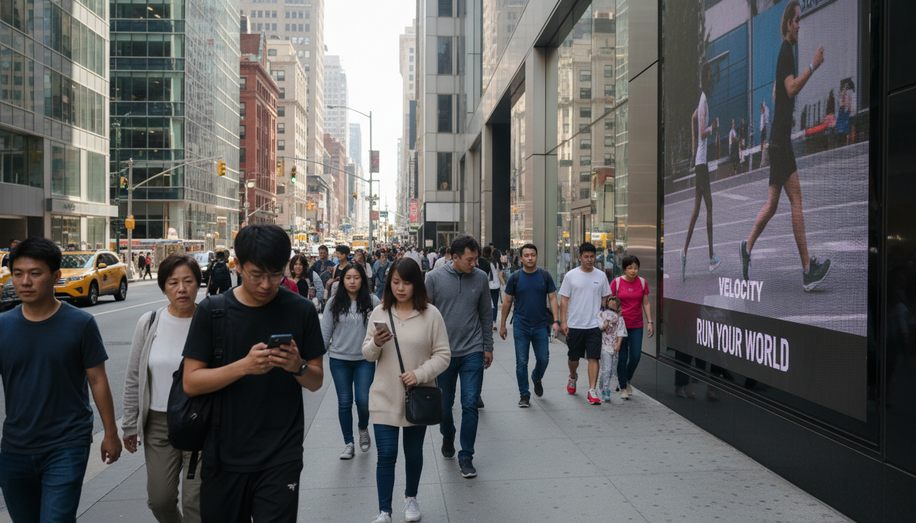

As programmatic digital out-of-home matures, the industry is discovering that the biggest factor shaping its future is not screen hardware, creative formats or bid strategies, but privacy. The same data signals that allow brands to buy DOOH impressions in real time, based on who is likely nearby and what they are doing, are raising fundamental questions about how, when and whether individuals are being tracked.
The tension is easy to describe and harder to resolve. Programmatic DOOH promises the holy grail of mass reach with digital-style precision: dynamic ads that react to audience movement, time of day, weather, traffic flows and even aggregated mobile data. To get there, networks, SSPs and DSPs want richer datasets and finer-grained audience segments. At the same time, regulators in Europe, North America and beyond are tightening rules on data collection and use, with frameworks such as GDPR and CCPA turning opaque profiling into a legal and reputational minefield.
Compared with online and mobile, DOOH has historically been seen as a privacy-friendly channel. There are no cookies on a billboard, and most campaigns are bought against location and contextual criteria rather than named individuals. But the rapid spread of programmatic pipes, Wi-Fi and beacon analytics, mobile location partners and computer-vision sensors has changed the equation. When a roadside screen is triggered by a probabilistic model derived from mobile ad IDs, or a mall display changes creative based on age and gender estimates from a camera, the distinction between “anonymous” and “personal” data begins to blur.
That ambiguity is now one of the central challenges for programmatic DOOH. Across the broader programmatic ecosystem, privacy and identity limitations have already disrupted long-established practices such as cross-site tracking, frequency capping and granular attribution. As third-party cookies and mobile identifiers recede, advertisers are being pushed toward first-party data, clean rooms and privacy-preserving IDs. In DOOH specifically, operators are grappling with how to integrate these emerging identity solutions in a way that respects the public, physical nature of the medium and avoids creating the sense that streets and transit systems have become surveillance networks.
Regulators and consumers are also demanding far more transparency. GDPR, CCPA and similar laws require clear disclosure of what data is collected, on what legal basis, for what purpose and for how long. In pDOOH, the data often flows through a complex chain of location providers, publishers, SSPs, DSPs and measurement vendors. The IAB has flagged transparency of spend, data collection methodologies and fees as a key concern as programmatic DOOH evolves. Without clearer standards and disclosures, brands risk being held responsible for opaque practices several steps removed from their own teams.
Despite these pressures, the industry is starting to map out viable strategies for reconciling targeting with privacy. A first pillar is genuine anonymization and aggregation. Many DOOH networks are leaning into sensor and mobility data that describe crowds and patterns, not identifiable people: for example, counting passersby to adjust creative or dayparting based on audience density, or using aggregated, privacy-screened mobile location data to model the likelihood that certain audience segments are present, without ever exposing individual device paths. When properly implemented, this allows for sophisticated audience buying while keeping data at a non-identifiable level.
A second pillar is contextual and environmental targeting. Rather than chasing individuals, advertisers can let the context do much of the work: tailoring creative to the venue type, surrounding retail mix, local events, weather or traffic conditions. The programmatic layer then optimizes bids and rotations in real time based on those signals, sidestepping some of the most sensitive forms of behavioral tracking. As cookie-based tactics erode online, contextual relevance is reclaiming ground across channels, and DOOH is well positioned to benefit.
On the technical side, new privacy-first identity frameworks are emerging that may give pDOOH buyers more precision without exposing people to persistent tracking. In the broader programmatic market, telco-backed, consented IDs and transaction-level pseudonymous IDs are being used to verify audiences and activate first-party segments behind strict firewalls. Applied carefully to DOOH, these kinds of systems could enable campaign planning, frequency management and cross-channel attribution based on obfuscated identifiers that never resolve to a natural person and expire rapidly after use.
None of this works without robust governance. Programmatic advertisers are under pressure to encrypt sensitive data such as location, limit access, and ensure that any partner handling consumer information has strong data integrity practices and security controls. Many are appointing privacy officers, rewriting contracts with data suppliers, and instituting training and internal audits to align their DOOH buys with corporate and legal standards. For operators, codifying privacy-by-design principles—from default aggregation thresholds to on-device processing for cameras—can be a differentiator in pitches to major brands.
Ethically, DOOH finds itself in a delicate position. Screens occupy public, often unavoidable spaces, which means people may feel they have less choice about exposure than they do online. That heightens the responsibility to avoid covert data capture and to communicate clearly when any form of audience measurement or targeting is in play. Some networks have begun experimenting with on-site signage and privacy notices, as well as publishing plain-language explanations of their data practices, as a way to build trust with municipalities and the public.
The commercial upside of navigating this correctly is significant. Programmatic DOOH is routinely cited as one of the growth engines of the OOH sector, thanks to its ability to plug into omnichannel buys, respond instantly to conditions and deliver clearer metrics. But growth will be constrained if agencies and brands fear that every location-based trigger is a potential headline risk. By investing in privacy-preserving data strategies now—aggregated analytics, contextual triggers, privacy-first IDs, robust governance—the industry can keep pushing toward smarter, more responsive campaigns without crossing the line into surveillance.
In that sense, data privacy is not an obstacle to programmatic DOOH’s evolution but the framework that will determine how far, and how fast, it can go. The players that treat privacy as core infrastructure rather than a compliance afterthought are likely to be the ones still standing when the next wave of regulation and consumer scrutiny arrives.