
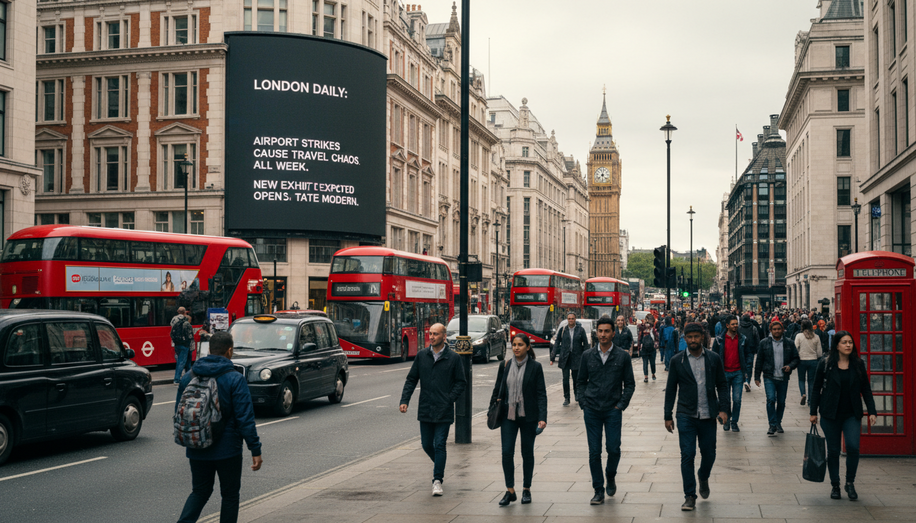

On a congested commuter artery, the weather shifts from drizzle to a sudden downpour. Within seconds, the digital billboard ahead swaps out a generic sedan ad for creative showing wipers dancing across a windshield, paired with a “rain‑ready” finance offer expiring at midnight. No one on the road sees a software update; they just see a message that feels timely and oddly relevant. That gap between invisible data infrastructure and visible human impact is where real-time content delivery is rapidly redefining out-of-home.
Digital OOH has long promised flexibility, but the integration of live data feeds, APIs and automation is turning that promise into a practical, scalable media tactic. Digital billboards now routinely pull in time, temperature, traffic, event and even social data to adjust creative on the fly, replacing one-size-fits-all loops with contextual messaging that shifts by minute, neighborhood or condition. The result is a medium that behaves less like a static poster and more like a responsive channel, capable of meeting people in their actual moment, not just their modeled demographic.
At the core is the evolution from simple scheduling to dynamic and conditional content. Early digital OOH innovation focused on dayparting—breakfast vs. drive-time vs. late night. Now, content management platforms let advertisers build template-based creatives that automatically populate with live inputs: countdown clocks to a sale or kickoff, time-and-temperature modules, or RSS-style feeds for news and sports scores. Conditional logic sits on top of those feeds, triggering specific creatives only when set criteria are met: a cold-weather coffee offer when the temperature dips below a threshold, or a traffic-triggered message when congestion spikes. Once the rules are set, campaigns self-orchestrate in the background, constantly re-optimizing to the world outside the screen.
For brands, the most immediate benefit is contextual relevance, a trait that consistently correlates with higher attention and recall. Digital billboards already stand out in the visual noise—Nielsen reports three out of five consumers noticed a digital billboard in the past month—but relevance is what turns noticing into remembering and acting. When a restaurant rotates creative to match dayparts and mindsets—breakfast in the morning, grab-and-go at lunch, comfort food at night—it is using the same screen more efficiently, aligning creative with what the audience is likely thinking about at that exact moment. Add weather, traffic patterns or event schedules, and a single face can host dozens of nuanced executions over a week, each tailored to its conditions rather than locked into a static buy.
Real-time data also sharpens media performance and ROI. Digital formats already eliminate printing and installation costs and allow remote, near-instant creative swaps. Layering dynamic content on top means marketers can push short-lived, time-sensitive offers that would never justify a static print run: a flash sale counting down on-screen, tickets remaining for tonight’s concert, or a “tune in now” message scheduled precisely to coincide with kickoff. When campaigns can pivot mid-flight—adjusting offers by inventory, pausing underperforming messages, or swapping in creative that responds to an emerging news story—OOH moves closer to the agile optimization that marketers expect from digital channels, without sacrificing the reach and stature of large-format displays.
The creative canvas itself is also expanding. Modern digital billboards support video, animation and HTML-based content, enabling sequences and micro-stories rather than single frozen frames. Dynamic widgets bring in live news, social feeds or weather in branded skins, keeping displays feeling fresh while reinforcing brand association with timely information. Interactive layers—QR codes, NFC, motion sensors—bridge OOH with mobile, allowing passersby to unlock offers or dive deeper on their phones. For advertisers, every scan or interaction becomes a signal, feeding back into campaign analytics and informing the next wave of creative and targeting.
Perhaps the most significant strategic shift is how real-time messaging repositions OOH within broader data-driven media plans. Instead of buying billboards solely on traffic counts and zip codes, planners are increasingly using mobility, purchase and behavioral data to identify high-value locations, then using dynamic creative to tailor what appears on those assets throughout the day. A screen outside a stadium can pivot from pre-game hype to real-time scores to rideshare offers as the crowd disperses; a panel near a shopping district can swap from brand storytelling in the morning to price-focused retail messages during evening commerce peaks. The physical location stays constant, but its narrative role within the customer journey changes hour by hour.
For all its promise, real-time content delivery does introduce new demands. Creative teams need to design for systems, not single files—building modular templates, defining data fields and logic, and planning for edge cases where feeds fail or conditions overlap. Operations teams must ensure data privacy, uptime and brand safety, particularly when tapping into user-generated or social content. Measurement frameworks must evolve to link on-the-go exposures with downstream actions, whether that is store visitation, site traffic or code redemptions. But as platforms mature, much of the complexity is moving under the hood, leaving buyers to interact with intuitive rule-builders rather than raw data streams.
What is clear is that dynamic, real-time content is no longer a fringe experiment; it is quickly becoming table stakes for digital OOH. As audiences grow more accustomed to personalized and context-aware messaging in their phones and feeds, they will expect physical media to feel just as timely. For marketers, the question is shifting from whether to integrate real-time data into billboard creative to how aggressively to lean into it—and how to align that responsive canvas with the rest of their omnichannel storytelling. The brands that get there first will be the ones whose messages feel less like ads on the side of the road and more like part of the world people are already navigating.