
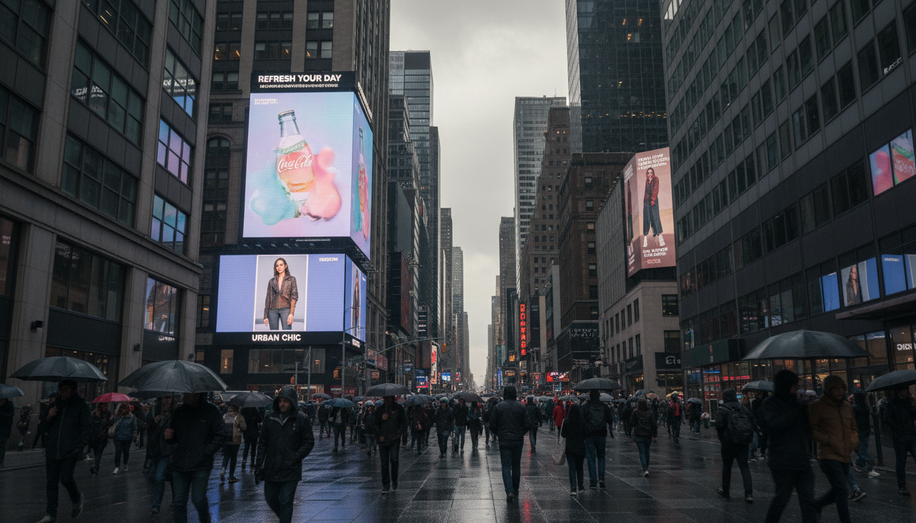

Weather has always been the silent media planner in out-of-home. It shapes footfall, alters travel patterns, affects mood and, ultimately, determines how long people look at a screen or poster – and how ready they are to act on what they see. For OOH advertisers, treating weather as a core data signal rather than an uncontrollable backdrop is increasingly the difference between wasted impressions and measurable uplift.
The most immediate impact is on audience movement and dwell time. Mild, pleasant conditions push people out of homes, cars and malls and into parks, streets and transit hubs, increasing total impressions and the time available to absorb an OOH message. In contrast, heavy rain or extreme heat can drive audiences underground or indoors, reducing roadside exposure while boosting traffic in covered transit hubs, shopping centres and petrol stations. Advertisers that still buy “average” reach based on historic traffic alone risk misaligning their spend with where people actually are on any given day.
Weather also changes *who* is out. School holidays in a heatwave skew audiences towards families in leisure zones; a snowy weekday morning may favour commuters over shoppers. These shifts in audience composition matter for categories like fashion, quick-service restaurants and tourism that depend on specific demographics. By layering historical and forecast weather data on top of location analytics, OOH planners can choose formats and environments that fit not only likely volumes, but the likely mindset of those passing by.
That mindset is strongly mood-driven. Research cited by The Weather Company indicates people are significantly more positive on sunny days, with up to three times more excitement and more than double the happiness compared with rainy days. Brain regions linked to engagement and detailed memory are more active, and ad detail recall rises when the message aligns with that weather-driven mindset. In practice, that can mean aspirational, discovery-led creative on bright days and more functional, comfort-oriented messaging when conditions are harsh.
Digital OOH is where these insights are translating into hard performance gains. Weather-triggered campaigns—where ad delivery or creative variants are activated only under specific conditions—consistently report sales lifts and efficiency gains. A weather-responsive campaign for Stella Artois Cidre delivered a 65.6% year-on-year sales increase while cutting wasted impressions by as much as 50%, because ads only ran when conditions were optimal for cider consumption. Another campaign using “weather specific” creatives outperformed generic ads across engagement metrics; users exposed to hot-weather-tailored messaging were 89% more likely to click a link and 50% more likely to interact with the brand page, with cost per click 67% lower than generic alternatives. Even when delivered through offline OOH screens, weather-triggered signage has driven double-digit gains, including a 34% uplift in web traffic and 17% sales increase during the active period for one retailer.
Behind these results sits a simple mechanism: relevance. Platforms now plug real-time weather APIs into programmatic DOOH, rotating creative from pre-loaded libraries as conditions change. A coffee shop can serve “Warm up with a latte” executions only when temperatures drop below a threshold; a car wash might push promotions after rainfall; a sunscreen brand can bid more aggressively when UV levels spike. This improves both media efficiency—ads run when they are most likely to influence purchase—and consumer perception, as messaging “fits” the moment in which it is seen.
However, weather impacts more than behaviour; it affects the medium itself. LED and LCD displays face visibility and performance challenges across temperature and precipitation extremes. At low temperatures, some displays respond more slowly, making motion content less fluid and potentially reducing the impact of dynamic video. Rain, fog, snow and heavy cloud cover can severely reduce readability, and in poor conditions drivers are understandably less willing to divert attention from the road, shrinking the effective window for message processing. This places a premium on high-contrast design, short copy and robust hardware with appropriate brightness, moisture protection and maintenance regimes to ensure legibility in bad weather.
Strategically, the most advanced OOH advertisers are now building weather into the full campaign lifecycle. During planning, historical climate patterns guide which formats to prioritise in a given city: more sheltered or transit-based inventory in regions with frequent rain or extreme heat, and pedestrian-heavy street furniture in milder climates. Seasonal norms are overlaid with sales data to identify thresholds—temperature, humidity, UV index or even pollen count—that correlate with demand spikes for specific products. These thresholds then become triggers for both buying and creative.
During activation, dynamic content rules allow networks to swap messaging in real time in response to the live forecast. A single buy might carry multiple executions—sun, rain, cold, hot—automatically scheduled based on conditions at each screen. Programmatic pipes ensure budgets are concentrated when and where the triggers fire, reducing wastage while maintaining flexible reach. On the measurement side, integrating weather data into attribution platforms enables advertisers to correlate performance metrics with specific conditions, revealing which triggers and creative variants genuinely move the needle.
For markets facing increasingly volatile climate patterns, this weather intelligence is becoming less of an innovation and more of a necessity. Fluctuating conditions mean historical averages are less reliable; real-time data and responsive creative provide a way to keep campaigns in sync with how people are actually living their days. OOH has always been about context. In an era of dynamic displays and programmatic pipes, weather is emerging as one of the most powerful contextual signals available—provided advertisers are ready to plan for it, buy against it and design creatively around it.