
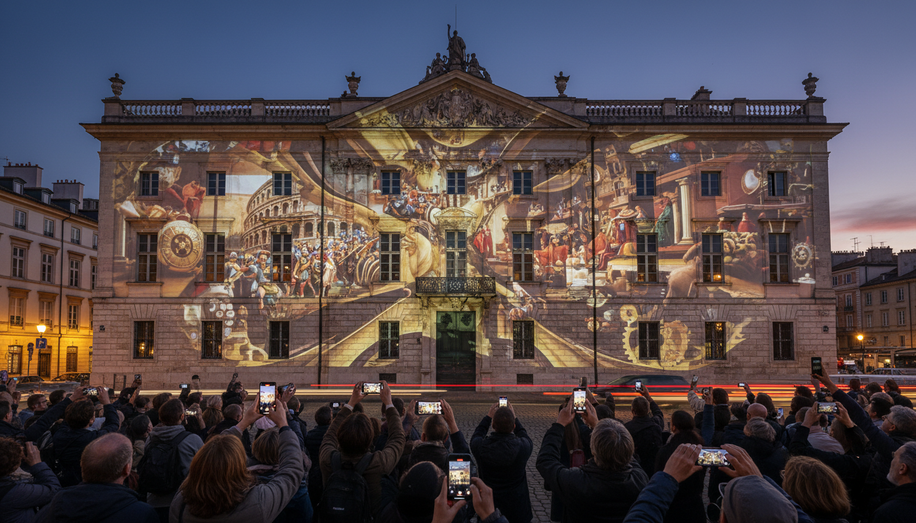

In the bustling heart of Times Square, a colossal Coca-Cola bottle appears to erupt from a digital billboard, bubbles cascading into the street as if ready to douse passersby in fizzy refreshment. This anamorphic 3D projection, blending robotics and high-resolution LED screens, marks a pivotal moment in out-of-home (OOH) advertising, where flat panels give way to lifelike spectacles that pull audiences into the brand’s world. Once confined to static images or simple video loops, OOH has evolved into a canvas for immersive 3D experiences, leveraging advanced projection mapping, naked-eye 3D displays, and forced perspective to redefine urban landscapes as interactive storytelling arenas.
The technology powering this rise combines high-refresh-rate LED walls with sophisticated software that simulates depth and motion without requiring glasses. Anamorphic illusions—distorted images that resolve into three dimensions from specific angles—trick the eye into perceiving objects leaping from screens, while naked-eye 3D creates floating holograms through parallax barriers and rapid pixel shifting. These innovations have proliferated in high-traffic zones like Tokyo’s Shinjuku Station, London’s Piccadilly Circus, and New York’s iconic squares, where millions of daily viewers encounter ads that demand attention amid digital overload. Brands report exponential engagement: Nike’s 2023 Air Max Day billboard in Shinjuku, for instance, depicted sneakers bursting from a shoebox, amassing over 50 million social media views and turning a local display into a global viral sensation.
Nike’s campaign exemplifies how 3D projections amplify product launches. Positioned outside Shinjuku Station—a hub for 3.6 million commuters daily—the ad featured oversized Nike boxes opening to reveal Air Max designs hovering mid-air, pawed back by a playful cat animation. This not only highlighted intricate sneaker details but also synced with cultural moments like Air Max Day, fostering anticipation and foot traffic. Similarly, Coca-Cola’s Times Square installation, the world’s first 3D robotic billboard, integrated mist sprayers triggered by a pixelated countdown, immersing viewers in a sensory refreshment ritual that refreshed the brand’s image in the digital era.
Entertainment giants have equally embraced the format to build hype. For Spider-Man’s Piccadilly Lights debut, a web-slinging hero seemed to vault from the screen, interacting with London’s skyline and drawing crowds that amplified pre-release buzz through shared smartphone footage. Netflix followed suit at the same venue with dynamic character projections, while Super Nintendo World’s Los Angeles promotion stretched a 50-foot-high, 300-foot-long display across Figueroa Street. Here, Mario Kart racers sped alongside park guests in a horizontal 6:1 aspect ratio spectacle, priming Southern California drivers for the park’s opening and capitalizing on motion to evoke thrill.
Beyond consumer goods, luxury and real estate brands are deploying 3D to evoke emotion. Pomellato’s Chengdu billboard conjured flawless diamond rings floating in water, transforming a luxury mall into an immersive jewelry fantasy via naked-eye tech that sparkled with realistic depth. In Wuhan, Donde Tianyu’s Taikoo Li lion leaped from a naked-eye screen, its mane rippling under a rising sun and moon, symbolizing untamed nature to market high-end properties. Samsung’s Lunar New Year “Tiger in the City” campaign prowled Times Square, with a tiger pawing toward the Galaxy logo before lunging forward, tying cultural symbolism to product drops across five global cities.
This surge stems from measurable returns. Traditional OOH reaches masses efficiently, but 3D variants boost dwell time—viewers pause, film, and share, extending reach organically. Nike’s Tokyo stunt, for example, enhanced brand awareness and sales potential by making products tangible in public spaces. Weather-triggered integrations, like Aperol’s spritz ads activating above 66°F near social hubs, layer relevance atop visuals, driving foot traffic to retailers. Costs remain high—Shinjuku screens demand premium slots—but ROI justifies it: viral amplification turns one-week runs into months of earned media.
Challenges persist. Technical precision is paramount; misalignment in anamorphic setups can shatter illusions, and massive scales like LA’s Nintendo billboard require custom engineering. Energy demands of LED arrays raise sustainability questions, though advancements in efficient panels mitigate this. Regulatory hurdles in historic districts also limit placements. Yet, as AI refines animations and programmatic buying enables real-time triggers, 3D projections will proliferate, blending OOH with AR for hybrid experiences.
Ultimately, these campaigns prove 3D technology doesn’t just advertise—it commandeers public spaces, forging emotional connections that static media can’t match. From sneakers defying gravity to lions ruling urban prairies, brands are no longer shouting into the void; they’re inviting audiences to step inside the ad, reimagining streets as stages for unforgettable narratives. As urban screens upgrade worldwide, the line between reality and projection blurrs, signaling OOH’s most captivating chapter yet.
For brands navigating this captivating new frontier, optimizing the substantial investment and measuring tangible returns is paramount. Blindspot offers critical tools for precise ROI measurement and attribution, coupled with sophisticated audience analytics and location intelligence, ensuring these technically complex and high-cost campaigns achieve maximum engagement and prove their value in the world’s most coveted urban spaces. Discover how at https://seeblindspot.com/