
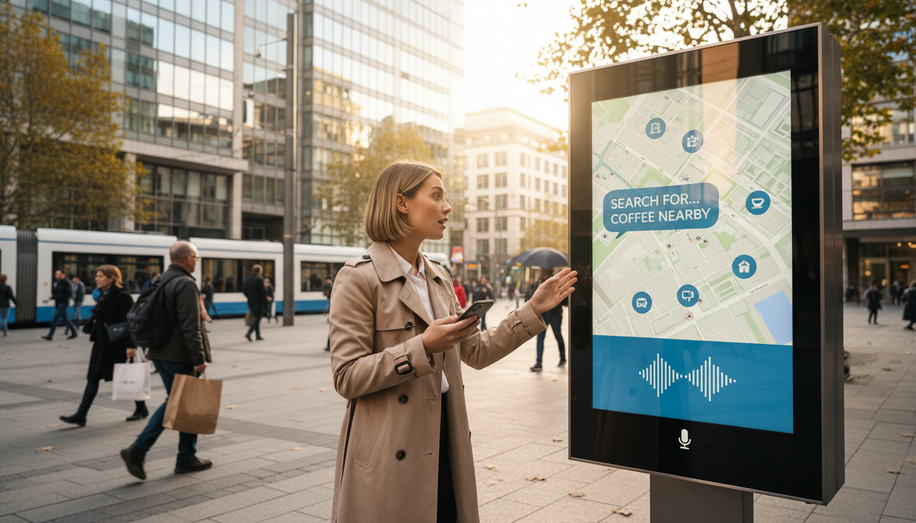

Imagine strolling past a bustling city billboard promoting a sleek new smartphone. As you approach, your phone’s voice assistant chimes in: “Hey, want to hear about the camera that captures night like day?” You reply affirmatively, and it launches a personalized demo, complete with augmented reality overlays visible only through your screen. This seamless fusion of voice technology and out-of-home (OOH) advertising is no longer a distant vision—it’s reshaping how brands capture attention in an increasingly distracted world.
Voice-activated tech bridges the gap between static outdoor displays and dynamic consumer interactions, turning passive passersby into active participants. Traditional OOH relies on bold visuals to cut through urban noise, but voice adds a layer of intimacy and immediacy. Smart devices, now ubiquitous with voice assistants like Siri, Alexa, and Google Assistant, serve as the conduit. Billboards embedded with QR codes or NFC tags prompt users to activate their phones, triggering audio narratives tailored to location, time, or even weather. Software for digital out-of-home (DOOH) screens plays a pivotal role here, enabling real-time content management and interactive elements that respond to voice commands.
Starbucks has pioneered this approach in the U.S., pairing LED billboards with nearby speakers that broadcast the soothing drip of fresh coffee or a warm voice touting limited-time offers. Passersby don’t just see the ad—they hear it, feel drawn in, and often pull out their phones to order via voice. This multisensory tactic boosts noticeability, as audio personalizes the experience in crowded environments where visuals alone blend into the background.
The mechanics are straightforward yet powerful. Advertisers deploy geofencing or beacons near OOH installations to detect nearby smart devices with user consent. Once triggered—say, by a simple voice prompt like “Talk to the ad”—the assistant delivers customized messages. For a cosmetics campaign, a billboard might invite: “Say ‘try me’ to see shades that match your skin.” The response pulls up a virtual try-on via AR, blending voice guidance with visual immersion. Platforms like Zigpoll enhance this by integrating SMS or voice-based polling; fans at a Nike billboard could vote on their favorite athlete via voice, with live results flashing on the screen, fostering community and data collection.
Programmatic audio takes it further, leveraging AI to optimize delivery. Audio OOH (AOOH) uses reporting tools to target demographics by time, location, or behavior, piping sound through headphones for a private touch or speakers for ambient allure. Tourism boards, for instance, evoke distant cultures with immersive soundscapes—think crashing waves or bustling markets—prompting voice-activated bookings. In retail, AI-powered digital signage employs gesture and voice recognition for hands-free chats, where consumers query product details and receive instant replies, all synced to their devices.
This integration promises measurable gains. Interactive voice ads can lift engagement by 30-50% over static formats, sharpen brand recall up to 70%, and drive 15-25% more foot traffic or conversions through personalization. Data from interactions fuels insights: poll responses reveal preferences, while voice logs track sentiment, enabling data-driven refinements. Privacy remains paramount; opt-in flows and compliance ensure trust, as location-based personalization hinges on explicit consent.
Challenges persist, but technology is closing them. Early hurdles like device compatibility and ambient noise are mitigated by advancing AI, which adapts content via facial recognition or mood detection on screens. Cross-channel synergy amplifies reach—voice OOH links to apps, social media, or e-commerce, creating seamless journeys from street to screen. Abu Dhabi’s forthcoming Sphere venue exemplifies this evolution, incorporating voice-command kiosks for fully interactive experiences.
Brands embracing voice OOH position themselves at the forefront of a multisensory revolution. As smart devices proliferate—projected to dominate daily interactions—advertisers who harness voice will forge deeper connections. A cosmetics line doesn’t just advertise; it converses. A coffee chain doesn’t beckon; it brews temptation in your ear. The future of OOH isn’t louder—it’s smarter, more responsive, inviting consumers to speak back.
Yet, success demands creativity. Campaigns must intrigue without intruding, using concise prompts and rewarding interactions with value, like exclusive discounts or gamified content. Tools like Poll Everywhere or Slido facilitate voice-tied voting, displaying real-time results to sustain momentum. Mobile deep linking ensures one-tap continuity, tracking journeys from billboard to purchase.
In cities worldwide, from New York’s Times Square to London’s Piccadilly Circus, voice-infused DOOH is testing these waters. JCDecaux’s multisensory experiments pair visuals with sound for immersive recall, while AI chatbots on screens handle queries fluidly. As 2026 unfolds, expect proliferation: voice tech not only grabs fleeting attention but cultivates loyalty through conversation.
The payoff? OOH evolves from interruption to invitation, where a whisper from your pocket turns a glance into engagement. Brands that listen—and respond—will own the streets.