
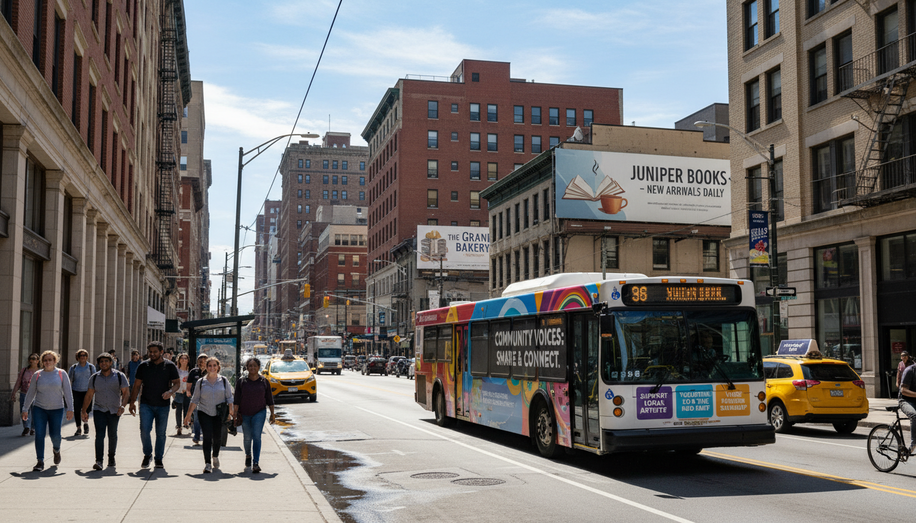

Transit Advertising: The New Frontier for Local Businesses
Local businesses can harness transit advertising’s explosive growth and hyper-targeted reach to drive foot traffic, boost engagement, and deliver outsized ROI amid tight budgets—turning daily commutes into profitable connections. (152 chars)
In an era of fragmented media landscapes and escalating digital ad costs, transit advertising stands as a beacon for local enterprises seeking cost-effective, high-impact visibility. Valued at USD 12.90 billion globally in 2024, the transit advertising market is projected to surge to USD 19.17 billion by 2033, growing at a compound annual growth rate (CAGR) of 5.00% from 2026 onward, fueled by urbanization and rising public transport ridership. For small and medium-sized businesses—from neighborhood retailers to service providers—this medium offers unprecedented access to diverse, on-the-move audiences without the premium price tag of traditional TV or online campaigns.
The appeal lies in its intrinsic hyper-locality. Transit ads on buses, subways, taxis, and rail systems immerse messages directly into community hubs, where riders—urban dwellers averaging 9.9 billion annual trips pre-pandemic and climbing with infrastructure investments—encounter them repeatedly during routines. Unlike static billboards, transit placements move with the audience, amplifying frequency and familiarity. A regional accounting firm, for instance, deployed static bus shelter ads alongside digital displays in a new market, generating 5.8 million impressions over four months. This effort yielded a 22% foot traffic spike, $450,000 in incremental revenue, and a 3:1 direct ROI, escalating to 5:1 when factoring brand lift—achieved with just $120,000 invested plus $30,000 in digital follow-up.
This precision targeting is transit’s superpower for budget-conscious locals. Public transport demographics span working professionals, students, tourists, and families, providing broad yet segmentable reach. Data analytics and digital out-of-home (DOOH) technologies enable real-time customization: screens update messages by time, weather, or events, while geofencing pairs transit ads with mobile push notifications for nearby prospects. A restaurant within blocks of a bus route can beam discounts to riders’ phones, converting impulse viewers into walk-ins. Retailers drive store visits similarly, with entertainment venues promoting events to boost attendance. Tourism operators highlight local attractions, fostering community ties that resonate beyond transactions.
Budget optimization is equally compelling. Out-of-home (OOH) advertising, including transit, delivers $5.97 in ROI per dollar spent, outpacing many digital channels when integrated smartly. Local businesses thrive here because campaigns scale affordably: a single bus wrap or subway panel costs far less than broad digital buys, yet garners millions of impressions. Consider a campaign yielding 2.3 million impressions, 12,400 QR scans (0.54% engagement), and $2.1 million in revenue—a staggering 28:1 ROI—by linking ads to marketing automation for instant lead nurturing. For enterprises pinching pennies, start small: calculate impressions via daily traffic counts, occupancy (1.2-1.5 people per vehicle), and attention rates (35-45% for digital). Regulatory hurdles exist—municipal rules vary, demanding compliance research—but partnerships with transit agencies unlock compliant, co-branded opportunities.
Community engagement elevates transit beyond metrics. Ads aren’t intrusions; they’re journey companions, sparking conversations and loyalty. A coffee shop’s bus-side promotion might nod to neighborhood events, turning riders into regulars. Sustainability adds allure: as cities prioritize green public transit over cars, these ads align with eco-conscious values, enhancing brand affinity. In the U.S., where local advertising hits $182 billion in 2026, transit emerges as a top growth driver amid DOOH acceleration and cross-platform strategies. Asia Pacific leads revenue, but Canada eyes the fastest CAGR through 2030, signaling global momentum.
Challenges persist, yet they’re navigable. Transient viewers demand bold visuals and calls-to-action like QR codes, while weather or routes can dilute exposure. Success hinges on integration: pair transit with social media or email for attribution tracking. Emerging tech like augmented reality (AR) overlays on digital panels promises immersive experiences, letting a boutique virtually showcase wares to passing commuters.
For local businesses, transit advertising redefines reach without recklessness. It transforms commutes into commerce pipelines, nurturing ties in the neighborhoods that sustain them. With markets ballooning—transit alone from $10.5 billion in 2024 to $19 billion by 2030 at 10.4% CAGR—forward-thinking owners who blend creativity, data, and partnerships will claim the frontier. In a crowded ad world, this mobile canvas delivers not just eyes, but enduring community impact—proving that the best investments move with the people.
(Word count: 712)