
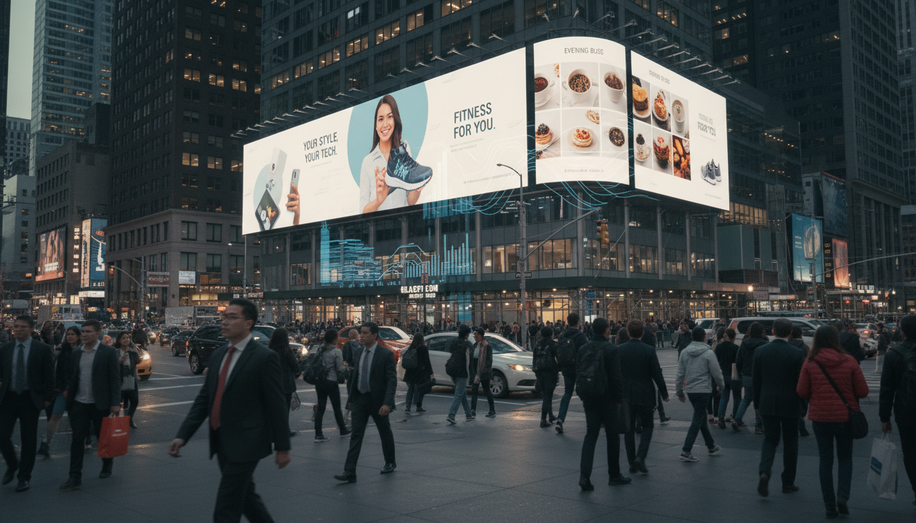

The Rise of Ultra-Personalization in OOH: Campaigns that Speak to You
Meta description: Data-driven DOOH is revolutionizing out-of-home ads, using real-time triggers like weather, sales data, and location to deliver hyper-targeted messages that boost engagement and sales for brands worldwide. (148 chars)
In the evolving landscape of out-of-home (OOH) advertising, ultra-personalization has emerged as a game-changer, transforming static billboards into dynamic conversations tailored to individual passersby. Powered by advancements in data collection—from weather sensors and sales analytics to geolocation and programmatic platforms—brands are crafting digital OOH (DOOH) campaigns that anticipate consumer needs with uncanny precision, driving measurable results like foot traffic surges and sales lifts.
This shift marks a departure from broad-spectrum messaging. Traditional OOH relied on high-visibility placements and eye-catching visuals to capture fleeting attention. Today, sophisticated data analysis enables hyper-targeting, where ads adapt in real-time based on environmental cues, behavioral patterns, and even proprietary brand insights. Programmatic technology automates this process, allowing advertisers to activate screens dynamically across networks of digital billboards, transit hubs, and urban displays. The result is advertising that feels eerily personal: a beer ad appearing only when temperatures drop, or a restaurant promotion triggered by local hunger peaks.
Consider Mad Mex, the Australian fast-casual chain that leveraged its own store-level sales data to redefine relevance. Facing the challenge of driving in-store traffic, the brand programmed DOOH ads to fire when and where audiences were most likely to crave a meal. Creatives dynamically shifted monthly—highlighting taste, health, or value based on what propelled sales at specific locations. The campaign reached 2.9 million consumers and delivered a 9% sales increase, proving how granular data turns OOH into a predictive sales engine.
Weather triggers exemplify this precision further, syncing ads with Mother Nature’s whims for maximum resonance. Guinness positioned itself as Australia’s “official beer of winter” by deploying ads near pubs only when temperatures fell, capitalizing on the chill to evoke cozy cravings. Similarly, Rain-X timed promotions for rainy downpours, appearing seamlessly as drivers navigated slick roads, with screens placed strategically near retailers to spur impulse buys. Aperol Spritz took a sunnier approach, activating near social hotspots when temperatures hit 66°F (19°C), associating the cocktail with perfect outdoor moments and maximizing engagement.
These examples underscore a broader trend: contextual intelligence derived from real-time data streams. Vandebron, a Dutch energy provider, analyzed grid data to create a “Green Energy Forecast,” displaying personalized charging tips on DOOH banners in EV-heavy zones. This empowered drivers with actionable insights, fostering brand loyalty through shared sustainability goals. Church’s Texas Chicken amplified this with location-based targeting and device ID retargeting, blending OOH with mobile for personalized offers that generated 19.6 million impressions, 2.4 million store visits, and a 12.2% conversion rate.
Advancements in data infrastructure are the backbone of this rise. Programmatic DOOH platforms now integrate vast datasets—IoT sensors for weather, mobile geofencing for audience proximity, and first-party sales metrics—enabling machine learning algorithms to predict behaviors at scale. As noted in 2026 industry outlooks, this convergence of mobile and OOH, via QR codes, NFC taps, and retargeting, sharpens personalization further, blurring lines between physical and digital realms. Nike’s real-time responsive campaign for athlete Femke Bol illustrates the agility: pre-race motivational creatives morphed into victory celebrations post-win, fitting any screen size and earning widespread acclaim for timeliness.
Yet ultra-personalization extends beyond triggers to immersive, individualized experiences. AR integrations, like Verizon’s Miami murals during Art Basel, used Snapchat lenses to animate local artist paintings when phones pointed at them, yielding over 657,000 plays and 670,000 views. Universal Pictures’ Jurassic World campaign let Times Square onlookers scan for AR dinosaurs roaming streets, turning billboards into interactive spectacles that exploded on social media. Even analog innovations, such as Heinz’s Ore-Ida rain-activated mural in Seattle, revealed hidden messages only when wet, cleverly nodding to local weather while garnering news buzz and an OBIE award.
Challenges persist, including privacy concerns and data accuracy, but 2026 forecasts emphasize ethical data use and AI-driven refinements as solutions. Trends point to even deeper personalization: predictive analytics forecasting individual preferences via anonymized mobility data, and hybrid campaigns linking OOH to e-commerce for seamless conversions.
For brands, the payoff is clear. Mad Mex’s sales bump, Church’s foot traffic boom, and Guinness’s contextual precision demonstrate ROI that static ads can’t match. As DOOH networks expand—projected to dominate OOH spends—ultra-personalization isn’t just innovative; it’s essential. Campaigns that “speak to you” don’t interrupt; they anticipate, resonating on a personal level amid urban noise. In this data-fueled era, OOH is no longer shouting into the void—it’s whispering exactly what consumers want to hear, right when they need it.
As ultra-personalization transforms OOH into a predictive sales engine, brands require sophisticated tools to navigate its complexity and maximize ROI. Platforms like Blindspot empower advertisers with programmatic DOOH campaign management, granular audience measurement, and precise location intelligence, enabling the delivery of hyper-targeted messages that resonate in real-time and drive measurable sales lifts and foot traffic. Explore how at https://seeblindspot.com/