
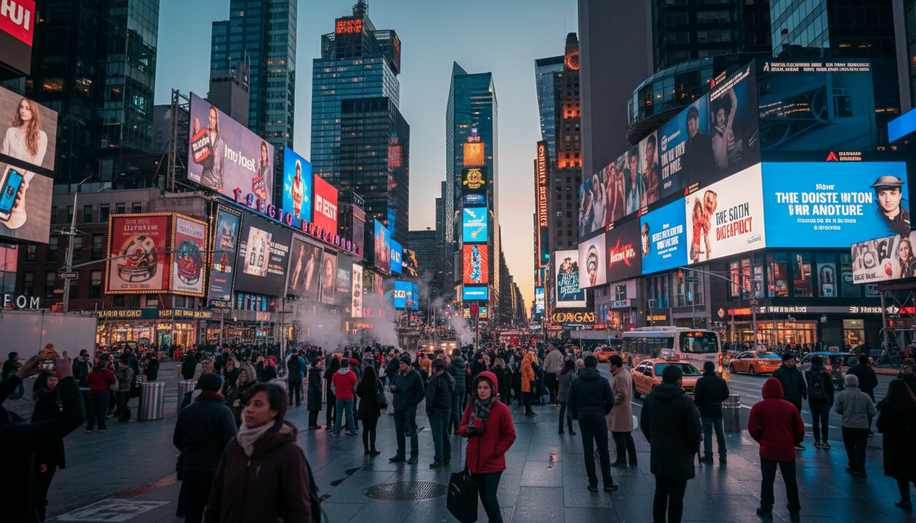

Marketing has a perennial habit of sounding the death knell for tactics that refuse to stay buried. Email newsletters? Dead, until they morphed into personalized drip campaigns. SEO? Obsolete, until voice search and AI overviews breathed new life into it. And now, out-of-home (OOH) advertising faces its own premature obituary, with pundits claiming digital overload and fragmented attention spans have rendered billboards irrelevant. Yet the data tells a different story: OOH isn’t dying—it’s evolving, expanding, and commanding record budgets in ways that prove its enduring power.
Consider the numbers. In the second quarter of 2025 alone, OOH revenue climbed 3% to $2.86 billion, bucking broader ad market slowdowns and signaling robust advertiser confidence. The Out-of-Home Advertising Association of America (OAAA) forecasts further growth, driven by budgets shifting from oversaturated channels like TV and online, where diminishing returns have left marketers chasing ever-el pricier pixels. Privacy restrictions have only amplified this pivot; unlike data-hungry digital platforms, OOH thrives on awareness-building without invasive tracking, delivering high ROI on metrics like brand lift and purchase intent. Far from fading, OOH is reclaiming shelf space as the antidote to algorithm fatigue.
This resilience stems from OOH’s chameleon-like adaptability. Programmatic digital OOH (DOOH), once a niche experiment, is exploding, projected to grow ad spend by 23% in 2025. It harnesses real-time data—weather, traffic, events—to swap messages dynamically, turning a static billboard into a contextual conversationalist. Picture a beverage brand pushing hot coffee on a rainy commute or iced refreshment under sunny skies; this isn’t guesswork, it’s precision targeting that boosts relevance without cookies or consent forms. As one analyst notes, programmatic DOOH elevates location from mere placement to predictive powerhouse, integrating seamlessly into omnichannel strategies.
Yet the evolution doesn’t stop at screens. Traditional OOH tactics are staging a triumphant return, blending nostalgia with necessity. Static billboards and transit wraps persist because they cut through digital noise with unskippable scale—big, bold, and unavoidable. Research shows 43% of adults who spot an OOH ad visit the featured business within 30 minutes, a real-time impulse digital retargeting struggles to match. Privacy changes and channel fatigue have funneled funds back to these basics, proving that what works doesn’t need reinvention, just refinement.
Interactivity adds the next layer, transforming passive glances into active engagements. QR codes, AR overlays, and AI-driven billboards invite participation, from gamified displays to motion-sensor activations that dispense scents or trigger personalized mobile extensions. Audiences, weary of one-way scrolls, now demand immersion: smart screens in cities deliver not just ads but utility, like navigation for newcomers alongside brand messages. Pop-up installations and experiential stunts amplify this, creating shareable moments that ripple across social media. In 2025, OOH’s creative playground status is undisputed—digital screens grow smarter, static formats bolder, and campaigns more culturally attuned.
Sustainability and hyper-localization further cement OOH’s vitality. Eco-conscious formats, from recyclable transit wraps to energy-efficient DOOH, align with consumer values while optimizing reach. Location-based storytelling—sunscreen near beaches, coffee at transit hubs—makes ads feel intuitive, not intrusive. Multisensory twists, like scented billboards or influencer tie-ins, crank up memorability, while countdowns and urgency tactics drive FOMO-fueled action. Geofencing pairs OOH with digital for closed-loop attribution, proving its role in full-funnel journeys.
Marketers who declare OOH’s demise miss the forest for the tweets. Nothing truly dies in this industry; it contracts during hype cycles, then rebounds stronger, making room for newcomers like AI without surrendering core strengths. The 2025 landscape underscores this: DOOH innovations coexist with proven tactics, programmatic precision enhances contextual punch, and interactivity bridges physical-digital divides. Revenue surges and trend forecasts aren’t flukes—they reflect OOH’s ability to evolve amid chaos.
The lesson? Stop eulogizing what’s working. Instead, lean into hybrids: pair a bold transit wrap with AR engagement and programmatic tweaks for maximum impact. As budgets reallocate and consumers tune out screens, OOH stands ready—not as a relic, but as the unfiltered canvas where brands still command attention. In a world of endless feeds, sometimes the best way forward is to look up.
For marketers looking to navigate this dynamic OOH landscape, platforms like Blindspot offer the essential intelligence to maximize impact and prove enduring value. By enabling sophisticated programmatic DOOH campaign management, precise location intelligence for optimal site selection, and comprehensive ROI measurement and attribution, Blindspot empowers brands to confidently cut through digital noise and reallocate budgets based on tangible results. Explore how to transform OOH into a fully optimized, data-driven channel at https://seeblindspot.com/