
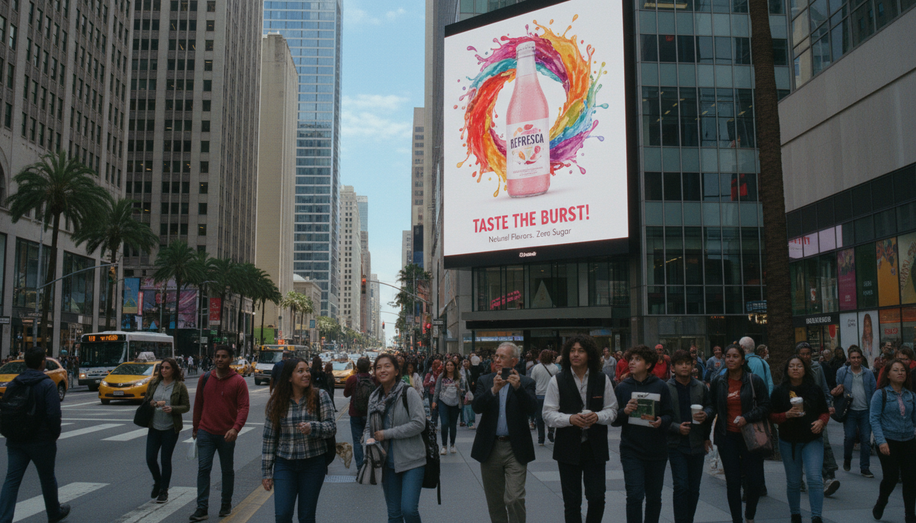

In the relentless rush of urban life, where drivers glance at billboards for mere seconds and pedestrians navigate a sea of visual noise, color emerges as a silent powerhouse in out-of-home (OOH) advertising. Far beyond mere decoration, it taps into the human brain’s primal wiring, triggering emotions, shaping perceptions, and driving engagement before a single word is read. Scientists and marketers alike have long studied this phenomenon—known as color psychology—which reveals how hues like red ignite urgency while blue fosters trust, making OOH campaigns not just seen, but felt.
At its core, color psychology in OOH hinges on the brain’s rapid processing of visual stimuli. Unlike digital screens with controlled lighting, OOH faces unpredictable foes: blazing sunlight, passing shadows, and high-speed viewers. Research shows colors influence subconscious reactions, evoking moods that align with brand messages in fractions of a second. Red, for instance, commands attention by raising heart rates and signaling excitement or passion—ideal for sales promotions or fast-food giants like McDonald’s, whose red-yellow combos spark hunger and impulse. This isn’t whimsy; it’s rooted in evolutionary cues where red once warned of danger or ripeness, now repurposed to propel action in outdoor retail signage.
Blue offers a counterpoint, conveying calm, reliability, and trust—qualities banks and tech firms exploit to build instant credibility amid chaotic streetscapes. In summer’s glare, when sunlight washes out pastels, blue’s cool tones provide visual relief, standing out against hazy skies and cutting through clutter for better recall. Yellow bursts with optimism and cheer, drawing eyes from afar with its high visibility, though overuse risks overwhelming viewers; paired smartly with black for contrast, it energizes family-oriented ads or clearance events. Green, evoking nature and health, reassures wellness brands like Whole Foods, signaling freshness in an environment already saturated with urban grit.
These effects aren’t universal—cultural nuances matter. White symbolizes purity in Western contexts but mourning in some Eastern traditions, demanding careful adaptation for global OOH campaigns. Black exudes luxury and authority, its stark elegance amplifying premium messages when contrasted against vibrant backgrounds. Gray adds modernity and balance, a neutral anchor for professional services, while avoiding the emotional flatness of overuse.
Yet, psychology alone doesn’t suffice; OOH demands strategic application. High-contrast pairings—think red on white or blue against yellow—ensure legibility from moving vehicles, where viewers have 3-5 seconds max. Summer heat alters perception further: warm tones like orange blend into sunlit palettes, while cool violets refresh overheated eyes, boosting emotional resonance. Advertisers test palettes in real-world light, not mockups, anchoring calls-to-action in hues that align with desired feelings—red for “Buy Now,” green for “Eco-Friendly.”
Real-world triumphs underscore the stakes. McDonald’s red-yellow assault doesn’t just grab glances; it stirs appetite, proven to accelerate decision-making in drive-thru signage. Facebook’s blue dominance reassures users amid digital distrust, a tactic mirrored in OOH for tech rollouts. In DOOH, dynamic color shifts amplify this: a video ad’s first three seconds, laced with urgent red, can spike engagement by evoking passion before fading to trustworthy blue. Studies affirm colors boost recall—up to 80% when emotionally tuned—transforming fleeting exposures into lasting brand bonds.
Challenges persist. Overreliance on bold hues risks visual fatigue in dense media hubs, where subtlety via neutrals like gray prevents alienation. Environmental context reigns: a billboard amid greenery favors contrasting pops, not mimicking foliage. Behavioral experts like B.F. Skinner highlighted how such stimuli shape actions; in OOH, color is the cue that turns passive passersby into engaged consumers.
Ultimately, mastering color psychology elevates OOH from background noise to emotional magnet. By wielding reds for urgency, blues for belief, and yellows for joy, advertisers don’t just capture eyes—they hijack hearts, forging perceptions that linger long after the commute ends. In a medium defined by split-second impact, this science isn’t optional; it’s the edge between ignored and iconic.