
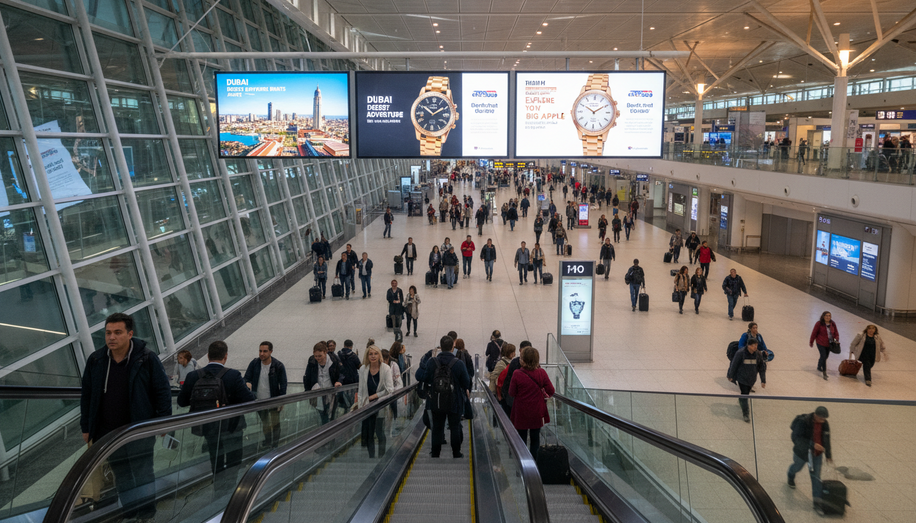

As America’s airports experience record-setting traveler volumes, airport advertising has emerged as one of the most effective out-of-home media channels available, offering brands unprecedented access to a captive and highly engaged audience. Recent research commissioned by Clear Channel Outdoor and conducted by Nielsen reveals the substantial impact this medium delivers across the entire marketing funnel, demonstrating why airports represent a premium environment for brand connection and conversion at scale.
The power of airport advertising lies fundamentally in its captive audience dynamic. Travelers spend hours navigating airports from check-in through boarding, creating extended dwell times that traditional advertising channels cannot match. During these periods, passengers are waiting with limited distractions, making them significantly more receptive to well-placed creative. This captive nature translates directly into measurable results: 82% of frequent flyers read airport advertisements, 61% recall seeing them, and 57% take action after viewing airport ads—an increase of 8% from 2022 studies. These metrics underscore a fundamental truth about airport environments: advertising placed strategically in these spaces doesn’t just reach audiences; it inspires tangible behavior change.
The metrics supporting airport advertising effectiveness are compelling across multiple dimensions. A Nielsen and Clear Channel Airports study found that airport advertising led to a 42% increase in brand recall compared to other advertising channels. Beyond awareness, the medium drives purchase intent, with a 21% increase documented among exposed consumers, and remarkably boosts customer engagement by up to 70%. These figures demonstrate that airport advertising functions as a complete marketing solution, addressing awareness, consideration, and conversion simultaneously—a rare capability in today’s fragmented media landscape.
When travelers do take action after encountering airport advertisements, their behavior reveals the medium’s conversion power. Among those who responded to airport ads, 61% visited the advertised location, 53% visited the advertised website, and 45% scanned a QR code—itself showing a 6% increase from prior years. These metrics indicate that airport exposure translates into offline foot traffic and online engagement, bridging the traditional and digital marketing worlds. The prevalence of QR code scanning in particular demonstrates that travelers at airports are primed to engage with interactive and immediate calls-to-action, creating opportunities for sophisticated measurement and attribution.
However, capturing attention in airports presents distinct challenges. The chaotic, crowded environment that makes airports such valuable advertising real estate also creates significant noise. Ad fatigue presents a formidable obstacle when multiple advertisements compete for limited attention spans. Travelers rushing between gates, processing travel logistics, and managing stress are not inherently motivated to absorb commercial messaging. Advertisers must overcome this clutter through creative excellence and strategic placement. Dynamic displays with bright lighting and innovative design prove more effective at capturing the eyes of busy travelers, while interactive installations leverage the high-intent environment to encourage engagement rather than passive viewing.
Targeting the right audience compounds these challenges. While airports offer demographic clarity—frequent flyers tend to be affluent, educated professionals with significant purchasing power—creating messages that resonate across diverse passenger types requires precision. The good news is that traveler preferences provide clear guidance. Research shows that 88% of frequent flyers want to see advertisements from local businesses, 53% want local sports team promotions, and 48% want educational institution advertising. This preference for local relevance suggests that hyper-targeted, community-focused campaigns significantly outperform generic national messaging in airport environments.
The future of airport advertising increasingly integrates digital innovation with traditional out-of-home tactics. Real-time feedback systems and automation enable rapid campaign iteration based on performance data. Proximity marketing, augmented reality activations, and personalized digital displays can increase passenger engagement by 20-30%, while data-driven approaches help allocate resources toward top-performing placements and creative variations. As the global airport advertising market continues expanding—projected to reach $12 billion in 2025—the convergence of creative excellence, strategic placement, and technological sophistication will define industry leaders.
Airport advertising succeeds because it meets travelers at a moment of genuine receptivity. By combining creative excellence with data-informed strategy and technological innovation, brands can transform busy airport corridors into some of the most productive advertising environments available today.