
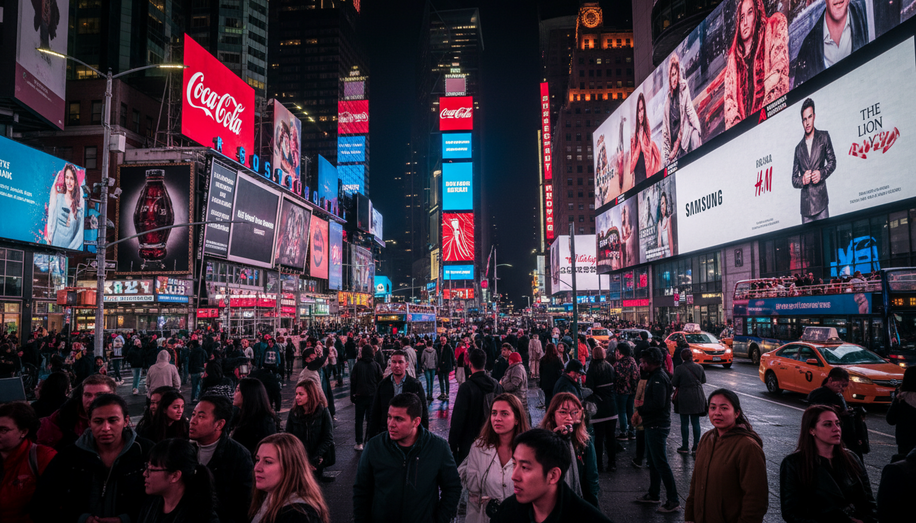

The Ads That Made People Feel Something In 2025, Per System1
System1’s 2025 U.S. rankings show that the year’s most effective ads paired big feelings with unmistakable brands, proving emotion still moves markets.
In a year of economic jitters, culture wars and AI fatigue, the U.S. ads that cut through in 2025 had one thing in common: they made people *feel* something – and they did it without ever losing sight of the logo.
That is the core story behind System1’s ranking of 2025’s most effective U.S. ads, a list built not on media spend or creative hype but on measured emotional response and the strength of branding throughout the work. System1, which tests thousands of commercials using its “Test Your Ad” platform and a database of more than 100,000 films, scores spots on a 1-to-5 Star scale designed to predict long-term market share growth rather than short‑term clicks.
The 2025 leaderboard, shared with AdMarket, underlines a trend that many OOH and brand marketers have sensed but struggled to quantify: the safest bet for effectiveness remains classic, broad‑reach, emotionally led creative with the brand wired into the story from frame one.
System1’s methodology asks nationally representative consumers to watch ads in naturalistic conditions, record their feelings in real time and identify the brand. Those responses are then modeled into a Star Rating indicating the ad’s likely impact on long‑term growth, plus a separate measure of brand recognition that captures how strongly the commercial is linked to its sponsor. For this year’s U.S. ranking, only ads that combined high Star Ratings with strong brand attribution made the cut.
While System1 has become known for its festive and regional rankings – from Amazon’s perennial presence on Christmas leaderboards in the UK to annual top 10 lists in markets like Australia – the 2025 U.S. compilation is notable for just how mainstream the winning work is. This is not a reel of edge‑case experiments; it is a return to big, accessible, emotionally fluent advertising.
Across categories, several creative patterns recur. Family rituals and intergenerational relationships are still emotional rocket fuel. Everyday life – school runs, grocery trips, late‑shift commutes – is framed with cinematic warmth rather than gritty realism. Pets, humor and gentle nostalgia show up again and again as the levers that unlock happiness, warmth and what System1 calls “feel‑good fluency,” a potent predictor of long‑term effectiveness in its model.
Crucially, this emotionality is never left to float free of the brand. The highest‑ranking 2025 ads do not rely on late pack shots or cryptic reveals; the advertiser is present via audio mnemonics, visual assets, characters, distinctive colors or product cameos from the opening seconds. That close coupling of story and brand appears to be one of the main differences between 4‑ and 5‑Star work in System1’s database and more average ads that entertain but fail to drive memory structures.
For OOH specialists, the implications are clear. First, the emotional palettes that surged on screens this year – warmth, reassurance, delight, light‑touch humor – are inherently translatable to public space. System1’s findings suggest that broad, positive emotions are a more reliable driver of commercial impact than the sharper, more divisive tones that sometimes dominate social platforms. In practice, that points toward OOH creative that prioritizes simple, optimistic storytelling over hyper‑targeted in‑jokes.
Second, the study reinforces the importance of distinctive brand assets. Because System1’s ranking explicitly weights both feeling and brand strength, the 2025 list is effectively a highlight reel of advertisers who have invested in consistent characters, sonic logos, colors and shapes – and then deployed them relentlessly. In OOH, where attention is glancing and audio is absent, these same assets become the primary carriers of emotion and memory. The brands that scored best on TV and online this year are, not coincidentally, the ones whose outdoor work can be recognized at a distance in a fraction of a second.
Third, the data is a counterweight to a decade of performance‑led orthodoxy. System1 positions its Star Rating as a predictor of long‑term market share gain, in contrast to short‑term response metrics. The 2025 winners therefore serve as evidence that investment in fame‑building, emotionally resonant creative remains commercially rational, even as marketers face mounting pressure to optimize every impression. For OOH, still one of the purest reach media, that is an important validation.
The ranking also highlights how quickly advertisers have adapted to a fragmented video landscape. System1’s test universe includes TV as well as digital video, and many of this year’s most effective U.S. ads were built to run across CTV, social and streaming environments. Yet the work that rose to the top did not feel like modular content; it felt like classic advertising – tight storytelling arcs, strong sound design, memorable payoffs – simply deployed wherever attention is available.
Looking across System1’s international outputs, from the Christmas charts where Amazon has repeatedly topped festive leaderboards, to national lists like Australia’s top 10 for 2025, one clear pattern emerges: the creative principles that work in one market tend to travel. Ads that tell simple human stories, powered by recognizable brand codes, rise to the top whether they are selling airlines, supermarkets or tech platforms. The new U.S. ranking slots neatly into that pattern.
For OOH buyers and sellers planning 2026, the message from System1’s 2025 U.S. list is less about copying specific executions and more about copying a mindset. Put emotional response on equal footing with reach in the brief. Demand creative that wears its branding proudly, not apologetically. Use outdoor not only as a performance driver or a last‑mile nudge, but as a stage for the kinds of big, emotionally led ideas that this year’s data says are still the most effective way to grow.
In a marketplace saturated with messages, the ads that mattered in 2025 did something deceptively simple: they made people feel good – and they made sure people knew exactly who to thank for that feeling.