

Driving Engagement: Innovative Retail Media Strategies in OOH Advertising
Retail brands are fusing OOH, retail media and mobile to turn streets, malls and store perimeters into immersive paths‑to‑purchase that drive measurable footfall.
Retailers are no longer treating out-of-home as a static awareness play. In the emerging retail media ecosystem, OOH — especially digital OOH — is being wired directly into shopper journeys, using data, interactivity and omnichannel targeting to move people from impression to store visit.
What is changing fastest is where the media lives. Programmatic digital-out-of-home (pDOOH) screens inside and immediately around stores are becoming central to retail media networks, with global spending on media within retail environments projected to hit $179.5 billion in 2025. These screens sit at entrances, in aisles and at checkout, giving brands a chance to shape decisions within metres of the shelf and lift sales by up to 20% through last‑minute influence.
For retailers, that proximity is gold. In-store networks let them sell highly contextualised, closed-loop inventory: a CPG brand can trigger a promotion on end‑cap screens when inventory is high, or rotate creative by time of day to match shopper missions, such as quick top‑ups at lunch or big basket shops after work. Programmatic tools and AI-driven planning extend that logic outside the store, optimising which roadside, transit or street‑level screens to buy based on footfall, nearby points of interest and even weather.
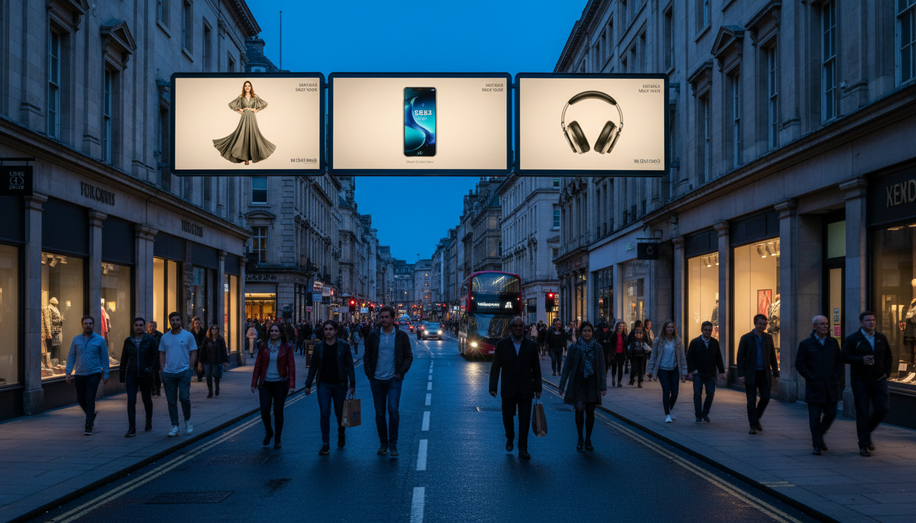
The result is a more fluid connection between classic OOH and retail media. Brands are using smart billboards that update in real time — for instance, promoting hot drinks when the temperature drops or pushing limited‑time offers when traffic builds near a retail park. Hyperlocal creative — drawing on neighbourhood culture, events and languages — makes these placements feel less like generic posters and more like context-aware retail touchpoints that point clearly to the nearest store.
Immersive experiences are doing the heaviest lifting on engagement. As consumers grow used to digital interfaces everywhere, interactive OOH is becoming an expectation, not an exception. Bus shelters, mall panels and roadside screens invite passers‑by to play games, trigger augmented reality overlays or scan QR codes that unlock instant rewards. When those experiences are tightly tied to retail, the line between media and merchandising blurs: scan a billboard to configure a sneaker, then pick it up in the flagship store two blocks away; play a game on a shelter screen to win an immediate discount at the supermarket behind it.
AR‑enhanced campaigns are particularly powerful in crowded high streets. Using their phones, shoppers can see products “come to life” on top of OOH placements — a lipstick animating on a beauty retailer’s window, or a 3D snack pack bursting off a transit poster — then tap through to store locators or click‑and‑collect options. Psychologically, these formats hand a degree of control to the shopper, which DOOH specialists note makes signage feel more like a tool than a broadcast, deepening engagement and recall.
Social integration is the other crucial layer. Instead of treating outdoor and digital as separate channels, brands are designing OOH as the spark for content that lives on Instagram, TikTok and retail apps. A campaign may invite people to take selfies with a spectacular 3D billboard, tag the brand and redeem an in‑store perk, turning a one‑off sighting into shareable proof of fandom and a store visit. This multichannel approach is fast becoming the norm in DOOH, with mobile used both as the remote control for interactive screens and the bridge to purchase and loyalty.
Behind the scenes, measurement is catching up with ambition. Historically, OOH struggled to attribute outcomes beyond awareness. Now, retailers and brands are stitching together location data, GPS‑based exposure modelling and in‑store transaction data to show how many people exposed to a specific screen or creative later visited a store and bought. Vendors cite data-driven OOH campaigns delivering 20–30% higher engagement, making it easier for retail marketers to justify shifting budgets from pure-play digital into omnichannel retail media that includes OOH.
Sustainability is also shaping execution. As brands build more immersive, always-on experiences, they are under pressure to minimise environmental impact. Networks are increasingly deploying energy‑efficient LED screens and experimenting with biodegradable posters and recycled materials, with some advertisers explicitly flagging these choices in creative to appeal to eco‑conscious shoppers. For retailers, greener OOH becomes part of a broader ESG narrative around their stores and supply chains.
For all the technology, the fundamentals still matter. Creative must be simple enough to land in a glance but rich enough to reward interaction when shoppers lean in. Location strategy has to reflect real patterns of movement: OOH still performs best where people already are, particularly around busy streets, transit hubs and high‑traffic retail zones. And success depends on integration — the same audiences and SKUs planned across retail media networks, DOOH, mobile and in‑store activation, with shared data and consistent KPIs.
As retail media matures, the most effective brands are using OOH not as a separate awareness layer but as the physical stage where their digital ecosystems show up in the real world. Streets, malls and forecourts become extensions of the aisle, and every screen — from a highway spectacular to a self‑checkout display — is a chance to turn passing attention into store traffic and measurable sales.