
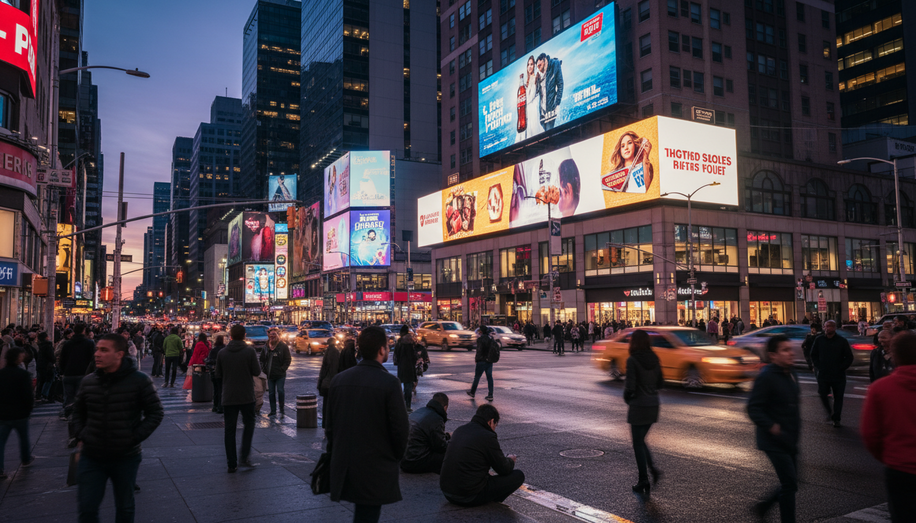

From Static Shadows to Digital Spectacles: The Billboard Revolution
Meta description: Discover how billboards evolved from static posters to AI-powered digital powerhouses, unlocking real-time interactivity, sustainability, and hyper-personalization in OOH advertising. (148 chars)
The humble billboard, once a static canvas battling weather and fading ink, has roared into the digital age as a dynamic force reshaping out-of-home (OOH) advertising. Technological leaps from LED displays to AI integration have propelled this transformation, turning passive glances into immersive engagements that demand attention in an urban jungle saturated with screens.
Traditional billboards ruled for decades with their simplicity: bold visuals plastered on plywood or vinyl, enduring rain, sun, and time but limited by one unchanging message. Their strength lay in sheer visibility—mass reach along highways and cityscapes—but they suffered from inflexibility. Campaigns couldn’t adapt to a sudden rainstorm or viral social trend, and measuring impact relied on crude estimates like traffic counts. Enter digital out-of-home (DOOH): high-definition LED and LCD screens that refresh content in seconds, driven by real-time data. By 2025, DOOH commands 42% of global OOH revenue, up from niche adoption, as brands like OUTFRONT deploy XScape tech for 3D spectacles that “eventize” ads, drawing 3.2 times more neural response than static formats.
This shift accelerated with core technological pillars. Programmatic buying, akin to online ad auctions, automates placements using AI to target demographics, routes, and timing—optimizing for rush-hour commuters or event crowds. Platforms like Mobilytics analyze audience density via sensors, enabling mid-campaign tweaks without halting production. High-efficiency LEDs now pair with 5G, IoT, NFC, and Bluetooth for seamless connectivity, pulling live feeds from weather APIs, traffic cams, or social media. Uber’s billboards, for instance, flashed real-time wait times with $10-off codes, bridging OOH to mobile conversions. Burger King’s “Hangover Whopper” pushed boundaries further, employing facial recognition AI to detect weary faces and serve discount offers, blending data with cheeky relevance—though it sparked debates on privacy.
Interactivity marks the creative zenith. Augmented reality (AR) and QR codes invite passersby to scan for product demos or gamified experiences, collapsing the gap between billboard and smartphone. 3D holographic displays, like those captivating global streets, create optical illusions—a tumbling soda can or soaring logo—that explode on social media, amplifying reach exponentially. Hyper-local targeting via geofencing tailors messages to neighborhoods: a coffee chain hypes iced lattes during heatwaves in one district while promoting hot brews elsewhere. AI elevates this with predictive analytics, segmenting audiences by inferred age, mood, or behavior from anonymous camera data, ensuring ads feel intuitively personal without veering into “creepy” territory—as Heinz demonstrated in its “Lost in Love” campaign, fusing automation with heartfelt storytelling.
Sustainability, once an afterthought, now fuels innovation amid eco-conscious consumers. Solar-powered billboards slash energy use, while recycled materials and low-emission LEDs align with green mandates in smart cities. Mobile digital LED trucks extend this ethos, zipping through urban zones with brighter, sharper screens and IoT tracking for precise ROI, backed by policies favoring sustainable mobility. These aren’t gimmicks; they’re responses to urbanization’s demands, where high-traffic hubs crave flexible, low-impact displays.
Yet this evolution isn’t without hurdles. Early interactive billboards faltered due to tech barriers and tepid demand, as charts show dormant growth spikes. Privacy concerns shadow AI personalization, and high upfront costs deter small advertisers. Still, the trajectory is clear: by 2035, top firms project AI, AR, and omnichannel “phygital” integrations dominating, with programmatic DOOH and neuroAI optimizing designs for subconscious impact.
Creative possibilities abound for OOH pros. Static’s rigidity yielded to digital’s canvas of infinite loops—10-second bursts cycling multiple ads, maximizing inventory. Now, imagine weather-synced promos (umbrellas in rain), event-tied blasts (concert tickets mid-festival), or neuro-responsive tweaks measuring dwell time via edge AI. Brands venturing here report superior recall and shares, with 3D formats perfect for viral stunts. Programmatic ensures efficiency, bidding in real-time for prime slots, while analytics dashboards quantify impressions, engagements, and uplift—data static signs could only dream of.
Looking ahead, billboards aren’t dying; they’re mutating into intelligent ecosystems. AR/VR hybrids promise “portal” experiences, holographic projections defy physics, and AI-human blends safeguard creativity amid automation. In smart cities, IoT weaves billboards into infrastructure—traffic-calming visuals or emergency alerts doubling as ad space. For advertisers, the mandate is clear: embrace this fusion of tech and tale-telling to cut through noise.
The evolution from static sentinel to digital dynamo proves billboards’ enduring vitality. Far from obsolete, they’re the future of OOH—versatile, measurable, and mesmerizing—primed to captivate a world in constant motion.