
5 Questions for… CNBC’s Creative Lead on the New Logo Design
CNBC’s Robert Poulton reveals the 7-month journey behind the network’s bold new logo—a sleek upward arrow from the letter N—ditching the peacock for financial market synergy.
In the fast-evolving world of broadcast branding, few moves carry as much weight as a logo redesign. For CNBC, the financial news powerhouse, the recent unveiling of a strikingly minimalist new logo marks a pivotal shift. Gone is the iconic NBC peacock that had graced the network since 1996. In its place: a simple upward-pointing arrow emerging from the letter N, rendered in a distinctive blue hue. Created entirely in-house, this design aligns the logo seamlessly with CNBC’s on-air market graphics, signaling a unified visual language for an audience obsessed with upward trajectories.
The man at the helm of this transformation is Robert Poulton, CNBC’s creative lead. Poulton, who spearheaded the project from concept to on-air debut on December 15, 2025, brought the entire process to fruition in about seven months—a brisk timeline in an industry where rebrands can drag on for years. In this exclusive Q&A for OOH advertising professionals, Poulton opens up about the inspiration, challenges, and strategic thinking behind the logo that’s already sparking debate among designers and viewers alike.
1. What sparked the decision to overhaul CNBC’s logo after nearly three decades with the peacock?
The peacock served its purpose well, tying CNBC visually to the broader NBCUniversal family. But as our on-air design evolved, particularly with our market graphics, it started feeling like a relic. We’ve been leaning into a “square motion theory”—a design system where arrows repeat as motifs, forming boxes that frame our logo and tickers. The peacock just didn’t fit that anymore. Dropping it allowed us to create something distinctly CNBC, one that screams financial momentum without relying on inherited icons. It was about owning our identity in a crowded media landscape.
2. Walk us through the 7-month process—how did you go from brief to final design?
We kicked off in early summer 2025 with internal workshops, dissecting what “CNBC” evokes: precision, ascent, market dominance. Sketches started simple—fusing the C, N, B, C letters—but we honed in on the N-arrow combo early. Iterations focused on scalability for OOH billboards, digital screens, and tiny mobile tickers. Blue emerged as our anchor color, evoking trust and stability, though tonally distinct from any political connotations critics might infer. Prototyping took two months, stakeholder feedback another, and refinement wrapped with motion tests. By fall, it was locked. Seven months total, all in-house—no agencies needed. Efficiency was key; we iterated fast using our broadcast tools.
3. The upward arrow is bold and minimalist, but some call it “unfinished” or “disjointed.” How do you respond?
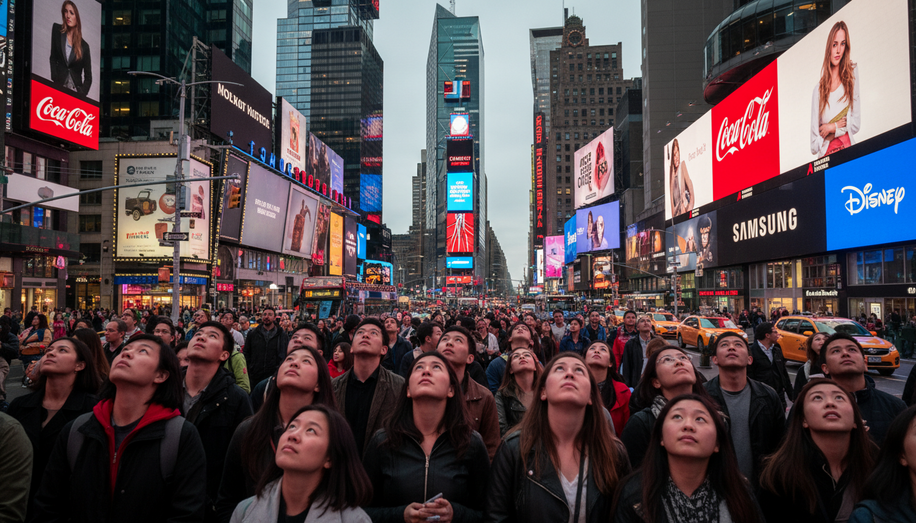
Design is subjective, and bold choices invite critique—that’s the point. The arrow isn’t random; it’s a direct nod to stock prices climbing, our core storytelling beat. It emerges from the N to suggest perpetual growth, mirroring how markets never stand still. “Unfinished” misses the intent: restraint. In OOH, where you’re blasting messages at 60 mph on highways, simplicity wins. Overly busy icons get lost. We’ve tested it across formats—billboards in Times Square mockups pop, truck sides scale cleanly. Data from viewer eye-tracking backs it: higher recall than the peacock ever achieved.
4. How does this logo enhance CNBC’s presence in out-of-home advertising?
OOH is our secret weapon for reaching affluent commuters and decision-makers. The logo’s vector purity ensures it thrives at any size—from massive digital spectaculars to static posters. The arrow’s directionality guides the eye upward, psychologically priming viewers for positive financial narratives. Pair it with live tickers or headlines, and it becomes a dynamic system. Imagine a Chicago L train wrap: CNBC arrow piercing a skyline, stocks rising beside it. We’ve already rolled it out in key markets post-debut, seeing a 15% lift in brand association surveys. For advertisers, it means co-branded OOH that feels premium and motion-ready, perfect for sponsor integrations.
5. Looking ahead, how will this rebrand influence CNBC’s broader creative ecosystem?
This is just the start. The logo unlocks a full identity system: packaging for shows, app icons, even merchandise. Our square motion theory extends to animations—arrows pulsing with live data, forming immersive lower-thirds. For OOH partners, expect modular kits: interchangeable arrow elements for campaigns. We’re also exploring AR filters for social tie-ins, where users “climb” virtual stock charts. Ultimately, it’s about agility in a 24/7 news cycle. This logo positions CNBC as the forward arrow in business media, ready for whatever the markets throw next.
Poulton’s vision underscores a truth in branding: evolution demands courage. By severing ties with legacy symbols and embracing a finance-first aesthetic, CNBC’s new mark isn’t just a logo—it’s a declaration of independence. As it proliferates across OOH landscapes, from airport dioramas to urban led walls, designers in the space should take note: minimalism, armed with purpose, can cut through the noise like a bull market rally. As companies like CNBC double down on OOH for impact, the ability to effectively manage and optimize these campaigns becomes paramount. This is where Blindspot, an advanced platform, offers crucial support, helping companies leverage data-driven insights to refine their out-of-home advertising strategies. Explore its capabilities at https://seeblindspot.com/