

Interactive Elements: The Game-Changer Elevating OOH Campaigns to Unforgettable Experiences
Discover how touchscreens, AR, and immersive installations are transforming out-of-home advertising, boosting engagement, virality, and real-world results in 2025.
In the bustling streets of 2025, out-of-home (OOH) advertising has evolved far beyond static billboards into dynamic playgrounds that demand participation. Interactive elements—touchscreens, augmented reality (AR) experiences, and immersive installations—are no longer novelties; they are essential tools for brands seeking to cut through digital noise and forge lasting connections with consumers. By inviting passersby to touch, scan, and play, these campaigns turn passive viewers into active participants, driving measurable outcomes like foot traffic, social shares, and sales lifts.
Consider Verizon’s AR murals in Miami during Art Basel, where local artists painted vibrant storefronts in Midtown, Hialeah, and Coconut Grove. Pedestrians pointed their phones at the murals via Snapchat’s location-based AR lens, animating the artwork into immersive 3D experiences. The result? Over 657,000 plays, 670,000 views, and more than 1,000 user-generated social posts, with a peak day hitting 4,000 plays. This fusion of physical art and digital interactivity not only celebrated neighborhood culture but also amplified Verizon’s brand through organic sharing, proving AR’s power to extend OOH reach exponentially.
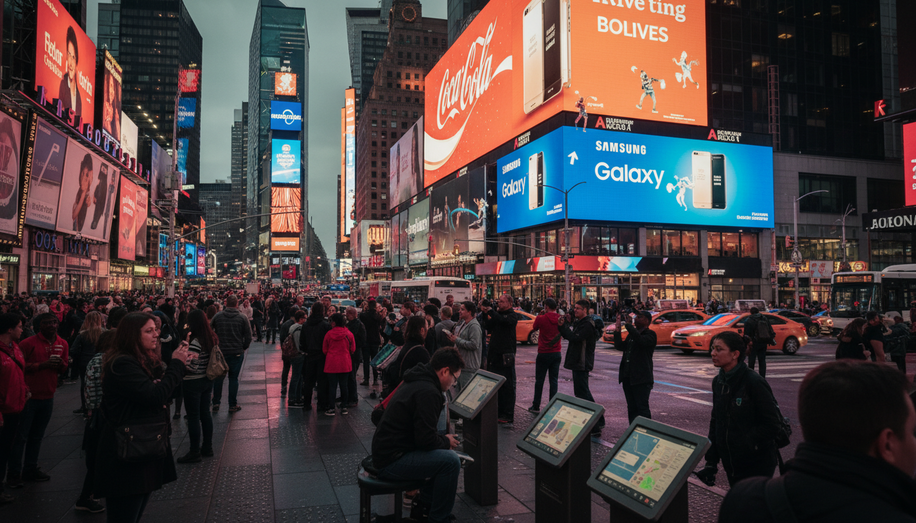
Touchscreens take this engagement further by enabling direct interaction in high-traffic zones. At AT&T Stadium, the Dallas Cowboys installed “Pose with the Pros” kiosks in 2019, a concept that endures in modern DOOH. Fans selected up to five players on interactive screens, and AR overlaid virtual images for shareable photos emailed or posted instantly. Such kiosks transform stadium concourses into social media factories, encouraging fans to broadcast the brand experience themselves. Fast-forward to 2025, and brands like Red Bull have scaled this model with QR-code-enabled Tetris tournaments at Birmingham New Street and Westfield London. Commuters scanned codes to play giant versions on OOH screens while grabbing free samples from a branded car, blending gaming nostalgia with real-time competition to create buzzworthy moments.
Immersive installations push boundaries even more, crafting physical environments that blur advertising with entertainment. Canva’s takeover at London Waterloo turned a commuter hub into a pop-up playground, with larger-than-life, colorful visuals inviting travelers to engage creatively—snapping photos, posing, and sharing on the spot. This playful activation embodied Canva’s ethos, turning mundane waits into memorable interactions that reinforced the brand’s innovative edge. Similarly, H&M leveraged Times Square’s iconic billboards for a live event stunt, where erupting screens synced with a surprise Charli XCX performance, drawing crowds and viral videos worldwide. The campaign drove foot traffic to a store reopening, illustrating how installations convert spectacle into commerce.
These tactics thrive on technology’s advancements. Digital OOH (DOOH) platforms now integrate AI for personalization, like Acadia GMC’s facial analytics displays that tailor one of 30 video ads based on age and gender detected by onboard cameras. Machine learning ensures relevance, keeping viewers hooked longer than traditional ads. Weather triggers add contextual magic: Aperol activated DOOH near social hubs only above 66°F, associating their spritz with perfect summer vibes and spiking engagement precisely when consumers craved it. Nike’s 3D billboard in Tokyo, with a suspenseful opening shoebox revealing Air Max designs, went viral globally, turning a local screen into a worldwide phenomenon through sheer visual intrigue.
The data underscores interactivity’s ROI. Verizon’s AR campaign generated peak daily plays rivaling digital ad metrics, while Red Bull’s Tetris activation fostered community tournaments that extended beyond the screens. Interactive OOH boasts higher dwell times—up to 40% more than static formats—leading to better recall and conversion, as consumers invest time and effort. Agencies note that touchpoints like promo codes or AR scans drive website traffic, with pop-up installations sparking virality: H&M’s stunt amassed massive media coverage, and Canva’s playground saw organic shares skyrocket.
Critics might argue interactivity risks overwhelming urban clutter, but 2025’s successes show thoughtful execution wins. DSA Signage emphasizes incorporating touchscreens with geotargeting for hyper-local relevance, while data analytics personalize at scale. Brands like Specsavers timed “blur” creatives for Oasis fans on Wembley Way, merging context with interactivity for instant rapport. Even experiential builds, like Joe Marler’s “living billboard” lounge for loveholidays, tapped viral stunts where a celebrity inside the structure invited Black Friday crowds to engage directly.
Looking ahead, trends point to deeper integration: Unreal Engine-powered backdrops in running activations that sync virtual deserts to real strides, complete with dynamic lighting and audio. AI and social amplification will dominate, with DOOH evolving into “live event platforms” that predict behaviors via real-time data.
Ultimately, interactive elements elevate OOH by making it participatory, transforming streets into canvases for co-creation. In a fragmented media landscape, they deliver not just impressions, but indelible memories—and tangible results. Brands ignoring this shift risk fading into the background, while pioneers like Verizon, Red Bull, and Nike redefine advertising as an invitation to play.
(Word count: 712)