
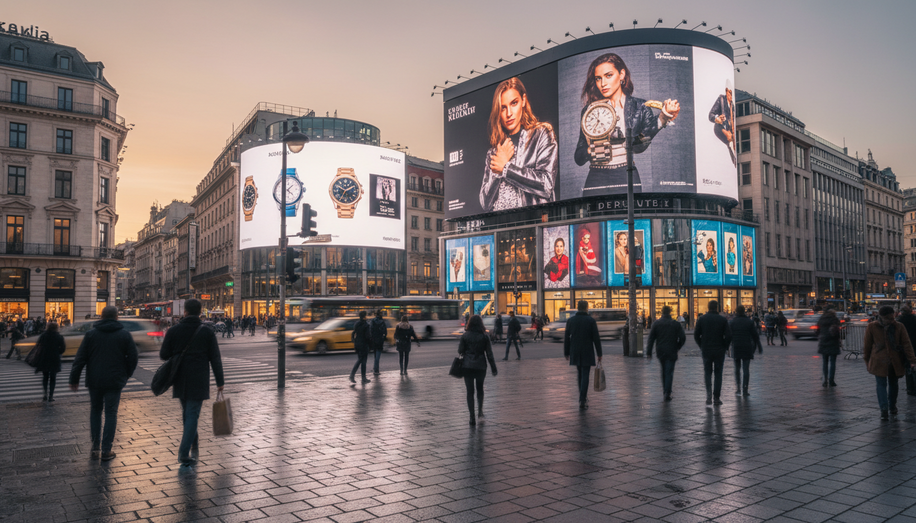

The Integration of DOOH with Smart Cities: A New Era of Advertising
Smart cities and DOOH are converging into a responsive urban media layer that blends data, utility and storytelling into every corner of the streetscape.
Digital Out-of-Home (DOOH) is fast becoming the visual operating system of smart cities, turning once-static urban surfaces into responsive media that inform, entertain and sell in real time. As municipalities wire up streets with sensors, 5G, and connected infrastructure, DOOH is evolving from a broadcast medium into a dynamic, data-driven platform that sits at the heart of the smart city stack.
At its core, a smart city is built on the networked connections between people, processes, data and things, using technologies such as IoT sensors, AI and cloud computing to improve mobility, safety, sustainability and public services. Those same networks now power digital billboards, transit screens and interactive kiosks, allowing them to react instantly to what is happening around them – from traffic flows and weather patterns to social media trends and public safety alerts.
This connectivity is transforming the value proposition of OOH. In smart bus shelters, metro stations and city kiosks, DOOH screens no longer just run ad loops; they double as utility surfaces, serving real-time transit arrivals, wayfinding, weather, emergency notifications and civic information alongside brand messages. New York City’s LinkNYC network, which combines Wi‑Fi hotspots, public service content and advertising on digital totems, is often cited as a template for this multifunctional approach.
The integration is most visible in the rise of programmatic and AI‑driven DOOH. Using live mobility data, location intelligence and environmental triggers, campaigns can now be bought, scheduled and optimized automatically, slot by slot, screen by screen. Creative is served when and where it is most relevant: umbrellas when rain hits a district, coffee during morning commute peaks, sports content around big local games. Algorithms ingest sensor data and mobile signals to decide which message appears on which screen at a given moment, turning the city into a responsive canvas.
AI is also reshaping the content itself. Research on AI and DOOH in smart cities highlights how machine learning can analyze behavioral patterns and contextual data to support more personalized creative, within the constraints of privacy and regulation. Rather than targeting identifiable individuals, AI clusters audiences by time, place and behavior – office workers, shoppers, tourists – and dynamically tailors messaging for those micro-moments. This makes DOOH feel more relevant without crossing the line into intrusive one‑to‑one targeting.
For municipal authorities, the same infrastructure is increasingly seen as an essential public communication channel. During the COVID‑19 pandemic, governments used programmatic DOOH to disseminate real-time health messaging based on triggers such as heavy footfall or non‑compliance with distancing rules, maximizing visibility where it mattered most. More broadly, cities are using DOOH networks for emergency alerts, traffic disruption notices, air-quality warnings and event information, effectively treating screens as an extension of the civic nervous system.
Sustainability is another driver aligning DOOH with smart city goals. Digital screens reduce paper and printing waste and, when paired with energy‑efficient LEDs and renewable power sources, can support lower‑carbon communication versus traditional paper-based OOH cycles. Smart controls can dim or shut down screens during low-traffic periods, further optimizing energy use in line with city climate commitments.
Crucially, DOOH is also becoming more interactive. Smart city digital signage increasingly incorporates touch, QR codes, NFC and augmented reality, enabling two‑way engagement that links physical locations with mobile and social channels. A transit screen might prompt commuters to scan for an AR product demo; a street kiosk could host a game that rewards participants with mobile coupons redeemable nearby. This convergence allows brands to build omnichannel journeys that start on a sidewalk screen and continue in the palm of the hand.
For advertisers, this integration changes planning assumptions. Instead of buying static locations, they can now think in terms of *moments* in the urban day – a rainfall spike, a gridlocked junction, a concert crowd – and deploy context-aware creative across a network that spans malls, airports, metro stations, clinics and gyms. Campaign performance can be measured with increasing precision using impression estimates derived from sensor and mobility data, feeding into continuous optimization loops.
The broader implication is that DOOH is no longer just riding the smart city wave; it is helping shape how these cities communicate. Industry bodies argue that OOH’s presence at the intersection of data, place and public life positions it as a pivotal component of the smart city ecosystem. When thoughtfully implemented, DOOH can enhance the aesthetics and cultural vibrancy of public spaces rather than clutter them, acting as digital street furniture that funds services while adding informational and experiential value.
Looking ahead, the trajectory points towards even tighter integration: DOOH screens acting as nodes in citywide sensor networks, feeding and receiving data; predictive analytics that anticipate audience flows and adjust schedules automatically; and richer creative formats blending real-time data visualizations, AR layers and localized storytelling. As that happens, the most successful campaigns will be those that treat DOOH not as isolated boards, but as part of a living, programmable media layer woven through the smart city itself. To effectively leverage this increasingly complex and data-rich urban media layer, advanced platforms are emerging to provide precise campaign management and optimization. Blindspot, for instance, offers an advanced solution designed to help companies optimize and manage their out-of-home advertising campaigns with data-driven insights, ensuring their messages resonate within these dynamic urban environments. Explore their capabilities at https://seeblindspot.com/.