

Bridging the Digital and Physical: How QR Codes Are Rewriting Airport OOH
Meta description: Airport OOH is evolving fast, with QR codes turning static screens and posters into mobile-first brand experiences for time-pressed, always-connected travelers.
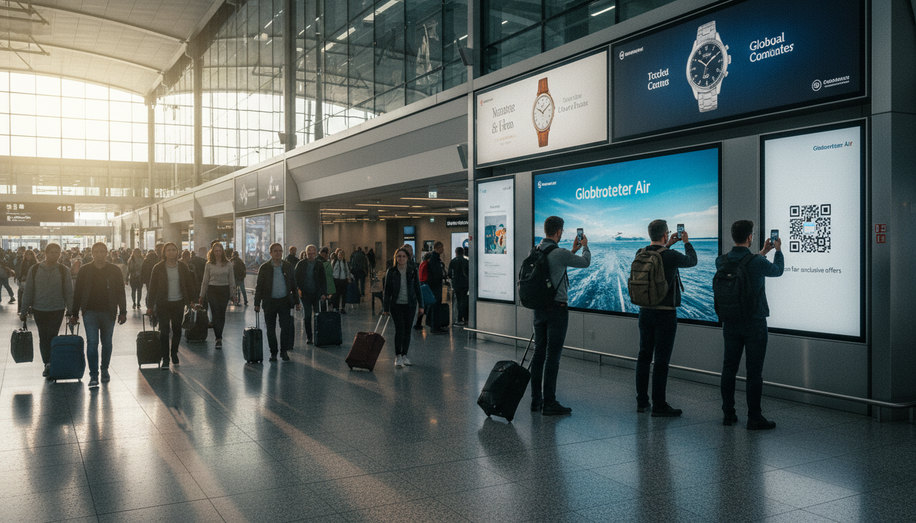
Airport concourses used to be the pinnacle of analogue media: big, bold, and fundamentally one-way. Now, the industry is rapidly learning that the most powerful airport campaigns are those that don’t end at the concourse at all. The bridge is a simple black-and-white square. QR codes are becoming the connective tissue between physical airport inventory and the digital ecosystems where brands transact, measure and build relationships.
Fresh data suggests that this bridge is already getting heavy use. A Nielsen Scarborough Recontact Study commissioned by Clear Channel Outdoor found that among frequent flyers who took action after seeing airport ads, 45% scanned a QR code, a figure up six percentage points from 2022. That puts QR interactions in the same performance band as visiting a location (61%) or checking a website (53%), and well ahead of following through to a social page (36%). For an element that, until recently, many creatives treated as an afterthought, that is a notable rebalancing of the airport OOH toolkit.
The timing is no coincidence. U.S. airports are seeing record traveler volumes, and TSA screening data points to growth continuing into 2026. Modernized terminals, longer dwell times and an increasingly mobile-native traveler base mean passengers are both primed and equipped to act in the moment. According to the Nielsen work, 82% of frequent flyers read airport advertisements and 57% take some form of action after exposure, an 8% jump on 2022. Within that funnel, QR codes are becoming the most direct way to convert attention in-terminal into measurable performance off-site.
For brands and media owners, the opportunity is twofold. First, QR codes allow airport OOH to behave like a digital performance channel while retaining its upper-funnel strengths. A QR scan can hand off to anything from dynamic pricing pages and app downloads to configurators, loyalty sign-ups, or priority-access offers. Broader OOH research indicates that QR codes on out-of-home surfaces can double to quadruple response rates compared with traditional print codes. Abstract metrics like “awareness” and “consideration” can be tied to hard data: click-throughs, basket size, repeat engagement and even downstream lifetime value.
Second, QR-enabled creative effectively extends the time window of influence well beyond the terminal. A long-haul passenger who scans a code in Departures may be retargeted in-flight via in-app content, then nudged again at arrivals. That continuity plays directly to airport media’s strength as a point of high intent. Clear Channel Outdoor’s airports division president Morten Gotterup notes that with over half of travelers taking “meaningful steps” after seeing airport ads—from visiting websites to scanning QR codes—brands can shape decisions “at a moment of high intent.” QR codes are the mechanism that carries that intent from physical space into the brand’s own environment.
Yet the medium also introduces new creative and operational challenges.
The first is design and usability. In an airport context, a QR code competes with wayfinding, safety signage, airline messaging and a barrage of personal notifications. Placement, contrast, and size need to be optimized for quick capture, often at oblique angles and from a distance. Calls to action must be brutally clear and context-aware: a passenger juggling a boarding pass, bag and coffee is not going to decipher small print or multi-step instructions. The reward must be immediate and obviously relevant to their journey—preferential boarding benefits, destination content, last-minute upgrades, or time-saving services resonate more strongly than generic brand storytelling.
The second is connectivity and latency. While airports are increasingly well served by Wi-Fi and 5G, coverage is still patchy and captive portals can introduce friction. A QR scan that resolves to a heavy site, a geo-blocked offer or a forced app download is a fast route to abandonment. Smart QR strategy in airports means lightweight landing experiences, device-agnostic design and fallbacks that preserve the value exchange even if a connection fails.
Privacy and trust form the third challenge. The act of scanning is inherently more intimate than a glance at a digital screen; it signals willingness to connect devices and data with a brand. Travelers are also more security-conscious in transit, wary of phishing and malicious codes. Clear, reputable branding around the code, transparent explanations of what will happen after scanning, and visible adherence to data protection norms are now part of the creative brief as much as the artwork itself.
From a planning perspective, QR integration is reshaping how airport OOH is sold and measured. Media owners are bundling dynamic digital inventory with performance-based components, and marketers are beginning to treat airport placements as full-funnel investments rather than siloed awareness plays. The Nielsen study underscores that this is a receptive environment: 61% of respondents who noticed airport ads visited the advertised location and 53% went to the advertiser’s website. With QR instrumentation, those behaviors can be attributed with a level of precision that was previously impossible, feeding into programmatic buying, creative optimization and audience modeling.
For creative agencies, this demands closer collaboration between OOH, digital, CRM and product teams. The QR code is not just a graphic asset; it is a strategic hinge. It must land on experiences that are consistent with broader campaigns, technically robust, and capable of closing the loop on measurement. For airport operators, the rise of scanable media invites questions about standards—code readability, safety verification, and placement policies—to protect both brands and passengers.
The broader direction of travel is clear. Airport media is evolving into an experiential, data-rich environment where the boundary between screen and smartphone dissolves. QR codes, once a niche utility, have quietly become one of the most effective tools for turning that environment into an interactive marketplace. For an industry under pressure to prove both reach and results, the opportunity is not just to stick a code on a lightbox, but to design airport campaigns where the physical touchpoint is only the beginning of the journey.