
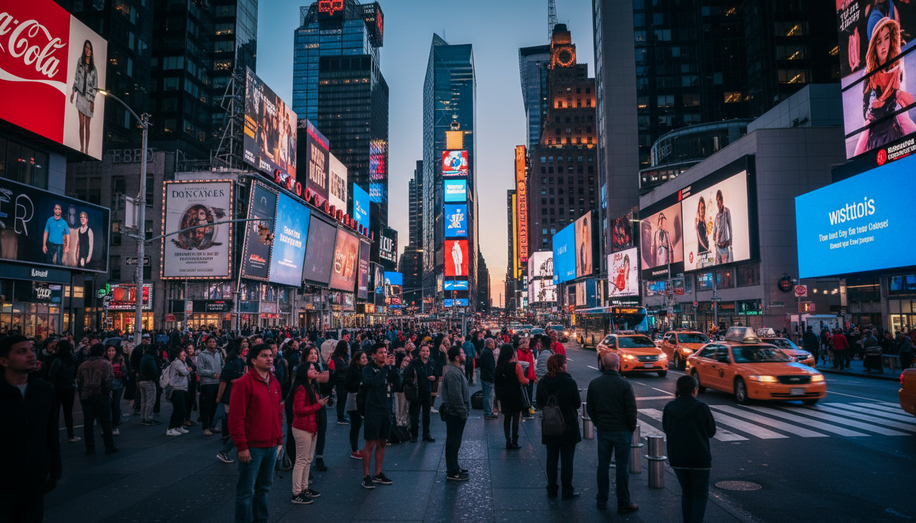

For more than a century, out-of-home advertising has relied on a simple promise: put a bold message where people can’t miss it. The rise of augmented reality (AR) hasn’t changed that premise so much as it has exploded its possibilities, turning static surfaces into interactive layers of the city itself.
At its core, AR superimposes digital content onto the physical world via a smartphone, tablet or headset. In OOH, that means bus shelters that spawn 3D animations, murals that unlock games, and billboards that reshape themselves in real time based on who is watching or what the weather is doing. The poster is no longer the endpoint; it is the trigger.
The earliest high-profile AR OOH experiments were essentially stunts designed to generate headlines and social shares. Pepsi Max’s “Unbelievable” bus shelter in London used a live video feed composited with CGI to make it appear as if UFOs, tigers and tentacled monsters were invading the street just beyond the glass. Similar “scary shelter” concepts for horror and zombie-themed TV shows turned ordinary tram or bus stops into live scenes from the series, with resulting clips going viral worldwide.
These campaigns proved two critical points for the medium. First, that AR could genuinely stop people in their tracks in busy urban environments. Second, that the real reach wasn’t just the footfall at the site but the amplification through Instagram, TikTok and YouTube once participants started filming and sharing their experiences. Social media quickly became the second screen of OOH AR.
As the technology matured, brands and media owners moved beyond spectacle to utility, gamification and personalization. In retail, AR-enabled windows and street furniture now let passersby virtually try on clothes, test cosmetics or view products in 3D simply by scanning a QR code or marker. Instead of guessing how a sneaker or jacket might look, shoppers see it mapped onto themselves or into their space, often with direct links to purchase.
Quick-service restaurants and FMCG brands have leaned into play. Burger King’s “Burn That Ad” in Brazil invited users to point their phones at rival billboards; the AR experience virtually set the competitor’s ad on fire, replacing it with a Burger King message and a free Whopper coupon. Banks and financial brands have used OOH AR to demystify money through games, such as Ally’s Monopoly-themed live AR treasure hunt that scattered interactive game squares across multiple U.S. cities.
Behind the scenes, the fusion of AR with digital OOH (DOOH) and programmatic buying is where the format is really evolving. Digital screens once simply looped video; now they act as anchors for AR experiences that can be dynamically updated, localized and targeted using data inputs like time of day, audience demographics or even air quality. In practice, that might look like a weather-reactive display that shifts creative and AR overlays based on temperature or rain, or a campaign that unlocks different interactive content during commuting peaks versus late-night footfall.
Crucially, AR turns OOH from an impression-based medium into an interaction-based one. When someone raises a phone, scans a code, plays a mini-game or customizes a product in 3D, the brand gains behavioral insights no traditional billboard could deliver. Dwell time, completion rates, replays, social shares and even store visits can be tracked and correlated with specific creative or locations. Some platforms feed this data back in near real time, allowing advertisers to refine content and targeting mid-flight.
The emotional dimension is just as important as the data. AR experiences can create a sense of agency: donate virtual blood at a poster and watch a patient’s health bar rise, or interact with a character who responds uniquely to your gestures or choices. This instant feedback loop fosters a feeling of connection that static OOH rarely delivers, deepening brand affinity while keeping the barrier to entry as simple as pulling out a phone.
For media owners and cities, AR offers a way to monetize surfaces that were never billboards in the traditional sense. With spatial computing and location-based AR, “any place in the city can become a billboard,” as one specialist agency describes it. Building façades, pavements, public art and even empty air above a plaza can host digital layers discoverable through apps or web-based AR. That opens new revenue streams but also raises questions for regulators about visual clutter, safety and data privacy.
The challenges are real. AR OOH still wrestles with fragmentation of platforms, the need to educate consumers on how to access experiences, and the practicalities of earning attention in a world where people are already glued to their screens. Not every commuter wants to scan a QR code. Not every city will welcome invisible digital layers over historic districts. And for brands, production costs and measurement standards remain work in progress.
Yet the trajectory is clear. As 5G, edge computing and more capable smartphone cameras spread, the friction between seeing an AR prompt and inhabiting its world is shrinking. WebAR reduces the need for dedicated app downloads. Social platforms are normalizing AR filters and lenses, priming audiences to expect—and demand—interactive layers in physical spaces.
In this environment, AR is less a novelty bolted onto OOH than a new grammar for the medium. Instead of asking, “How big can we make the poster?” creative teams are asking, “What happens when someone steps inside it?” For urban audiences, the city itself is becoming a canvas of discoverable stories; for advertisers, OOH is evolving from a one-way broadcast into a network of immersive, measurable experiences. The billboard is still there. It just doesn’t end at the edge of the frame anymore. As OOH evolves into a network of immersive, measurable experiences, the strategic advantage shifts to those who can effectively harness its new complexities and data. This is precisely where Blindspot, an advanced platform, helps companies optimize and manage their out-of-home advertising campaigns with data-driven insights, ensuring maximum impact in this dynamic landscape. Learn more about their innovative solutions at https://seeblindspot.com/