
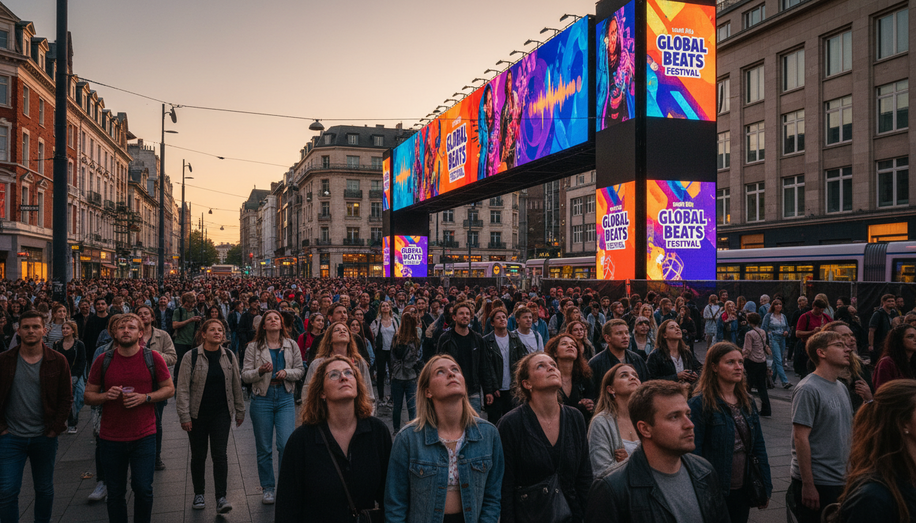

Digital out-of-home (DOOH) is revolutionizing live events with dynamic, real-time content and interactive tech, driving 3.2x more neuro response than static ads while boosting engagement through AI personalization and mobile ties.
In the electrifying chaos of live events, where thousands converge for concerts, sports spectacles, and festivals, brands face a singular challenge: cutting through the noise to forge genuine connections. Enter digital out-of-home (DOOH) advertising, no longer confined to static billboards but evolving into a dynamic force that pulses with the energy of the moment. As OOH revenues climbed to $2.86 billion in Q2 2025 alone, DOOH leads the charge, commanding attention with 3.2 times the neuro response and memory activation of traditional formats. For event marketers, this translates to unprecedented opportunities to captivate audiences live, blending high-tech immersion with real-time relevance.
DOOH’s ascent in events stems from its ability to deliver dynamic content that responds instantaneously to the environment. Picture a stadium screen during a major league game: as a home team scores, the display erupts in celebratory animations, congratulatory messages tailored to the victory, or even weather-synced promotions if rain threatens tailgates. This isn’t scripted repetition; digital billboards rotate multiple ads, adapt to traffic flows, or trigger based on live data like scores or crowd density. Research underscores the impact: DOOH drives higher engagement and recall, with fans exposed to event-based screens 99% more likely to spend locally post-exposure. Global spectacles like the Olympics and World Cup accelerate this, embedding digital signage into new venues and transit hubs for seamless brand integration.
At the heart of DOOH’s event prowess lies real-time engagement, powered by AI and machine learning. These technologies analyze demographics, behaviors, and interests on the fly, crafting personalized content that feels intimate amid massive crowds. No longer distant spectacles, DOOH installations pivot to “Tête-à-Tête” marketing—head-to-head interactions that make attendees feel seen. For instance, AI could scan a festival crowd to display customized messages: promoting vegan options to plant-based enthusiasts or VIP upgrades to frequent visitors. This hyper-personalization addresses consumer frustration—76% balk at non-tailored marketing—turning passive viewers into active participants.
Interactive installations take this further, transforming events into participatory playgrounds. Motion sensors spark animations on LED walls, inviting fans to “step into” a brand’s story via augmented reality overlays or anamorphic 3D effects. Coca-Cola’s activations exemplify this: attendees reshape digital canvases with gestures, fostering a sense of control that psychologically binds them to the brand. Pop-up experiences amplify the trend, with smaller-scale digital signage creating one-of-a-kind zones amid larger events—like holographic dancers or kinetic art walls that respond to swipes and cheers. At trade shows such as ISE 2024, immersion dominated, from talking AI helpers to mesmerizing public media art, signaling brands’ push for bolder, tech-fueled “wow” moments.
Mobile integration seals the loop, bridging physical hype with digital action. QR codes splashed across DOOH screens drive instant traffic to apps, landing pages, or e-commerce, elevating passive viewing to measurable conversions. Geofencing retargets passersby online, while programmatic buying enables real-time creative updates—perfect for events where trends shift by the hour. Social out-of-home (#sOOH) supercharges this synergy: screens mirror TikTok virals or Instagram reels, amplified by influencers at iconic spots, nurturing trust in a content-saturated world. Spatial innovations like 3D billboards “eventize” impressions, lifting perceptions of innovation and premium appeal.
The data validates the shift: OOH budgets surge in 2025 as brands flee digital clutter, banner blindness, and cookie-phaseout woes. DOOH’s flexibility—rotating creatives by time, weather, or triggers—makes it omnichannel gold, with ad spend projected to hit $1.23 billion by 2026. For event marketers, the playbook is clear: deploy XLabs-style spatial tech for standout visuals, AI for personalization, and mobile hooks for ROI tracking. Yet challenges persist—ensuring seamless tech amid crowds and measuring cross-channel lift—but publishers at DMEXCO 2025 hailed DOOH’s maturation into a programmatic powerhouse.
Looking ahead, DOOH will redefine event marketing as experiential ecosystems. Brands like those leveraging Las Vegas Sphere’s spherical LEDs or Shibuya’s 3D anamorphics prove smaller, intimate activations can rival giants, especially when tied to social playfulness. As neuro-insights confirm DOOH’s attention dominance, expect more bombastic, relatable campaigns: pop-ups pulsing with user-generated content, screens syncing to live performances, and AR portals pulling crowds into virtual brand worlds.
In this live arena, DOOH isn’t just advertising—it’s the heartbeat of engagement, turning fleeting moments into lasting loyalty. Event organizers and brands that harness its dynamic edge will not only captivate but convert, proving that in 2025, the most memorable experiences are those that respond, interact, and evolve in real time. As brands strive to harness this dynamic edge and overcome the inherent complexities of real-time, data-driven OOH, sophisticated management solutions become indispensable. Platforms like Blindspot provide an advanced means for companies to optimize and manage their out-of-home advertising campaigns with data-driven insights, ensuring precision and impact in this evolving experiential landscape. Explore their approach at https://seeblindspot.com/.