
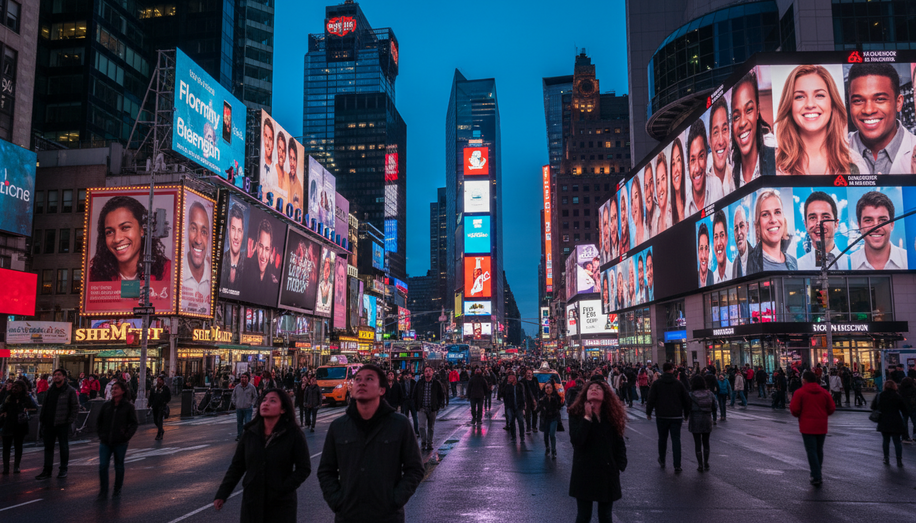

Diversity and Inclusion in OOH Campaigns: From Nice-to-Have to New Standard
Brands are turning billboards into powerful stages for representation, reshaping how consumers see themselves – and the companies that court them.
Out-of-home advertising is no longer just a canvas for big logos and short taglines; it is fast becoming a frontline medium for diversity and inclusion, with brands and media owners treating representation as a strategic imperative rather than a CSR side project.
The business case is clear. Participation in outdoor and lifestyle categories is rapidly diversifying, with Black and Hispanic communities adding more than five million new outdoor participants in 2024 alone, and younger cohorts skewing significantly more diverse than previous generations.For brands that depend on mass reach, ignoring that shift is not just tone-deaf – it is commercially reckless.
As a result, more OOH campaigns now foreground inclusive casting, community-specific storytelling and culturally nuanced creative instead of defaulting to a single, generic “every consumer” visual. Agencies and strategists emphasise that authentic representation – not just ticking boxes in a casting brief – is now central to growing market share and building trust with new audiences.
That authenticity test is tough, and consumers are ready to enforce it. Social media has armed underrepresented groups with platforms to call out tokenism and “diversity-washing,” quickly exposing when an inclusive billboard is not matched by inclusive products, workplaces or policies.In response, some of the most effective OOH work connects directly to structural change: LinkedIn’s inclusive hiring messaging has been tied to product tweaks to reduce algorithmic bias, while Nike’s disability-inclusive FlyEase work was co-designed with disabled athletes, linking bold visuals to real-world access.
OOH’s public nature gives inclusive campaigns an extra charge. When Nike celebrated the England women’s football team with “Fear the Lionesses” outdoor executions, it turned city streets into shared viewing rooms for women’s sport, fusing national pride with gender representation and showing who belongs at the centre of the story.Similarly, initiatives around the Women’s Euros, from traffic light iconography to giant public artworks, have used physical space to normalise female athletes as cultural icons rather than footnotes.
Media owners themselves are stepping into a more active role as gatekeepers and amplifiers of inclusive narratives. In Canada, PATTISON Outdoor’s Elevating Voices Media Grant commits up to $1 million in media value to charities and organisations championing equity and inclusion, effectively underwriting campaigns that many non-profits could never afford to run at scale.UNITI’s community inclusion campaign, amplified through the programme, illustrates how pro-bono inventory and strategic placement can turn a local social mission into a high-visibility civic conversation.
In parallel, PR and comms partners are building infrastructure around justice, equity, diversity and inclusion rather than handling it as a one-off campaign theme. OutsidePR’s J.E.D.I.+ programme, for instance, offers multi-month support to organisations working to diversify outdoor participation, aiming to “elevate visibility and engagement” for initiatives that expand who feels welcome outside.Those efforts inevitably flow into OOH, where visibility – who appears on the billboard, in which neighbourhoods, in what context – is itself a statement about who the industry is talking to.
For categories like outdoor, sport and lifestyle, this shift is rewriting long-standing playbooks. Historically, many brands defaulted to a narrow archetype of the “core” participant; now, with participation and spending power growing in communities historically left out of the marketing, brands are rethinking everything from product imagery to ambassador rosters.Specialists argue that women-led and inclusivity-focused brands tend to adopt more holistic approaches, connecting inclusive creative with wider commitments to sustainability and community-building – and using OOH to signal that broader value set in a single, high-impact frame.
The pay-off goes beyond short-term reach metrics. Inclusive OOH campaigns, when backed by credible action, are building deeper emotional connection and long-term loyalty. Research and case studies highlight that campaigns addressing real-world barriers or reflecting lived experiences – from body diversity in sport to disability access in cities – can significantly lift brand perception, with consumers rewarding brands that “see” them with advocacy and repeat purchase.OOH’s ability to intersect with daily routines and public rituals makes it a particularly powerful medium for that kind of recognition.
Yet the emerging standard also raises the bar. Representation alone is no longer enough: audiences increasingly expect brands to show cultural literacy, local relevance and continuity. That means collaborating with community organisations, diverse creators and local ambassadors to co-create campaigns that feel rooted in place and experience, not imported from a global template.It also means treating inclusion not as a themed month, but as an ongoing thread across flight schedules, formats and markets.
For the OOH industry, the implications are significant. As diversity and inclusion move from campaign “specials” to table stakes, creative and media teams will need sharper insights into multicultural audiences, stronger partnerships with community groups, and more rigorous checks on whether the stories on the street reflect the realities behind the brand.
What is clear is that the billboard has changed. It is no longer just a poster; it is a mirror. And in the emerging standard for OOH, brands that fail to broaden the reflection risk fading into the background of a landscape where inclusion is not an add-on but the expectation.