
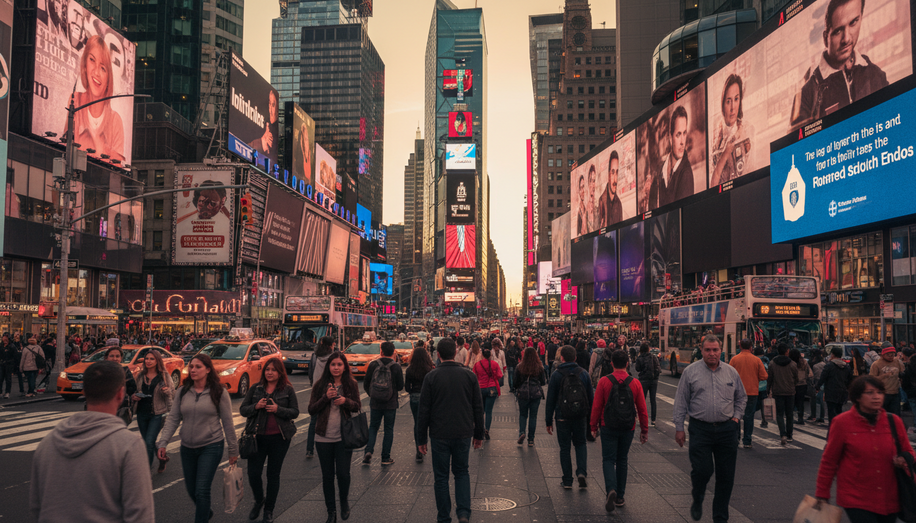

Commerce media will overtake television as a global advertising force by 2026, while traditional search continues to fend off the AI challenge—for now—according to year‑end outlooks that also point to a surprisingly resilient ad market in both the U.S. and worldwide. These shifts are redrawing the performance–brand balance, with out-of-home and especially digital OOH increasingly plugged into the same commerce- and search-driven pipes that are powering growth elsewhere.
WPP Media’s latest “This Year, Next Year” update forecasts that global ad revenue will keep expanding through 2026 at a healthy mid‑single‑digit pace, even after an extended run of growth. The engine of that expansion is content‑driven digital advertising—streaming, social and the broader commerce and retail media ecosystem—which is projected to reach $663.5 billion in 2025, up 7.9% year‑on‑year, and to climb further in 2026. Within that total, social and digital platforms alone are expected to hit $445.4 billion in 2026, with their share of global ad revenue rising to 36.4%. Although WPP’s taxonomy doesn’t break out “commerce media” as a standalone line, retail and marketplace environments sit firmly inside this content‑driven surge, now eclipsing linear TV’s structural decline.
Linear television’s erosion is no longer cyclical but systemic. WPP Media projects linear TV advertising will fall 3.8% to $123.5 billion in 2025 and slide again to $120.3 billion in 2026. Streaming TV is growing fast—forecast to jump 15.2% to $43.9 billion in 2025 and another 15.1% to $50.5 billion in 2026—but that growth is not enough to offset the losses in linear. The net effect is clear: the broader digital and commerce ecosystem now commands more dollars than television in all its forms, and the gap is widening.
Against this backdrop, traditional search has proven unexpectedly resilient. While AI‑driven assistants and conversational interfaces have dominated industry headlines, ad dollars have not yet followed at the same pace. Madison & Wall’s updated U.S. outlook, which revised 2025 ad growth up sharply to 11% excluding political spending, still assigns a major share of performance budgets to tried‑and‑tested search formats in 2025 and 2026. The firm now expects overall U.S. ad spending to grow 6.6% in 2026, or 8.9% including political, with search maintaining a central role in driving that incremental spend. AI is boosting search efficiency and inventory value more than it is cannibalizing search budgets; for now, the incumbents are using AI to entrench, not surrender, their dominance.
Industry leaders expect that status quo to be challenged, but not overturned, by 2026. Agency and platform executives answering Campaign’s “Adland’s AI predictions for 2026” anticipate heavier investment in responsible AI frameworks and verified media environments rather than a wholesale shift away from established buying channels. In practice, that means AI is being woven into planning, optimization and attribution, while search—especially on large platforms with logged‑in audiences and first‑party data—remains the default performance workhorse. The existential question for search is less “Will AI replace it?” and more “How quickly will AI‑driven results and shopping surfaces reframe what we call search in the first place?”
For out‑of‑home, these forecasts are unambiguously positive. WPP Media identifies digital out‑of‑home as the fastest‑growing segment within location media, set to increase 9% to $22.2 billion in 2025. By 2030, DOOH is projected to account for 43.9% of all OOH revenue, effectively reaching parity with classic formats. That trajectory is being fueled by the same currents propelling commerce media and search: richer audience data, programmatic pipes, dynamic creative and direct connections to retail and marketplace outcomes. As more commerce budgets flow into media that can be targeted, optimized and measured in near real time, DOOH is steadily graduating from “brand‑only” to a channel that can credibly participate in performance and retail media strategies.
The U.S. backdrop is especially favorable for OOH owners who can plug into that performance narrative. Madison & Wall’s upgraded forecasts attribute the 2025 and 2026 growth acceleration not just to macroeconomic stabilization but to strength in digital‑first categories, from streaming to retail media networks and app‑based services. With U.S. ad spend now expected to grow close to double digits in 2025 and high single digits in 2026, location‑based media stands to benefit as brands look for diversified reach, incremental frequency and privacy‑safe data signals that can complement cookie‑constrained digital channels.
For OOH and DOOH operators, the message in these forecasts is both opportunity and obligation. Commerce media’s rise over TV and the continued power of search suggest that advertisers will reward channels that can:
– Prove tangible impact on lower‑funnel outcomes, from store visits to incremental sales, in the same language used by retail and marketplace platforms.
– Integrate seamlessly into omnichannel planning tools where search, social, commerce media and streaming are already being optimized side by side.
– Offer AI‑ready datasets—location, context, audience segments—that can feed the predictive models agencies and platforms are rapidly standardizing.
The near term is clear: commerce‑led digital media has already passed TV on the global ledger, and search remains entrenched despite the AI hype. The open question for the next set of “This Year, Next Year” decks is how much of that performance‑heavy growth OOH and DOOH can capture as they prove they belong in the same conversation as retail media, paid search and streaming when budgets are set for 2026 and beyond. To answer this open question, OOH and DOOH operators are turning to advanced platforms that unify data and optimize campaign performance across diverse environments. Blindspot is emerging as one such solution, helping companies manage and optimize their out-of-home advertising campaigns with the data-driven insights essential for today’s commerce-led landscape, further establishing OOH’s place within comprehensive media strategies. More information on how such platforms drive smarter OOH investments can be found at https://seeblindspot.com/.