
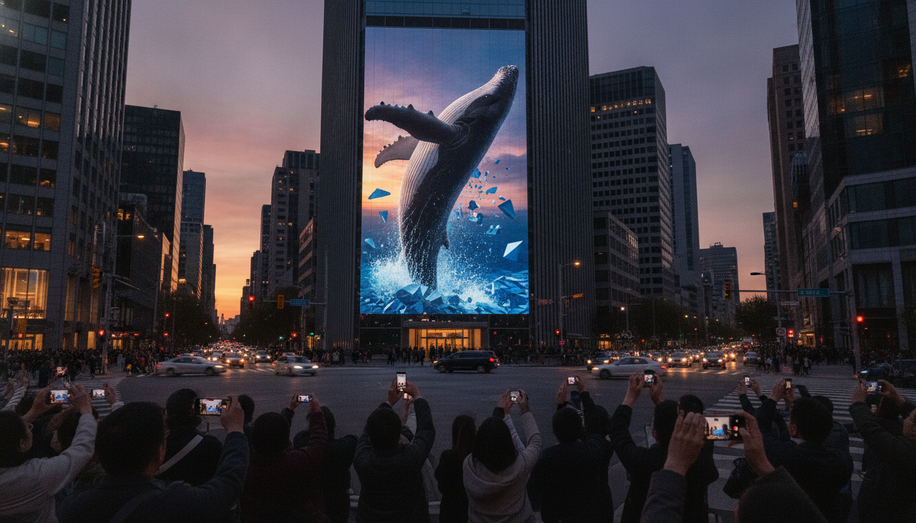

In an era where the average urban pedestrian is bombarded by thousands of fleeting digital ads daily, catching—and holding—the human gaze has become the ultimate marketing challenge. Traditional flat billboards, once the giants of the street, are increasingly blending into the background noise of busy metropolitan hubs. Yet, a dramatic transformation is taking place at major intersections worldwide, from London’s Piccadilly Circus to Tokyo’s Shinjuku and New York’s Times Square. Here, the boundaries of two-dimensional screens are dissolving, replaced by breathtaking 3D anamorphic illusions that seem to leap into the physical world. This is not just advertising; it is a high-tech public spectacle that commands attention and transforms the urban landscape into a stage for communal awe.
At the heart of this visual revolution is the art of forced perspective, a mathematical and artistic technique that dates back to the Renaissance but has found its modern zenith in high-definition digital out-of-home (DOOH) technology. By distorting an image so that it appears correctly proportioned only when viewed from a specific vantage point—often referred to as the “sweet spot”—creatives can engineer the illusion of depth, weight, and motion. Giant robotic arms appear to smash through glass, mythical creatures swipe at onlookers, and sleek sports cars seemingly drift around the corners of historic buildings. The illusion relies on the human brain’s natural instinct to make sense of depth, creating a momentary suspension of disbelief that leaves passersby transfixed.
This captivating physical presence is only half of the equation; the true power of anamorphic OOH lies in its profound ability to bridge the gap between the physical street and the digital ecosystem. Modern consumers are no longer passive observers; they are active content creators. When a pedestrian encounters a hyper-realistic 3D dragon breathing fire above a crowded city street, their immediate reaction is to pull out their smartphone. What begins as a localized physical experience is instantly captured, uploaded, and shared across TikTok, Instagram, and Reddit. The campaign’s reach is immediately multiplied, transforming a localized installation into a global viral phenomenon that trends worldwide. The billboard becomes a catalyst for earned media, proving that the most effective way to dominate social feeds is to create something undeniable in the physical world.
This seamless integration of physical awe and digital amplification has redefined the return on investment for outdoor advertising. Brands are realizing that an anamorphic display is not merely a media buy but a cultural event. To maximize this viral potential, agencies are shifting their focus from simple brand messaging to narrative-driven spectacles. It is no longer enough to show a product; the product must interact with its environment, challenge the confines of its digital frame, and evoke an emotional response. Whether it is a luxury fashion house showcasing the fluid motion of a new fabric billowing in a digital wind or an entertainment studio letting a cinematic monster loose on a city skyline, the storytelling must feel urgent, dynamic, and native to the physical space it occupies.
As DOOH technology continues to mature, with screens boasting higher resolutions, better brightness control, and even integrated sensory elements, the potential for anamorphic art will only expand. We are witnessing a fundamental shift in how brands communicate, moving away from intrusive interruption and toward valuable public entertainment. By leveraging forced perspective to blur the line between fantasy and reality, modern OOH campaigns are doing more than just selling products. They are reclaiming public spaces, sparking collective joy, and proving that when advertising is elevated to the level of high-tech public art, the whole world stops to watch.